Executive Overview
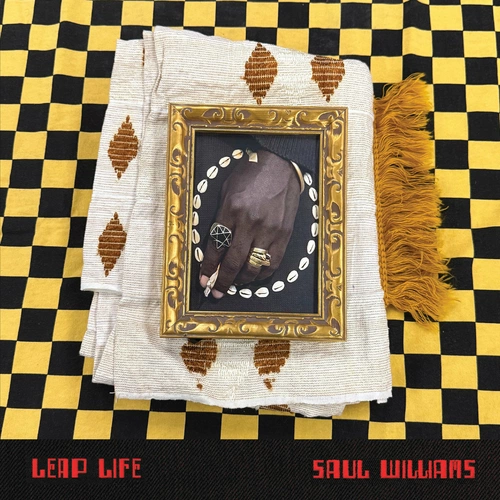
Four years following his last major studio statement, visionary poet, actor, writer, and musician Saul Williams has returned with Leap Life. Released to critical intrigue, the album represents a distinct and sophisticated evolution in a career that has consistently defied easy categorization. Hailing originally from the crucibles of New York City’s legendary 1990s open-mic poetry scene, Williams has spent decades dismantling the boundaries between spoken-word performance, radical politics, theater, and avant-garde music.
Leap Life—a title drawn playfully yet existentially from the artist’s own February 29 leap-year birth date—is far from a casual listening experience. Critics and early listeners have universally described it as a rich, multi-layered tapestry, a musical equivalent to a slow-simmered stew that demands patient rumination rather than passive consumption. Eschewing the conventional structures of modern commercial releases, Williams opts instead for an immersive, deeply textured auditory journey. The project merges ambient soundscapes, organic jazz instrumentation, global folkloric elements, and forward-thinking electronic rhythms into a cohesive whole.
This comprehensive feature offers a rigorous examination of Leap Life. We will deconstruct its thematic core, explore its expansive musical landscape, trace Williams’s artistic lineage from the boom-bap corridors of Amethyst Rock Star to his current incarnation as a stately sonic preacher, and contextualize the album within the broader continuum of contemporary politically engaged art.
Detailed Chronology: The Evolution of an Iconoclast
To understand the profound stylistic shift manifested on Leap Life, one must trace the winding artistic timeline that brought Saul Williams to this specific juncture. His entry into the public consciousness took place during the electric revitalization of the spoken-word circuit in late-20th-century New York. Alongside contemporaries who populated the Nuyorican Poets Cafe and similar cultural hubs, Williams weaponized language, transforming the traditional poetry reading into an intensely theatrical, rhythmically urgent performance art.
From the Page to the Boom-Bap Grid
When Williams dropped his debut full-length album, Amethyst Rock Star, in 2001, the underground music scene took notice. While firmly rooted in the ethos of hip-hop—featuring gritty boom-bap percussion loops, sharp turntable scratching, and Williams’s signature breathless, eloquent delivery—the record operated on the fringes of the genre. It functioned as an early harbinger of alternative rap, blending rock instrumentation and counter-cultural philosophy with urban street poetry.
Throughout the 2000s and 2010s, Williams continued to expand his scope. Projects like The Involatile Concentration and collaborations with industrial rock royalty such as Trent Reznor of Nine Inch Nails (notably on 2007’s The NiggyTardust Chronicles) pushed him further into electronic and abrasive rock territories. His voice grew sharper, more urgent, and increasingly calibrated to challenge systemic injustice, corporate surveillance, and post-millennial alienation.
The Four-Year Silence and the Genesis of ‘Leap Life’
Following his previous studio work, Williams retreated into a period of intensive multidisciplinary creation. During this four-year hiatus, he remained active in theater, film, and social advocacy, while quietly accumulating field recordings, conceptualizing new lyrical frameworks, and collaborating with an eclectic roster of international musicians.
When work on Leap Life finally crystallized, it became apparent that Williams had shed much of the overt, industrial aggression of his mid-career outputs. In its place emerged a measured, wise, and profoundly contemplative persona. The frantic, youthful energy of his early hip-hop days has matured into the measured cadence of a sage elder—a preacher of the avant-garde whose words carry the weight of lived history.
Supporting Context & Metrics: Sound, Structure, and Instrumentation
Musically, Leap Life defies simplistic genre tagging. The sonic palette of the record has been aptly compared to a rich mulligatawny soup: dense, aromatic, and packed with complex flavors that reveal themselves gradually with each subsequent listen.
Atmospheric Production and Global Textures
The production value on Leap Life is astonishingly dense, often described by reviewers as thick as mountain fog. Rather than relying on standard software synthesizers or predictable sample libraries, the album utilizes a sprawling array of organic instruments and global acoustics.
A prime example of this adventurous sonic curation can be found on the track "Great, Great-Grandmother." Here, Williams weaves together an arresting triad of acoustic elements:
- "Mouth strings": An unconventional vocal-acoustic technique that mimics plucked chordophones.
- Bamboo flute: Providing airy, breath-driven melodic counterpoints.
- Khaen: A traditional bamboo mouth organ originating from Laos, injecting a reedy, hypnotic drone that anchors the track’s ancestral theme.
This commitment to acoustic authenticity is paired seamlessly with ambient soundscapes and jazz arrangements, creating a listening environment that feels simultaneously ancient and hyper-futuristic.
Rhythmic Diversity: From Amapiano to Jungle
Despite its serious, contemplative tone, Leap Life is remarkably dynamic and rhythmically alive. Williams refuses to let the record sink into monotonous solemnity, integrating diverse dance and club idioms with surgical precision:
- "The Dagger": Infuses the record with the warm, infectious, and vibrant syncopated swing of amapiano, the South African house genre that has taken global dancefloors by storm.
- "Controlled Is Not Controllable": Features a notable collaboration with Robert Del Naja (aka 3D) of trip-hop pioneers Massive Attack. This track flirts aggressively with the breakneck, intricate percussive patterns of jungle and drum and bass.
- "Robot Slave": Offers an infectious, highly accessible counterweight with an undeniable earworm chorus and a heavy, undulating bass line that commands physical movement.
Lyrical Architecture
Lyrically, Williams operates at the peak of his literary powers. His delivery across Leap Life is deliberate, grave, and commanding. Every syllable is calculated to resonate deeply within the listener’s consciousness.
Consider the stunning couplet from the opening track, "Baobab Constellations":
"Project dreams how bodies interpret what every rhythm means / What do fishermen dream?"
Lines like these showcase Williams’s unique ability to bridge the gap between concrete urban realities ("project dreams") and abstract, existential philosophy ("what do fishermen dream?"). The text acts not merely as lyrics to be sung, but as sacred texts to be dissected and interpreted.
Critical Reception and Industry Perspectives
Upon its release, Leap Life immediately captured the attention of progressive music critics, cultural theorists, and long-standing devotees of Williams’s oeuvre. Industry analysts have lauded the project as a masterclass in artistic maturation—a rare instance where an artist successfully integrates decades of multidisciplinary experimentation into a unified, definitive statement.
Thematic Analysis: "All Life Is Here"
Cultural critics have focused heavily on the album’s thematic breadth. While the title Leap Life references the chronological anomaly of Williams’s February 29 birthday, the content of the album suggests a much broader philosophical scope.
Reviewers note that the album "bubbles and squirms with outrageous humanity." It refuses to shy away from the contradictions of modern existence. In an era dominated by algorithmic homogenization and sterile digital consumption, Leap Life serves as a chaotic, beautiful reminder of human flaw, ancestral connection, and emotional depth.
The inclusion of guest artists like Robert Del Naja underscores a broader ethos of cross-pollination. Williams is not working in a vacuum; he is actively drawing upon a global network of artists who share his commitment to pushing the boundaries of contemporary sound.
Future Outlook: The Legacy and Impact of ‘Leap Life’
As Leap Life establishes its place in the musical landscape of the year, its long-term implications for Saul Williams’s career—and for the wider landscape of alternative art-rap and spoken-word music—are significant.
Redefining Longevity in Independent Music
In an industry increasingly obsessed with rapid content turnover, viral TikTok moments, and algorithmic micro-trends, Saul Williams has taken the opposite approach. Leap Life is an intentional rejection of the fast-food consumption model of modern media. By crafting an album that explicitly demands to be "chewed upon, savoured and considered," Williams provides a blueprint for how legacy artists can age gracefully without compromising their avant-garde integrity or succumbing to creative stagnation.
Upcoming Touring and Multimedia Explorations
Industry insiders anticipate that the complex, multi-instrumental arrangements of Leap Life will translate into extraordinary live performances. Given Williams’s extensive background in theater and performance art, fans and promoters are looking ahead to specialized tour dates that are expected to incorporate theatrical staging, visual poetry projections, and live collaborations with the diverse instrumentalists featured on the record.
Furthermore, the release of Leap Life is expected to spark renewed interest in Williams’s literary and cinematic endeavors. As a writer whose voice has continually challenged systems of power, his commentary on contemporary socio-political shifts remains more vital than ever.
Conclusion
Leap Life is not merely an album; it is an auditory monument. It stands as a testament to the power of linguistic precision, sonic fearlessness, and unyielding human empathy. For both die-hard followers who have tracked Saul Williams since his 2001 debut and newcomers stumbling upon his universe for the first time, this record offers an invaluable space for reflection, movement, and intellectual awakening. It proves definitively that true artistry does not age—it merely deepens, transforming into something rich, wholesome, and permanently resonant.