Executive Overview
In the contemporary landscape of classical choral music, few organizations wield as transformative an influence on early-career composition as ORA Singers. Under the visionary leadership of founder and Artistic Director Suzi Digby, the ensemble has established itself as a premier champion of new vocal repertoire. At the heart of this mission lies the Graduate Composers’ Scheme, a cornerstone of the broader Composers’ Pathway designed to bridge the gap between academic training and professional performance.
Now celebrating its third iteration, the scheme provides a vital launchpad for emerging musical voices. By pairing professional commissions with rigorous, ongoing mentorship from Suzi Digby, the initiative equips young artists with the practical skills, artistic confidence, and industry exposure necessary to navigate a notoriously competitive field.
The culmination of this year’s intensive mentorship journey arrives on October 2, 2026, at the Dora Stoutzker Hall within the Royal Welsh College of Music & Drama (RWCMD). This high-profile showcase will feature world premieres by the five selected 2026 Graduate Composers: Evie Atkin, Eluned Davies, Marcello Palazzo, Sarah Henderson, and Harry Rees.
True to ORA Singers’ signature curatorial aesthetic—which forms the backbone of their ambitious 100 Commissions Catalogue—each newly minted composition has been conceived as a direct response to, or "reflection" of, a designated Renaissance choral masterpiece. By programming these modern premieres side-by-side with their historical counterparts, ORA Singers continues a dialogue that spans centuries, proving that the polyphonic innovations of the 16th century remain an inexhaustible wellspring for 21st-century creativity.
This comprehensive report examines the anatomy of the 2026 Graduate Composers’ Scheme, tracing its pedagogical framework, profiling the five rising talents, contextualizing the historical weight of the Renaissance pairings, and evaluating the broader cultural implications of sustained compositional incubation in the modern musical ecosystem.
Detailed Chronology: From Application to Showcase
The journey of an ORA Singers Graduate Composer is rigorous, deliberate, and deeply collaborative. It is structured to replicate the demands of a professional commission while offering a safety net of artistic guidance.
Phase One: Selection and Onboarding (Late 2025 – Early 2026)
The process begins months before the public performance. Open to recent graduates and early-career composers based in the United Kingdom, the application process demands not only technical proficiency in vocal writing but also an imaginative approach to historical dialogue. Applicants must demonstrate an understanding of choral textures, range management, and textual setting.
Upon selection, Evie Atkin, Eluned Davies, Marcello Palazzo, Sarah Henderson, and Harry Rees entered an intensive phase of creative development. They were each assigned a specific Renaissance choral work—ranging from sacred motets to complex polyphonic masses—serving as the thematic and structural blueprint for their new commissions.
Phase Two: The Mentorship Crucible (Spring – Summer 2026)
Central to the Graduate Scheme is the mentorship provided by Artistic Director Suzi Digby. Unlike standard commissioning models where a score is submitted and performed with minimal interaction, ORA Singers operates on a workshop-heavy, developmental philosophy.
- Draft Reviews: Composers submit early sketches of their works, receiving detailed feedback on vocal writing, acoustic balance in performance spaces, and idiomatic text-setting.
- Vocal Mechanics: Because ORA Singers specializes in virtuosic a cappella performance, mentorship sessions frequently focus on how contemporary harmonic languages interact with pure vocal tuning (just intonation vs. equal temperament), vowel modifications, and breath management.
- The "Reflection" Challenge: The core compositional constraint requires the modern composer to engage in a musical conversation with the Renaissance original. This is not mere pastiche; rather, it involves extracting motivic cells, harmonic intervals, structural frameworks, or philosophical themes from the historical work and filtering them through a distinctly contemporary lens.
Phase Three: Rehearsal and Refinement (Late Summer 2026)
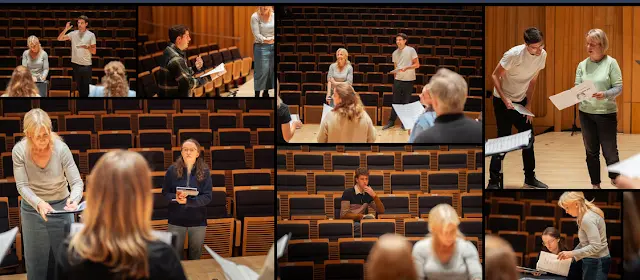
As the premiere date approaches, the scores are finalized and handed over to the vocalists of ORA Singers. This phase involves reading sessions where the composers hear their ink brought to life for the first time. Adjustments are made to phrasing, dynamics, and text underlay, ensuring the works sit comfortably within the professional ensemble’s virtuosic wheelhouse.
Phase Four: The RWCMD Showcase (October 2, 2026)
The process culminates at the Dora Stoutzker Hall in Cardiff. The concert format is deliberately curated: for each set, the audience hears the historical Renaissance work performed with pristine historical awareness, immediately followed by its 2026 Graduate counterpart. This structural pairing invites listeners to appreciate how past and present illuminate one another, highlighting the timeless ductility of the human voice.
Supporting Context & Metrics: The Composers’ Pathway
To fully grasp the significance of the Graduate Composers’ Scheme, one must examine the institutional architecture of ORA Singers and the wider ecosystem of contemporary classical music in the UK.
The Composers’ Pathway Architecture
ORA Singers approaches artist development as a continuum rather than an isolated event. The organization’s Composers’ Pathway is divided into distinct tiers tailored to different career stages:

- The Schools and Youth Programmes: Engaging teenagers and children to demystify contemporary music and inspire the next generation of listeners and creators.
- The Graduate Composers’ Scheme: Designed for those at the threshold of professional life, providing the critical first major commission and institutional credit required to secure future funding and publishers.
- Open Competitions and Mid-Career Commissions: Collaborating with established international composers to expand the choral canon further.
The 100 Commissions Catalogue
At the core of ORA Singers’ artistic identity is its monumental quest to commission 100 new works. This initiative is built on a conceptual framework: pairing 50 masterpieces of the Renaissance golden age with 50 brand-new companion pieces.
By commissioning works that "reflect" historical precursors, ORA Singers avoids the alienation sometimes associated with contemporary classical music. Audiences enter the concert hall with a familiar anchor—often a work by Tallis, Byrd, Victoria, or Palestrina—and are gently guided into the sonic world of the 21st century through the modern response. The Graduate Composers contribute directly to this grand catalogue, ensuring that the next generation of writers is woven into the fabric of this historical dialogue.
The 2026 Cohort: Meet the Graduate Composers
The five selected composers represent a diverse cross-section of emerging talent, each bringing a unique compositional voice to the vocal medium:
- Evie Atkin: Known for her sensitivity to text and atmospheric harmonic landscapes, Atkin’s work often explores the psychological resonance of historical poetry.
- Eluned Davies: Bringing a Welsh musical sensibility and a penchant for intricate contrapuntal textures, Davies’ writing bridges traditional modal pathways with modern chromaticism.
- Marcello Palazzo: Recognized for his bold rhythmic architecture and exploratory vocal timbres, Palazzo challenges conventional choral boundaries while respecting classical discipline.
- Sarah Henderson: A composer whose work is characterized by luminous textural transparency and a deep fascination with sacred spatial acoustics.
- Harry Rees: Blending narrative-driven composition with sophisticated harmonic scaffolding, Rees’ music often investigates the friction between ancient text and contemporary emotional states.
Official Statements and Industry Perspective
The launch of the 2026 Graduate Showcase has drawn praise from arts educators, performers, and cultural commentators alike.
Artistic Vision: Suzi Digby on Nurturing Voice
Reflecting on the philosophy behind the Graduate Scheme, Suzi Digby emphasized the necessity of structural support for young artists:
"When a composer leaves conservatoire, they face a daunting precipice. The technical training is there, but the professional bridge—the portfolio piece, the recording, the validation of a major ensemble—is terribly difficult to secure. With ORA Singers, we don’t just ask for a piece of music; we invest in the human being behind the score. We sit with them in rehearsals, we interrogate the vocal line together, and we offer them a platform that says to the classical world: ‘Take notice of this voice.’ The 2026 cohort has approached the Renaissance masters with a rare blend of reverence and fearless originality."
Institutional Partnership: The Role of RWCMD
Hosting the showcase at the Royal Welsh College of Music & Drama underscores the national reach of the scheme. Professor Helena Gaunt, Principal of RWCMD, noted the alignment between the college’s ethos and ORA Singers’ mission:
"We are thrilled to welcome ORA Singers and our own brilliant alumni and early-career talents to the Dora Stoutzker Hall. Contemporary music thrives on collaboration and risk-taking. By giving these five young composers a professional showcase of this caliber, ORA Singers is actively shaping the future of our art form. It is a masterclass in how institutional mentorship should operate."
Future Outlook: The Legacy of the 2026 Scheme
As classical music institutions face ongoing financial pressures and shifting audience demographics, initiatives like the ORA Singers Graduate Composers’ Scheme offer a blueprint for sustainable cultural renewal.
Cultivating New Audiences
By anchoring contemporary music to historical masterworks, ORA Singers solves one of the primary marketing challenges of new music: accessibility. Audiences who come to hear a Renaissance motet leave having experienced five world premieres. This cross-pollination builds a loyal, curious demographic that is increasingly receptive to unfamiliar sounds.
Sustaining the UK’s Creative Economy
The United Kingdom has long punched above its weight in the production of world-class classical composers. However, without proactive commissioning bodies like ORA Singers, many gifted writers abandon the medium due to a lack of professional opportunities. By providing a tangible stepping stone from conservatory to career, the Graduate Composers’ Scheme helps secure the nation’s musical future.
Looking Beyond 2026
With the 2026 showcase approaching on October 2 at the Dora Stoutzker Hall, attention is already turning to the long-term impact on the participants’ careers. Past participants of ORA’s developmental pathways have gone on to secure commissions with major symphony orchestras, BBC ensembles, and international opera houses. For Atkin, Davies, Palazzo, Henderson, and Rees, the October premiere is not a destination, but a launchpad.
In an era characterized by digital fragmentation and rapid consumption, the patient, collaborative, and deeply human art of a cappella choral music—championed so fiercely by ORA Singers—reminds us of the enduring power of the unamplified human voice in shared acoustic space.