Executive Overview
In the annals of modern rock music, few figures loom as large as Anthony Frank "Tony" Iommi. As the founding guitarist and primary musical architect of Black Sabbath, Iommi did not merely participate in the evolution of rock ‘n’ roll—he personally forged the sonic blueprint for heavy metal. From the ominous tritone that inaugurated the band’s self-titled 1970 debut to the crushing, down-tuned assault of their mid-70s output, Iommi’s right hand has fueled generations of guitarists across subgenres ranging from doom and stoner rock to thrash and sludge metal.
When Metal Hammer conducted a comprehensive global poll to identify the single greatest guitar riff in music history, the outcome underscored Iommi’s enduring reign as the undisputed "Riff Lord." While universally celebrated anthems such as "Iron Man," "Paranoid," "Sweet Leaf," and "Black Sabbath" dominated the shortlist, it was "Symptom of the Universe"—the ferocious centerpiece of the band’s 1975 album Sabotage—that captured the top spot.
Born out of extreme psychological tension, severe financial stress, and relentless legal harassment from former management, "Symptom of the Universe" stands as a monumental achievement in heavy music. This investigation examines the creation of this landmark track, the legal crucible that inspired the record, the technical brilliance behind Iommi’s signature tone, and the guitarist’s own reflections on five decades of riff-making mastery.
Detailed Chronology: The 1975 Legal Crucible and the Birth of ‘Sabotage’
To understand the ferocity embedded in "Symptom of the Universe," one must examine the high-stakes turmoil that engulfed Black Sabbath between late 1974 and mid-1975. Following the massive critical and commercial success of their first five studio albums—culminating in 1973’s progressive masterpiece Sabbath Bloody Sabbath—the band discovered that their financial affairs were in catastrophic disarray.
+-----------------------------------------------------------------------------------+
|                            BLACK SABBATH: 1970–1975 TIMELINE                      |
+-----------------------------------------------------------------------------------+
| Feb 1970 | Releases self-titled debut album 'Black Sabbath'; invents heavy metal. |
| Sep 1970 | 'Paranoid' released; achieves massive international success.           |
| Dec 1973 | 'Sabbath Bloody Sabbath' introduces progressive/synthesizer elements.   |
| Late 1974| Severe management rift opens with Patrick Meehan / World Wide Artists.  |
| Feb 1975 | Recording sessions for 'Sabotage' begin at Morgan Studios, London.      |
| Mid 1975 | Band subpoenaed continuously in studio; forced into London high court.   |
| Jul 1975 | 'Sabotage' released to critical acclaim; features "Symptom..." & "The Writ"|
+-----------------------------------------------------------------------------------+
The Conflict with Management
By early 1975, the band was embroiled in a bitter legal war with their former manager, Patrick Meehan, and his management company, World Wide Artists. Black Sabbath felt financially exploited and legally bound to contracts that severely constrained their autonomy. As the band entered Morgan Studios in London to begin work on their sixth studio LP, Sabotage, the legal disputes escalated into an all-out siege.

Process servers regularly invaded the recording environment. Injunctions, subpoenas, and court orders were delivered directly to the band members while they held their instruments. The pressure forced Iommi, vocalist Ozzy Osbourne, bassist Geezer Butler, and drummer Bill Ward to divide their days between formal high court proceedings and midnight recording sessions.
"It was a complete nightmare," Iommi recalls of the Sabotage sessions. "We had a court case with our ex-manager while we were in the middle of making the album. We’d get a writ and end up having to go into bloody court in the morning, all dressed up in suits, then try to get back to the studio afterwards to carry on working. It was hard to come up with things under that kind of pressure. You had to have two heads."
Aggression Transformed into Art
Rather than breaking the group, the legal harassment channeled an unprecedented level of hostility into their music. Butler translated the band’s fury into visceral lyrics, most notably on the track explicitly titled "The Writ." Musically, Iommi responded by sharpening his riffs into hyper-aggressive, razor-edged weapons.
The sessions for Sabotage extended over nearly a full year—an eternity for a band that had recorded their entire debut album in a single 12-hour session five years earlier. The grueling process, paradoxically, bound the four musicians together.
"We’ve always fought through whatever was there," Iommi explains. "Without the music, we’d have all gone bloody loony. I think it actually brought us all together as a band. Whenever we went through problems, we’d just fight through it together."

Technical Deep Dive: The Anatomy of ‘Symptom of the Universe’
Musically and structurally, "Symptom of the Universe" is widely recognized by musicologists and heavy metal historians as a primary catalyst for the thrash metal subgenre that emerged a decade later. Bands like Metallica, Megadeth, Slayer, and Sepultura directly trace their rhythmic velocity to the riffing mechanics Iommi deployed on the track.
        "SYMPTOM OF THE UNIVERSE" - STRUCTURAL ANATOMY

  [0:00 - 0:25]  -->  THE PRIMORDIAL RIFF (Chromatic Staccato / Drop Tuning)
        │
  [0:25 - 3:45]  -->  THE AGGRESSIVE CORE (Fast Triplets & Down-picked Rhythm)
        │
  [3:45 - 5:15]  -->  HEAVY BLUES JAM (Dynamic Tempo Transition)
        │
  [5:15 - 6:30]  -->  ACOUSTIC PROG-JAZZ CODA (Unscripted Studio Jam / Phase Shift)
The Riff Architecture and Physical Innovation
The main riff relies on a relentless, staccato palm-muted pattern built around a diminished fifth/chromatic movement—a variation of the classic diabolus in musica (the "Devil’s Interval") that Iommi pioneered on "Black Sabbath."
- Down-Tuning Mechanics: To relieve tension on his severed fingertips—the result of a famous industrial accident at a sheet-metal factory on his final day of work as a teenager—Iommi fitted his Gibson SG with ultra-light gauge strings and tuned down to C# (three semitones below standard E tuning). This lowered string tension delivered a thicker, darker, and vastly heavier bottom-end sound.
- Amplification and Modification: Iommi fed his Gibson SG (fitted with custom John Birch pickups) into a Dallas Rangemaster Treble Booster, driving cranked Laney Supergroup 100-watt tube amplifiers. The treble booster cut through the dense bass and drum low-end, imparting a sharp, metallic bite to the opening attack of "Symptom of the Universe."
- Dynamic Dualism: Unlike modern metal tracks that maintain a uniform texture, "Symptom of the Universe" abruptly pivots at the 4:15 mark. The track abandons its heavy, distorted assault and transitions into an unscripted, acoustic-driven jazz-prog coda featuring flamenco-style guitar passages, Latin percussion, and clean vocal melodies.
+-----------------------------------------------------------------------+
|              TONY IOMMI'S CLASSIC SIGNAL CHAIN (1975)                 |
+-----------------------------------------------------------------------+
| [Gibson SG / Custom Pickups]                                          |
|        │                                                              |
|        ▼                                                              |
| [Dallas Rangemaster Treble Booster (Modified)]                         |
|        │                                                              |
|        ▼                                                              |
| [Laney Supergroup 100W Tube Amplifier (Full Volume)]                   |
|        │                                                              |
|        ▼                                                              |
| [Laney 4x12 Cabinets with Celestion Speakers]                         |
+-----------------------------------------------------------------------+
When asked whether the song’s genre-defying second half was a calculated attempt to write early progressive metal, Iommi dismisses the idea of grand pretension:
"No, that was just us jamming together," he says. "It was something I came up with and Geezer and Bill followed, and then Ozzy came in. But then a lot of Sabbath’s stuff went to places you didn’t think they would go. I remember when we had Ronnie James Dio with us years later, I played him the track ‘Die Young’ [from 1980’s Heaven and Hell]. It went into this completely different tempo, and he went, ‘You can’t do that!’ I went, ‘Of course we can. It’s what we’ve always done.’"
Official Statements and Direct Insights: Tony Iommi on the Craft of the Riff
In a series of detailed reflections, Tony Iommi opened up about his creative methodology, his internal competition, and the eccentricities surrounding Black Sabbath’s peak years.

+--------------------------------------------------------------------------+
|                       KEY STATEMENTS FROM TONY IOMMI                     |
+--------------------------------------------------------------------------+
| ON CREATING RIFFS:     "I've not had much trouble coming up with riffs... |
|                         I've got hundreds of them over the years on CDs."|
|                                                                          |
| ON COMPETITION:        "Me. I was in competition with myself... I didn't  |
|                         really listen to other people, just in case I    |
|                         started playing someone else's riff by mistake." |
|                                                                          |
| ON THE SABOTAGE COVER: "Bill put on his wife's red tights... It looked   |
|                         bloody ridiculous. It definitely didn't come out |
|                         like we wanted it to."                           |
|                                                                          |
| FAVORITE ALL-TIME RIFF:"Deep Purple's 'Smoke On The Water'... And Jimmy  |
|                         Page has some great riffs."                      |
+--------------------------------------------------------------------------+
The Isolation of Creative Process
Unlike many of his 1970s peers—who closely monitored rival acts like Led Zeppelin, Deep Purple, or Uriah Heep—Iommi purposefully operated in self-imposed musical isolation to maintain original songcraft.
"I was in competition with myself," Iommi asserts. "I would always try to come up with more and more inventive ideas—different tunings, changing the amps, just fiddling about with the guitars really. I would constantly be trying to improve things and change things. I didn’t really listen to other people, just in case I started playing someone else’s riff by mistake."
His songwriting process relied heavily on spontaneous rehearsal jams rather than deliberate, pre-planned composition.
"Generally, yeah, we came up with riffs in rehearsal," he notes. "Sometimes I’ve come up with stuff at home and taped it just to remember it, but I don’t really work things out as such. Dare I say it, but I’ve not had much trouble coming up with riffs. Now I’ve said it, I’ll probably never come up with another one!"
The Vault of Unreleased Material
Over five decades of active recording—spanning the original Ozzy Osbourne era, the Ronnie James Dio era, and frontmen Ian Gillan, Glenn Hughes, and Tony Martin—Iommi accumulated an enormous, unreleased archive of guitar ideas.
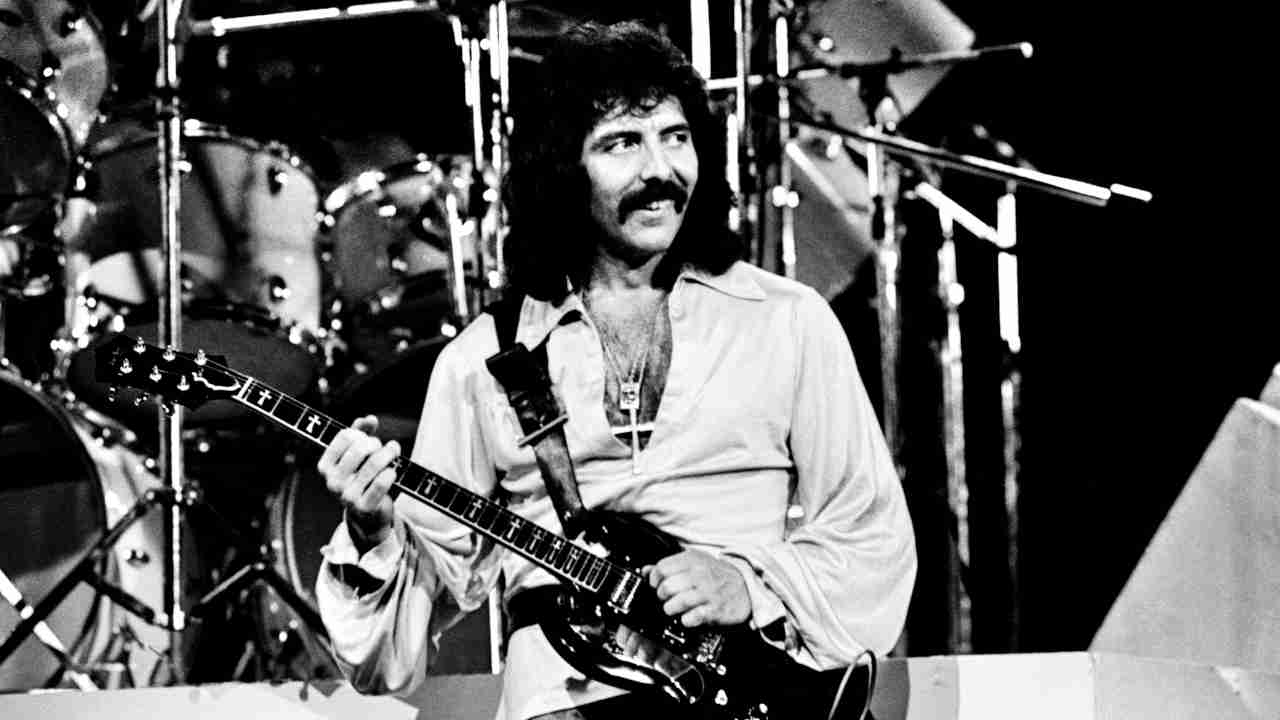
"I’ve got hundreds of them from over the years on various CDs," Iommi reveals. "Some of them go back to the original Sabbath, some from the Dio era, bits and bobs from when Ian Gillan or Tony Martin were in the band. I don’t even know what’s on there. I keep threatening to sit down and listen to them all one of these days when I get the chance."
Even during Black Sabbath’s final studio record, 2013’s critically acclaimed 13, exceptional material was left on the cutting room floor. "There’s about four or five from the last Sabbath album that we didn’t use," he admits. "I listened to a CD with them on recently. I thought, ‘Blimey, that’s good, why didn’t we use it?’"
The Visual Disaster of ‘Sabotage’
No historical examination of Sabotage is complete without addressing its infamous front cover art—a bizarre, distorted photograph featuring the band standing in front of a heavy mirror, with drummer Bill Ward dressed in high-waisted red tights.
         THE 'SABOTAGE' COVER ART ANECDOTE

         [Original Concept]
         Band mirrored in high-concept artistic reflection.
                 │
                 ▼
         [Day of the Shoot]
         No wardrobe coordinator present; mass confusion.
                 │
                 ▼
         [Bill Ward's Solution]
         Borrows wife's red tights + Ozzy's underpants.
                 │
                 ▼
         [Final Result]
         One of heavy metal's most bizarrely iconic album covers.
"Ha ha ha!" Iommi laughs when recalled of the cover. "A guy who worked for us who was an artist came up with a great idea—us reflected in a mirror, stuff like that. But when it got to the day, somebody said to Bill, ‘What are you gonna wear?’ And he was like, ‘I dunno.’ So he turned to his wife and said, ‘Can I borrow your tights?’ So he put on this pair of his wife’s red tights. And I think he might have borrowed Ozzy’s underpants, too. It looked bloody ridiculous. It definitely didn’t come out like we wanted it to."
Comparative Analysis: The Pantheon of Historic Guitar Riffs
When evaluating Iommi’s catalog against the broader landscape of rock history, music critics frequently place "Symptom of the Universe" alongside a tiny elite of transformative guitar compositions.

To contextualize the song’s victory in the Metal Hammer poll, the following table compares key metrics of heavy music’s most influential guitar riffs:
| Song Title | Artist | Year | Primary Tuning | Key Musical Characteristic | Cultural Impact & Legacy |
|---|---|---|---|---|---|
| "Symptom of the Universe" | Black Sabbath | 1975 | C# Standard | Chromatic palm-muted down-picking | Voted #1 Riff of All Time; birthed thrash metal. |
| "Smoke on the Water" | Deep Purple | 1972 | Standard (E) | Parallel fourths played with fingers | The definitive beginner guitar riff; iconic hard rock anthem. |
| "Whole Lotta Love" | Led Zeppelin | 1969 | Standard (E) | Blues-based octave slide & driving rhythm | Defined 1970s arena-rock guitar production. |
| "Iron Man" | Black Sabbath | 1970 | Standard (E) | Heavy bend-driven unison riffing | One of the most instantly recognizable riffs in pop culture. |
| "Master of Puppets" | Metallica | 1986 | Standard (E) | High-speed down-picked chromatic thrash | The pinnacle of 1980s thrash metal guitar technique. |
When asked to step outside his own discography and name the single greatest guitar riff written by someone else, Iommi’s choices reflect deep respect for his 1970s contemporaries:
"That’s hard," Iommi says. "There’s so many great riffs out there from the past, and up-to-date stuff. But you’ve got to have Deep Purple’s ‘Smoke On The Water.’ And of course there are a lot of Zeppelin songs. Jimmy Page has some great riffs."
As for his personal favorite among his own creations?
"Oh my god, that’s difficult," he muses. "I like ‘Into The Void.’ And I like some of the stuff we did with Dio—’Heaven And Hell’ was a good riff, ‘Neon Knights.’ There’s so many I like. I like pretty much all the stuff we’ve done."
Future Outlook & Legacy: The Enduring Power of the Riff King
Tony Iommi’s influence continues to reverberate across the global music landscape. Even as Black Sabbath concluded their touring career with the emotional The End tour in 2017 in their hometown of Birmingham, Iommi’s creative output has not ceased.

+-----------------------------------------------------------------------+
|                    TONY IOMMI: CURRENT & FUTURE PROJECTS              |
+-----------------------------------------------------------------------+
| • Solo Releases & Archival Projects (e.g., 'From The Dark' sessions)  |
| • Remastering & Reissuing Tony Martin-era Black Sabbath Catalog       |
| • Cataloging Decades of Unreleased Riff Tapes & Studio Jams           |
| • Philanthropic Work & Classical/Acoustic Orchestral Collaborations   |
+-----------------------------------------------------------------------+
Through new solo ventures—such as his recent release From The Dark—and ongoing archival remasters of the Tony Martin-era Black Sabbath catalog (Headless Cross, Tyr, Cross Purposes), Iommi remains actively engaged with his musical heritage. Guitarists across every subgenre of rock continue to analyze his drop-tuned techniques, his use of treble boosters, and his innate ability to construct immortal melodies out of raw noise.
Ultimately, the genius of Tony Iommi lies in the unpredictability of his inspiration. The magic of the riff remains an unquantifiable force—one that can strike at any hour, in any circumstance.
"Ha ha! Oh yeah," Iommi concludes when asked if ideas strike during the mundane moments of daily life. "I have riffs that come in all the time at different times, different places. You never know when the magic’s going to strike."
Fifty years after legal battles almost derailed Sabotage, "Symptom of the Universe" stands as proof of that magic—an unyielding monument to the man who gave heavy metal its voice, its aggression, and its immortal soul.