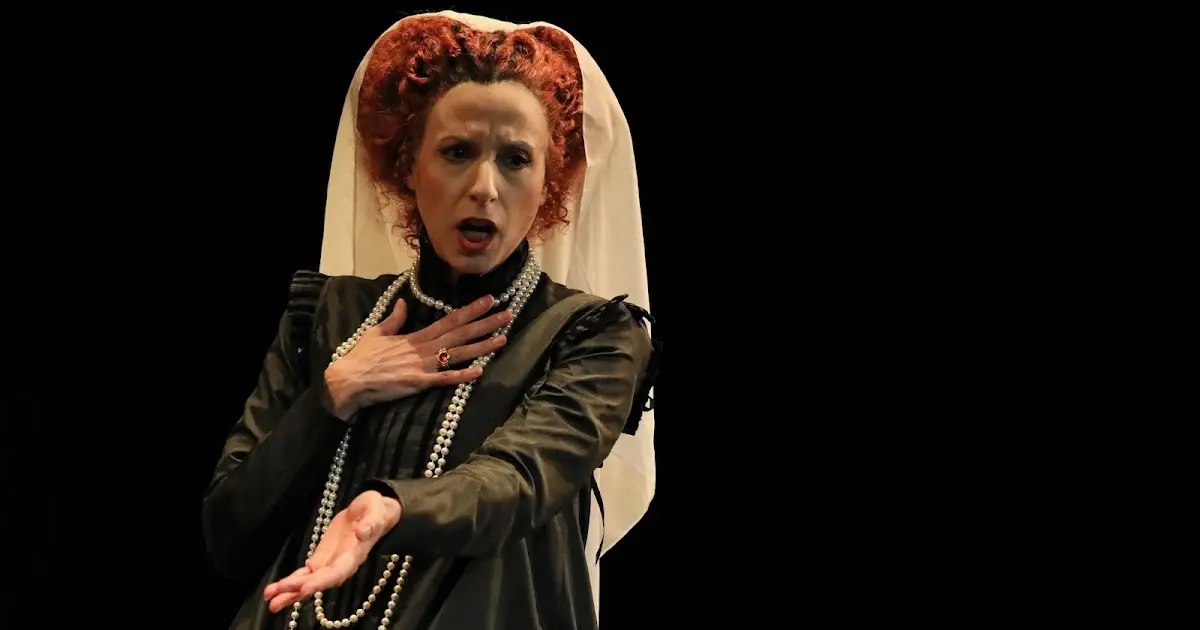
The contemporary opera landscape received a compelling and atmospheric addition on September 9, 2026, with the world premiere of Eight Days. Staged at London’s renowned Cockpit Theatre as part of the esteemed Tête à Tête: The Opera Festival, this chamber piece represents the fourteenth operatic work by the remarkably prolific composer Louis Mander. Produced by Cantata Dramatica, Eight Days narrows its historical and emotional lens to focus intensely on the final, agonizing week in the life of Mary, Queen of Scots.
The production is deeply collaborative, driven by librettist, producer, and principal solo performer Louisa Petair. Set for a solo soprano accompanied by a compact, dark-hued chamber ensemble, the opera delves into the psychological interiority of a monarch facing execution. Rather than relying on sweeping, grand-scale historical pageantry, Mander and Petair construct an intimate, almost claustrophobic sonic and dramatic world. The work weaves together historical letters, spoken-word elements, and tonal musical motifs to paint a haunting portrait of a tragic queen caught in the geopolitical chess match of Elizabethan Europe. Following its successful London debut, the production prepares for a deeply resonant site-specific performance on September 19, 2026, at St Mary’s Church in Fotheringhay—the very locale where Mary spent her final night before her execution at Fotheringhay Castle.
Detailed Chronology of the Production and Performance
The journey of Eight Days from conception to its high-profile festival debut reflects a meticulous creative process. Below is the operational and performance timeline charting the development and unfolding of the production:
- Pre-Production and Composition Phase: Louis Mander completes the score, collaborating closely with librettist Louisa Petair. The structural framework is divided into discrete, theme-based vignettes matching the final eight days of Mary’s life.
- Rehearsals and Ensemble Integration: The chamber ensemble—comprising Kiana Umali Garvey (violin), Theadora Griffiths (viola), Max Chen (cello), and Jack Cherry (double bass)—rehearses under Mander’s musical direction. Concurrently, sound design elements, historical voiceovers (featuring Kieran Rayner), and visual aesthetics (costumes by Natalia Zinkevych, wigs by Brandon Marchant, and make-up design by Sara Sorrenti) are finalized under production assistants Olga Lavant and Dominic Bujega-Lane.
- World Premiere (September 9, 2026): Eight Days debuts officially at the Cockpit Theatre in London as a cornerstone presentation of the Tête à Tête: The Opera Festival. Louisa Petair takes the stage as Mary, delivering a continuous lyric arioso backed by the live string quartet and integrated pre-recorded soundscapes.
- Critical Evaluation & Post-Premiere Analysis: Reviewers highlight the work’s distinctive dark-toned orchestration, Petaïr’s commanding stage presence, and the production’s psychological depth, while noting technical hurdles regarding textual clarity in the absence of surtitles.
- Upcoming Site-Specific Performance (September 19, 2026): The production travels to St Mary’s Church in Fotheringhay, offering audiences a historically charged, immersive performance experience directly adjacent to the historical execution site of the Scottish queen.
Supporting Context & Production Metrics
To fully appreciate the artistic scope of Eight Days, it is essential to examine the structural, musical, and narrative choices made by its creators. The work breaks down into a finely calibrated matrix of sound, text, and theatrical staging.

Narrative Architecture and Libretto Design
The libretto, authored by Louisa Petair, derives its text directly from the surviving historical letters of Mary, Queen of Scots. Eschewing a linear narrative of public political maneuvering, the opera fragments into short, thematic scenes. Each vignette represents one of the final eight days, exploring distinct emotional and domestic motifs:
- The Cat and Mouse Motif: A satirical reflection on Mary’s fraught, adversarial relationship with Queen Elizabeth I, symbolized through her embroidery work.
- Maternal Anxiety: A poignant musical and textual prayer dedicated to her son, King James VI of Scotland.
- Marital Tumult: Reflective sequences navigating her troubled past relationships with Lord Darnley and the Earl of Bothwell.
- Diplomatic Appeals: A desperate, final plea directed to her brother-in-law, Henri, King of France (whose elder brother was Mary’s first husband).
Musical Score and Orchestral Palette
Louis Mander’s score demonstrates a masterclass in economic orchestration. Utilizing a chamber ensemble restricted to a single violin, a viola, a cello, and a double bass, Mander deliberately steers clear of the bright, soaring upper registers traditionally associated with tragic operatic heroines.
- The Lower-Register Tincture: By omitting a second violin and heavily featuring the rich, resonant lower tones of the cello and double bass, the ensemble evokes the historical sonority of a consort of viols. This grants the score a continuous, shadowy atmosphere.
- Melodic Fragments over Grand Arias: Eschewing traditional, expansive arias, Mander employs an evolving network of motivic fragments, folk-inflected touches, and shifting textures. The vocal writing for Petair manifests as a continuous lyric arioso—meandering through recitative-like passages that prioritize psychological realism over conventional vocal display.
Production Credits and Ensemble Personnel
- Composer & Conductor: Louis Mander
- Librettist, Producer, & Principal Performer (Mary, Queen of Scots): Louisa Petair
- Voice Actor, Dramaturg, & Sound Designer: Kieran Rayner
- Production Assistants: Olga Lavant, Dominic Bujega-Lane
- Costume Design: Natalia Zinkevych (Fiorentina Costuming)
- Wig Design: Brandon Marchant
- Make-up Consultant: Sara Sorrenti
- String Quartet: Kiana Umali Garvey (Violin), Theadora Griffiths (Viola), Max Chen (Cello), Jack Cherry (Double Bass)
Official Statements and Artistic Vision
The creative team behind Eight Days has consistently emphasized the psychological interiority of Mary Stuart over standard historical dramatization. In promotional materials and production notes distributed by Cantata Dramatica and the Tête à Tête festival, the focus is placed squarely on the human element behind the royal mythos.
Louis Mander has noted that his compositional choices are designed to mirror the claustrophobia of imprisonment. By keeping the instrumental textures tightly bound around the mezzo-soprano voice—rarely allowing the single violin to break free into unrestrained heights—the music acts as an acoustic cage, reinforcing the historical reality of Mary’s confinement.

Librettist and performer Louisa Petair approached the text not as a political indictment or defense, but as a deeply personal excavation of a woman’s inner voice during her final hours. By anchoring the performance in the exact words preserved in Mary’s correspondence, the production seeks to reclaim the human narrative from centuries of polarized historical myth-making. Despite minor criticisms regarding vocal diction and the absence of surtitles—which occasionally obscured the dense textual poetry of the letters—the collaborative vision has been widely lauded as a triumph of contemporary chamber opera staging.
Future Outlook
The trajectory of Eight Days points toward a vibrant future within the contemporary chamber opera circuit. As Louis Mander solidifies his reputation as one of the UK’s most industrious contemporary composers—with a catalogue now boasting fourteen operas—works like Eight Days demonstrate a growing appetite for lean, highly focused historical storytelling.
The immediate horizon features the high-stakes, site-specific performance at St Mary’s Church, Fotheringhay, on September 19, 2026. This venue carries profound historic weight, offering an unprecedented atmospheric alignment between the performance space and the real-world tragedy it commemorates. Beyond this engagement, the modular and scalable nature of the four-piece string ensemble and solo vocal setup makes Eight Days an ideal candidate for future touring. Festival directors and specialized chamber music curators looking for intellectually engaging, historically grounded, and emotionally intense repertoire will likely find Mander and Petair’s collaboration an attractive addition to upcoming seasons. If the production addresses minor acoustic and textual intelligibility hurdles—perhaps through the introduction of discreet surtitles—Eight Days stands well-positioned to enjoy a long, resonant life on both national and international stages.