Executive Overview
For decades, modern music producers, film scorers, and contemporary orchestrators have faced a persistent dilemma: how to capture the living, breathing essence of a live orchestra without the staggering financial, logistical, and spatial costs of booking a full symphonic hall and its musicians. While sample libraries have evolved exponentially—growing from crude, megabyte-sized soundfonts to multi-terabyte behemoths featuring hundreds of articulation switches and microphone positions—they remain bound by a fundamental limitation. They are inherently static. Traditional virtual instruments are collections of recorded audio fragments; no matter how deeply sampled they are, playing a note at a different velocity or with a different expression simply triggers a pre-recorded file, often resulting in the dreaded "machine gun" effect or unnatural tonal shifts when forced to bend to a composer’s dynamic whims.
Enter Japan-based music technology innovator Dreamtonics. Known for pushing the boundaries of voice synthesis and AI-driven audio applications, the company has officially entered the orchestral arena with its flagship new plugin and technology suite: Instrument X.
Rather than relying on massive, hard-drive-choking libraries of static audio files, Instrument X introduces what Dreamtonics defines as “Neural Acoustics Modelling.” This cutting-edge software harnesses artificial intelligence to dynamically manipulate the foundational physics of human playing styles in real time. Instead of switching between pre-recorded samples, the plugin mathematically and acoustically alters sound waves to reflect authentic physical phenomena—such as the subtle micro-variations of breath pressure in woodwinds and brass, or the shifting friction of horsehair against steel and gut strings in bowed instruments.
Alongside its revolutionary synthesis engine, Instrument X introduces “3D Sound-Field Control,” allowing producers to place virtual instruments directly into simulated acoustic environments with authentic microphone setups ranging from close spot mics to classic Decca Trees and ambient pairs. Available now in a modular ecosystem that includes a free foundational version alongside tiered instrument packs scaling up to $649, Instrument X promises to dismantle the barriers between synthetic production and organic orchestration. This report provides an in-depth look at the technology, its development philosophy, market impact, and what it signals for the future of digital composition.
Detailed Chronology: The Evolution of Orchestral Emulation and the Birth of Instrument X
To understand the magnitude of Dreamtonics’ breakthrough, one must examine the evolutionary trajectory of virtual orchestration over the past half-century.
The Era of Static Playback (1980s–2010s)
In the early days of electronic music production, composers relied on hardware ROMplers and primitive samplers (such as the Fairlight CMI or early Akai units) to evoke orchestral sounds. As computing power grew through the 1990s and 2000s, software samplers like Native Instruments’ Kontakt revolutionized the industry. Developers began recording world-class orchestras note-by-note, dynamic-by-dynamic, and articulation-by-articulation.
However, this approach created a massive logistical footprint. Modern orchestral libraries frequently demand hundreds of gigabytes—sometimes upwards of a terabyte—of high-speed solid-state drive (SSD) storage. Furthermore, while these libraries sound magnificent in isolation, they notoriously struggle with fluid, transitional phrasing. If a composer wanted a violin section to swell dynamically between notes in a way that wasn’t pre-sampled, they were forced to automate volume faders or apply artificial compression and EQ—methods that manipulate amplitude rather than the true harmonic timbre of the instrument.
The Shift Toward AI and Physical Modeling (2020s)
As artificial intelligence permeated the creative industries, audio developers began searching for ways to bypass the storage and fluidity bottlenecks of traditional sampling. Physical modeling—synthesizing sounds using mathematical equations that mimic the physical properties of instruments—offered a lightweight alternative, but historically struggled to capture the rich, chaotic organic imperfections of real human performances.

Dreamtonics identified the sweet spot between these two methodologies. By training neural networks on vast datasets of real-world acoustic performances, the company bridged the gap between raw physical modeling and machine learning. This research culminated in Neural Acoustics Modelling, a technology designed to compute the acoustic output of an instrument dynamically based on performance parameters, rather than playing back fixed audio recordings.
The Launch of Instrument X
The development of Instrument X represents a multi-year engineering effort by Dreamtonics to scale their AI synthesis expertise away from human vocal cords and toward the complex physics of symphonic instruments. Released to the global market as both a standalone application and a Digital Audio Workstation (DAW) plugin, Instrument X strips away the multi-terabyte bloat of traditional libraries. By generating sound waves via AI-driven synthesis parameters, the software reduces storage footprints to a fraction of conventional standards while offering an unprecedented level of expressive control over breath, bow, and strike dynamics.
Supporting Context & Metrics: Under the Hood of Neural Acoustics Modelling
To fully appreciate what Instrument X achieves, it is necessary to examine the technical architecture powering the plugin and how it redefines the producer’s workflow.
1. Granular Control Over Physical Articulations
In a traditional orchestral mockup, expression is often limited to a few standard CC (Control Change) messages—chiefly CC1 (Modulation for dynamics) and CC11 (Expression for volume). While skilled orchestrators can massage these controllers to breathe some life into a MIDI performance, the underlying audio remains bound to the physical recording it came from.
Instrument X treats the performance parameters as direct inputs into its neural acoustic engine. Producers can manipulate variables that mimic real-world physical mechanics:
- Bow Friction: Controls the microscopic stick-slip phenomenon of a bow gripping and releasing a string, allowing for hyper-realistic scratch transients, smooth legatos, and biting marcato attacks.
- Breath Pressure: Emulates the air column dynamics of flutes, clarinets, and brass instruments, translating modulations directly into realistic timber shifts, overblowing harmonics, and natural vibrato evolution.
2. 3D Sound-Field Control and Spatial Authenticity
A great symphonic recording is as much about the room as it is about the instruments. Instrument X incorporates an advanced spatialization engine dubbed 3D Sound-Field Control. Rather than relying on static convolution reverbs baked into a sample, this system allows producers to position instruments within meticulously modeled microphone configurations:
- Spot Microphones: For direct, intimate detail.
- Decca Tree Arrays: The classic three-microphone orchestral setup used in legendary scoring stages like Abbey Road.
- Ambient Pairs: To capture the natural early reflections and late decay of a symphonic hall.
3. Workflow and Storage Efficiency
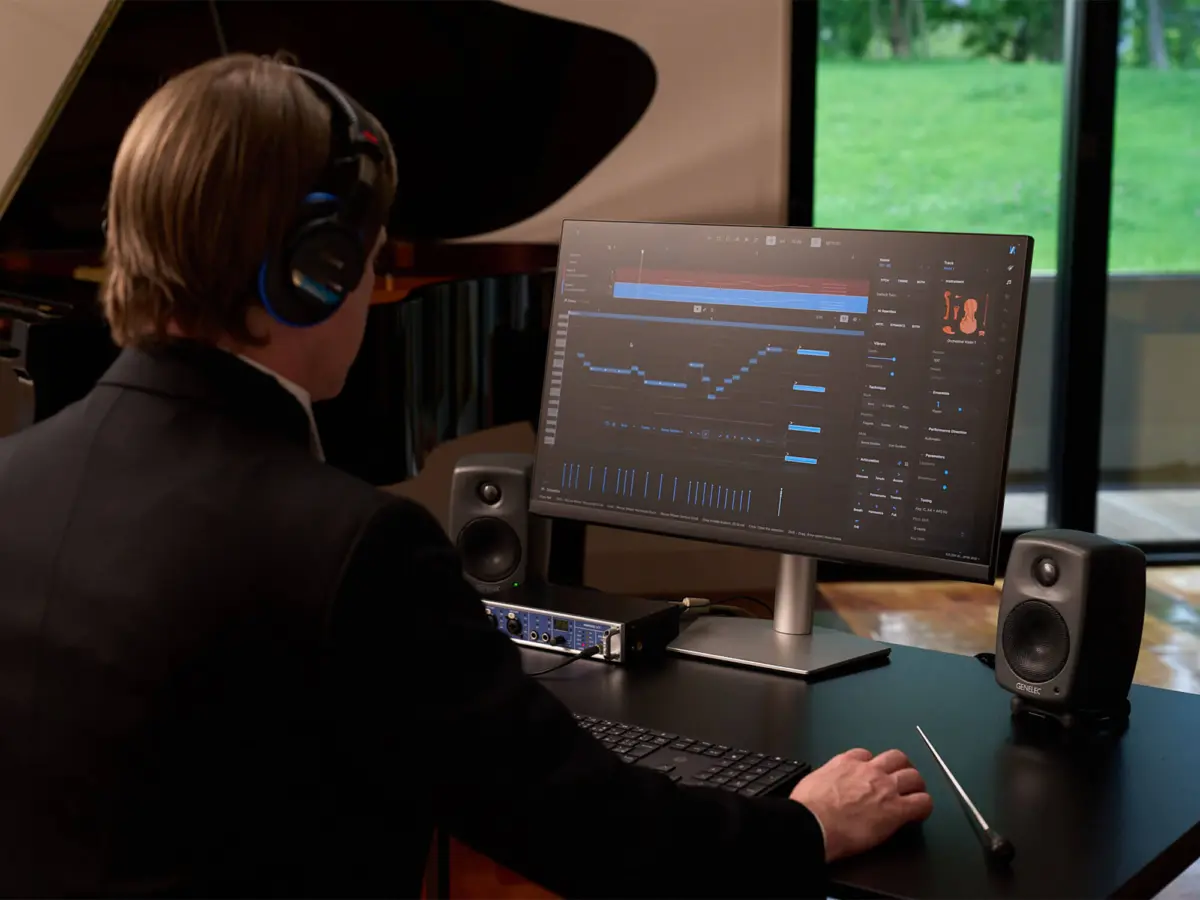
Because Instrument X alters sound waves via algorithmic synthesis rather than streaming multi-gigabyte audio files from a disk cache, system resource management is radically optimized. Producers no longer need dedicated RAID arrays or massive PCIe SSDs solely to host orchestral templates. Furthermore, the user interface (UI) has been deliberately designed to mirror standard DAW architecture. The new physical parameters appear as familiar, assignable automation lanes, ensuring that the learning curve for professional composers is virtually nonexistent.
4. Ecosystem Pricing and Tiers
Dreamtonics has deployed Instrument X through a flexible, tiered commercial model designed to accommodate everyone from hobbyists to high-end film composers:

- Free Standalone & Plugin Version: Serves as the foundational engine and entry point.
- Modular Instrument Packs: 10 distinct expansion packs ranging from $99 to $649, offering a spectrum of bundled software instruments, standalone libraries, and a comprehensive master collection.
Official Statements and Industry Insights
The philosophy behind Instrument X speaks directly to the demands of modern music production, where genres frequently bleed into one another—such as the integration of heavy orchestral elements in electronic music, pop, and cinematic trap.
Kanru Hua, Founder and CEO of Dreamtonics, addressed the core philosophy and the engineering hurdles overcome during the development process in an official company statement:
"While it may sound incredibly difficult to transcend the static constraints of traditional sample playback to achieve a fluid, organic performance, the ‘AI-driven’ synthesis is actually the straightforward part," Hua explained.
He elaborated on the distinction between algorithmic capability and practical utility, noting where the true bottleneck of software design lies:
"The true challenge lies in deep-customizing this technology to satisfy the exacting, high-end demands of real-world composition and production experts."
Industry analysts note that as pop and electronic producers increasingly look to score for film, television, and game media—frequently collaborating with crossover outfits like the Kaleidoscope Orchestra—the demand for intuitive, high-fidelity symphonic tools has never been higher. Instrument X directly targets this crossover demographic, removing the intimidation factor of complex sample library management while delivering professional-grade sonic results.
Future Outlook: The Horizon of AI in Orchestral Composition
The launch of Dreamtonics’ Instrument X marks a potential watershed moment for music production software. By proving that Neural Acoustics Modelling can successfully replace or heavily augment traditional sample playback, Dreamtonics has opened a Pandora’s box of possibilities for the future of virtual instruments.
What Lies Ahead?
- Expansion into Unsampled World Instruments: While orchestral instruments are the primary focus for the initial launch, the underlying principles of Neural Acoustics Modelling can theoretically be applied to any acoustic instrument on Earth—from rare ethnic flutes and percussive oddities to complex multi-stringed instruments like the koto or sitar.
- Real-Time Performance Integration: As CPU efficiency and neural processing units (NPUs) become standard in modern computing architectures, plugins like Instrument X pave the way for live performers to control hyper-realistic orchestral emulations via MIDI wind controllers, guitar synths, or expressive keyboard controllers (such as MPE-enabled boards) without latency.
- The Redefinition of Sample Libraries: Major legacy sample library developers may find themselves forced to adapt. While traditional sampling will always hold a revered place in music production for its raw documentary capture of specific players and rooms, the flexibility of generative neural acoustics threatens to make static libraries feel increasingly antiquated for fast-paced commercial scoring work.
Conclusion
Dreamtonics has taken a bold step away from the brute-force data storage solutions of the past two decades. With Instrument X, the company is not merely offering another virtual instrument; it is introducing a paradigm shift in how digital sound is conceptualized, manipulated, and performed. For composers navigating tight deadlines, massive orchestrations, and uncompromising sonic standards, the age of Neural Acoustics Modelling has officially arrived—and the symphony will never sound the same.