Executive Overview
Jazz has always maintained a deeply philosophical, almost mythological relationship with time. If literature and the visual arts frequently look backward for inspiration or lurch frantically toward the novel, jazz operates inside a permanent creative wormhole. It is an art form anchored by a Tiresian vision—possessing the mythical blind prophet’s capacity to gaze simultaneously into the hallowed corridors of the past and the uncharted nebulae of the future. Each successive generation of improvisers grows organically out of the fertile compost of its forebears. No matter how aggressively avant-garde, abstract, or decentralized a modern jazz manifestation might appear, it invariably demands a comprehensive, encyclopedic knowledge base to abstract from, ensuring that the constant, radical newness of the present moment remains tethered to a rich ancestral lineage.
Within the celestial pantheon of jazz greats, John Coltrane stands undisputed as its Zeus—the quintessential iconoclast who stretched the harmonic and structural language of the form to its absolute breaking point while simultaneously suffusing it with an intense, burning spirituality. Yet, to push the classical metaphor further, Coltrane was equally the Prometheus of American music. He reached into the heavens, stole the very fire of the gods, and delivered it to humanity in its most volatile, transformative state. For this supreme act of creative defiance, the universe exacted a heavy toll: Coltrane was struck down by liver cancer in 1967 at the tragically premature age of 40, sealing his legacy as the eternal martyr of avant-garde fire music.
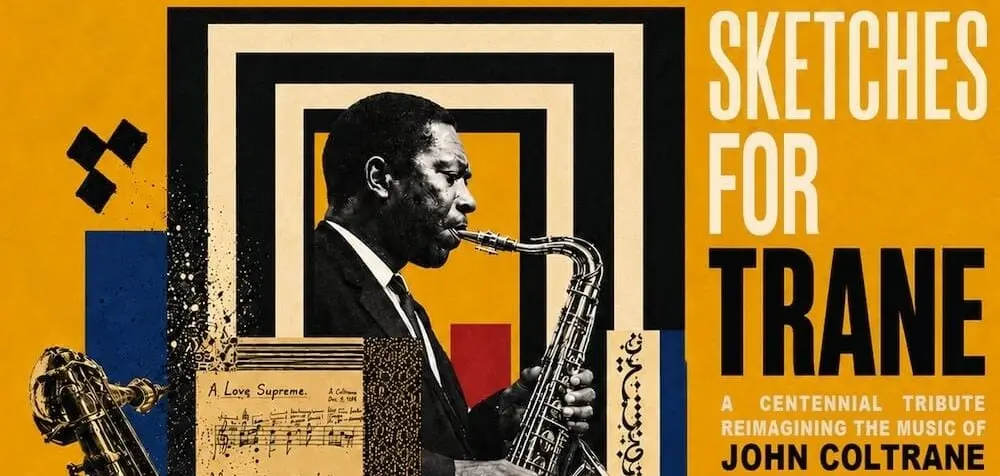
Now, as the global music community anticipates the centenary of his birth, legendary Chicago percussionist and composer Kahil El’Zabar has stepped forward to honor that eternal flame. Released via Spiritmuse Records, Sketches For Trane is an astonishing, multi-generational suite that serves not merely as a tribute to Coltrane, but as a living, breathing extension of his boundless spiritual architecture. At 72 years old, El’Zabar—a titanic architect of the Chicago avant-garde and a veteran of the Association for the Advancement of Creative Musicians (AACM)—has crafted a masterwork that looks back to move forward, channeling Coltrane’s gospel of expanded human potential for a new century of listeners.
Detailed Chronology & Track-by-Track Breakdown
Sketches For Trane is not a polite, note-for-note replication of Coltrane’s canonical catalog; rather, it is an exploratory dialogue across decades, featuring an elite roster of contemporary improvisers who parse, deconstruct, and elevate the master’s vocabulary.
The Genesis of the Suite: Trane in Mind and Sketches of a Love Supreme
The journey begins with Trane in Mind, an El’Zabar composition that captures the playful, unpredictable energy reminiscent of the legendary Art Ensemble of Chicago. Here, see-saw melodies collide with heavy, unbridled free-blowing. The track features an incandescent performance by saxophonist David Murray, El’Zabar’s long-standing creative foil. Murray’s playing is nothing short of supernatural; he charges torrents of raw emotion through pristine intellectual logic, sounding as though he is physically turning himself inside out to find the exact microscopic crack in his reed that might cause the entire ensemble to levitate off the floorboards.
The emotional center of gravity shifts dramatically with Sketches of a Love Supreme. El’Zabar brilliantly reinvents the iconic, instantly recognizable opening motif of Coltrane’s spiritual masterwork, injecting it with a wonderfully lopsided, skip-rhythm groove. This rhythmic pivot sets the stage for vocalist Dwight Trible, whose voice vibrates with a searing spiritual candor not felt on record since Albert Ayler’s transcendent Music is the Healing Force of the Universe. Trible’s message of cosmic yearning becomes devastatingly poignant when framed by the exquisite, weeping trumpet lines of Corey Wilkes and the majestic, deeply felt piano of David Ornette Cherry.
Tragically, this recording serves as a historical document of profound sorrow. David Ornette Cherry—son of the legendary trumpeter Don Cherry, and brother to Nenah and Eagle-Eye Cherry—recorded these piano parts just nine months before his sudden, tragic passing in a London hotel room. His death occurred shortly after a triumphant performance at a tribute concert dedicated to his father, lending his performance on Sketches For Trane an eerie, posthumous resonance.
Cubist Perspectives and Celestial Chi: Resolution and Sketches of an Afro Blue
As the suite unfolds into its second movement, Resolution (originally part of the A Love Supreme suite), saxophonist Isiah Collier reinterprets the source material with the analytical mastery of a Cubist painter. Collier offers multiple, simultaneous perspectives of the primary themes, shattering linear time into shimmering shards of sound. He achieves a state of immolating transcendence, propelled by sudden, thunderous bursts of El’Zabar’s signature drum-clouds and the rich harmonic underpinnings of keyboardist Justin Dillard.
The album closes with Sketches of an Afro Blue, a dense, labyrinthine layer of tessellating percussion that feels less like a rhythm section and more like the pavement itself convulsing beneath the listener’s dancing feet. This jiving, earthbound bedrock provides the ideal launchpad for cellist Ishmael Ali, who proceeds to explore the absolute outer limits of his instrument. Ali spins line upon cascading line of celestial chi, bridging the physical earth and the spiritual cosmos in a single, sustained arc of bow against string.
Supporting Context & Metrics: The Architects of the Chicago Avant-Garde
To fully understand the gravity of Sketches For Trane, one must examine the monumental pedigree of its principal architect, Kahil El’Zabar. Born in Chicago in 1953, El’Zabar has spent over five decades cementing his status as a foundational pillar of the global creative music community.
Kahil El’Zabar: A Lifetime of Sonic Innovation
- The AACM Connection: As a pivotal member of the Association for the Advancement of Creative Musicians, El’Zabar helped codify an ethos of uncompromising artistic independence, multi-instrumentalism, and cultural pride that reshaped the global trajectory of improvised music.
- The Ethnic Heritage Ensemble: Founded by El’Zabar in the early 1970s, this pioneering ensemble fused traditional African percussion, socio-political consciousness, and avant-garde jazz long before "world music" became a corporate marketing term.
- An Intergenerational Collaborator: Over his illustrious career, El’Zabar’s resume reads like a who’s who of twentieth-century sonic royalty. He has recorded and performed alongside jazz titans such as Pharoah Sanders, Dizzy Gillespie, Archie Shepp, Stevie Wonder, Nina Simone, and Lester Bowie.
Album Metrics & Release Details
- Sketches For Trane
- Release Date: September 23rd, 2026
- Record Label: Spiritmuse Records
- Primary Personnel:
- Kahil El’Zabar (Drums, Percussion, Composition)
- David Murray (Tenor Saxophone, Bass Clarinet)
- Dwight Trible (Vocals)
- Corey Wilkes (Trumpet)
- David Ornette Cherry (Piano)
- Isiah Collier (Saxophone)
- Justin Dillard (Keyboards)
- Ishmael Ali (Cello)
- Format: Digital download, streaming, and physical vinyl editions via Bandcamp and select independent retailers.
Official Statements & Critical Perspectives
While Spiritmuse Records has positioned the release as a cornerstone of the global jazz calendar leading into Coltrane’s centenary, early critical reception highlights the project’s unique ability to transcend standard tribute album tropes.
In promotional statements accompanying the release, label executives emphasized El’Zabar’s unique position in modern music:
"Kahil El’Zabar does not merely look back at John Coltrane through a historical lens; he communes with him as a contemporary peer. ‘Sketches For Trane’ represents the living continuity of avant-garde spiritual jazz—a bridge connecting the fire of 1965 Chicago and New York to the urgent sonic explorations of the 2020s."
Jazz historians and contemporary reviewers have similarly lauded the project’s daring instrumentation and emotional depth. Reviewers have noted that by blending veteran stalwarts like David Murray with rising virtuosos such as Isiah Collier and Ishmael Ali, El’Zabar has constructed an intergenerational masterclass. The album bypasses nostalgic pastiche, opting instead to treat Coltrane’s catalog as a living, malleable DNA sequence ready to be spliced, evolved, and reborn.
Future Outlook: The Enduring Flame in Modern Jazz
As the musical world looks toward the centennial celebrations of John Coltrane’s birth, Sketches For Trane sets an impossibly high artistic standard. It demonstrates that the avant-garde tradition is neither a museum exhibit nor a relic of the past, but an active, breathing ecosystem capable of profound emotional healing and intellectual renewal.
At 72 years of age, Kahil El’Zabar has proven that true mastery lies not in repeating what has already been said, but in using the lessons of the past to illuminate the darkness of the present. By gathering an extraordinary ensemble of artists to channel the Promethean fire of Coltrane—and honoring the memories of fallen brethren like David Ornette Cherry along the way—El’Zabar has delivered a defining document of contemporary creative music.
Sketches For Trane is an indispensable addition to any serious listener’s library. To borrow a phrase from the annals of both space exploration and jazz history: this is one small step for man, but one Giant Steps for mankind.