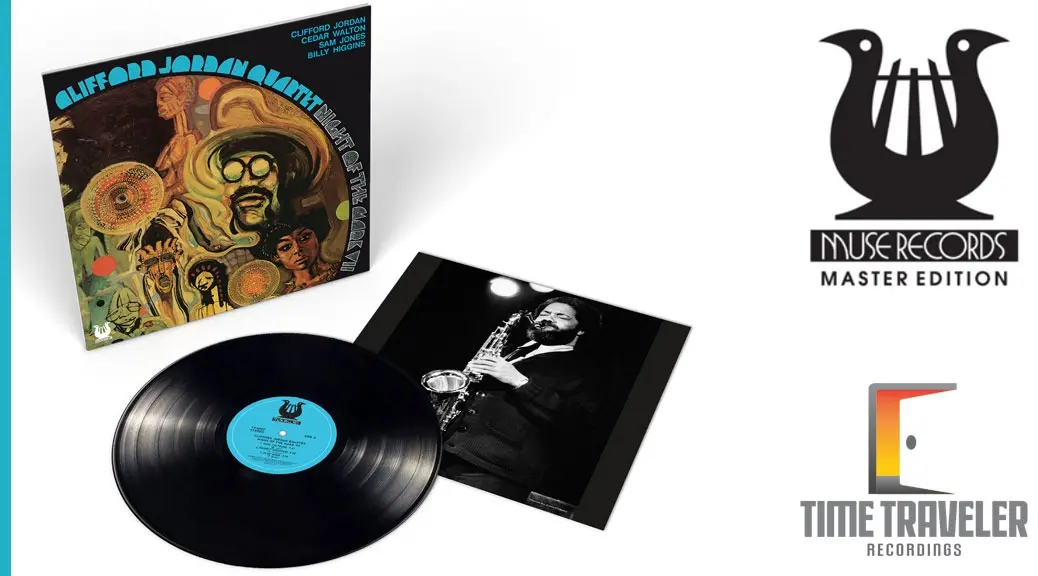
In the storied annals of post-bop jazz, few instruments hold as mythic a status as the one unpacked in a Parisian club on March 26, 1975. As tenor saxophonist Clifford Jordan arrived in the French capital at the zenith of his mid-decade creative resurgence, a brand-new Selmer Mark VII tenor saxophone awaited him. That very evening, before an intimate crowd of roughly 300 mesmerized patrons, Jordan baptized the horn on stage alongside an elite rhythm section featuring pianist Cedar Walton, bassist Sam Jones, and drummer Billy Higgins.
The resulting performance yielded a historic recording that has long captivated collectors and jazz historians alike. Now, through the dedicated archival efforts of Time Traveler Recordings—spearheaded by producer Zev Feldman as part of their acclaimed Muse Master Edition Series—this monumental evening is receiving the definitive deluxe treatment it has long deserved. Titled Night of the Mark VII, the newly remastered reissue breathes fresh life into a classic document of a working band operating at the absolute peak of its powers.
Meticulously transferred and remastered from the original analogue tapes by mastering engineer Matthew Lutthans at The Mastering Lab, the release is pressed on heavy-duty 180-gram vinyl at Furnace and packaged in a hand-numbered Stoughton tip-on jacket. Accompanied by insightful new liner notes from jazz journalist Willard Jenkins, rare period photography by Raymond Ross, and the original sleeve notes, this release is far more than a simple reissue; it is an archeological recovery of a vital chapter in jazz history. While preserving the raw, unvarnished acoustic atmosphere of a live club date, the release underscores the telepathic interplay of four masters defining the contours of modern jazz during a transformative era.
Detailed Chronology: The Road to Paris and the Genesis of Night of the Mark VII
To fully appreciate the magic captured on the night of March 26, 1975, one must trace the convergence of relationships, shared repertoires, and geographic movements that brought Clifford Jordan, Cedar Walton, Sam Jones, and Billy Higgins together on a European stage.
By the mid-1970s, Jordan was experiencing a profound career renaissance. While he had made indelible contributions to the hard-bop canon during his late-1950s and 1960s stints with Blue Note and Atlantic Records, the following decade found him operating with an elevated sense of compositional maturity and spiritual urgency. His associations with kindred spirits in New York’s fertile underground scene yielded masterworks, most notably his participation in the sessions for Glass Bead Games, the monumental 1973 Strata-East double album that remains a touchstone for contemporary jazz collectors.
The quartet that assembled in Paris was not a pickup band assembled hastily for an overseas tour; it was a tight-knit collective of kindred musical minds who shared a deeply interconnected history. Just prior to this European excursion, these four musicians formed the foundational DNA of Cedar Walton’s legendary group, Eastern Rebellion, in 1974. Although George Coleman would famously occupy the tenor chair when that group officially entered the recording studio in December 1975, the Paris concert captured the unalloyed, original incarnation of Walton’s conceptual vision.
The concert itself began with a stroke of spontaneous theatricality. According to Jordan’s later recollections, the quartet opened the set "out of left field" with Walton’s hypnotic composition "Midnight Waltz." It was a stylistic feint that felt as though eight o’clock had suddenly morphed into midnight, initiating the performance "from the middle out." However, when the live set was originally sequenced for commercial release, the track order was adjusted: Bill Lee’s evocative tribute "John Coltrane" took the lead on side one, holding back "Midnight Waltz" to anchor the dramatic arc of side two.
The program functioned as a living museum and forward-looking laboratory of the quartet’s shared repertoire. Four of the five compositions performed that evening had already been recorded by members of the ensemble in various configurations. Sam Jones’s driving modal workout "One For Amos" had been cut by this exact quartet in October 1973 for the aforementioned Glass Bead Games. "John Coltrane" hailed from those same landmark sessions, utilizing Jordan and Higgins within that album’s alternate quartet setting. Meanwhile, Jordan’s labyrinthine composition "Highest Mountain" dated back to 1965, having originally appeared on his Atlantic Records album These Are My Roots. Furthermore, Muse Records had previously captured Jordan, Walton, and Jones tackling "Highest Mountain" and Thelonious Monk’s "Blue Monk" during live performances at Boomer’s in New York, featuring Louis Hayes on the drum kit.
Thus, when Jordan stepped onto the Parisian stage holding his gleaming, untried Selmer Mark VII, he was supported by musicians who knew his phrasing, breathing, and harmonic lexicon as intimately as their own.
Supporting Context & Metrics: Repertoire Analysis and Sonic Architecture
The structure of Night of the Mark VII reveals a masterclass in setlist pacing, balancing cerebral, technically demanding modern compositions with deep-rooted blues and modal explorations.

Side One: Exploring Lineage and Technical Rigor
Side one sets a high benchmark, moving seamlessly through Bill Lee’s "John Coltrane," Jordan’s intricate "Highest Mountain," and Monk’s enduring "Blue Monk."
- "John Coltrane": Opening the performance on record, this version possesses a soulful elegance and a subtle Latin inflection that distinguishes it from the original Glass Bead Games studio recording. Sam Jones’s resonant bass line anchors the foundation before Jordan steps forward to state the theme. Soon after, the ensemble engages in a captivating, vocal-like chant of the dedicatee’s name—a spiritual nod that later inspired saxophonist Nat Birchall to dedicate an entire side of his 2014 double album, Live In Larissa, to the piece.
- "Highest Mountain": Clocking in as the shortest piece of the evening, it is paradoxically the most knotty and structurally demanding. Built around two distinct sections spanning 23 bars apiece, the tune is notoriously difficult to navigate. Cedar Walton, who played on the original 1965 recording, famously confessed that it took him five years of playing the piece before he could execute it comfortably. On this particular night, listeners can hear Jordan wrestling with the mechanical adjustments of his brand-new horn; his tone turns wonderfully guttural, digging deep into the saxophone’s lower register as he breaks in the unfamiliar keywork. Following a typically inventive drum solo by Billy Higgins, the theme reprises before the tune resolves on a soaring, gospel-infused run of Amens.
- "Blue Monk": A reliable favorite of the discerning Parisian jazz cognoscenti, Thelonious Monk’s classic blues receives a definitive reading here, brimming with the effortless swing, swagger, and harmonic sophistication that the material demands.
Side Two: Modal Expansions and Bop Pyrotechnics
Side two shifts focus to compositions penned by the pianist and bassist, offering the two most expansive musical excursions of the evening.
- "Midnight Waltz": Cedar Walton’s standout modal masterpiece anchors the second half of the record. The hypnotic, cyclical progression draws spontaneous applause from the Parisian audience midway through Sam Jones’s acrobatic bass solo, and erupts into further cheers after each subsequent instrumental intervention.
- "One For Amos": Sam Jones’s rip-roaring bop anthem brings the evening to a fiery, high-energy close, challenging the leader to push his newly acquired Mark VII to its absolute mechanical and expressive limits.
Production and Remastering Metrics
From a sonic standpoint, Night of the Mark VII reflects the charmingly gritty realities of 1970s European club recordings. Despite the exceptional care taken by Matthew Lutthans at The Mastering Lab to extract maximum fidelity from the original analogue tapes, the recording retains the sonic footprint of a budget-conscious remote setup in a small venue. The piano—discernible to keen ears as an upright rather than a grand—cuts through clearly, though the acoustic environment is markedly removed from the polished sheen of a dedicated New York recording studio. Nevertheless, these technical limitations do nothing to diminish the emotional resonance of the music, offering a vital, unvarnished window into a legendary working band in full flight.
Official Statements and Archival Significance
The release of Night of the Mark VII is the latest triumph for Time Traveler Recordings’ ambitious Muse Master Edition Series. Spearheaded by renowned producer and archivist Zev Feldman, the series has earned widespread critical acclaim for rescuing overlooked jazz gems from the vaults and presenting them with uncompromising production standards. Previous entries in the series—including Woody Shaw’s Love Dance, Roy Brooks’s The Free Slave, Carlos Garnett’s Cosmos Nucleus, and Kenny Barron’s Sunset to Dawn—have established a gold standard for archival jazz curation.
In the official liner notes accompanying the release, esteemed jazz critic and historian Willard Jenkins contextualizes the recording within Jordan’s broader artistic trajectory:
"Clifford Jordan was an artist who commanded absolute authority on his instrument, yet he continually sought out new avenues for creative expression. The transition to the Selmer Mark VII in Paris was not merely a hardware upgrade; it marked a psychological and physical shift in how he engaged with his sound. Hearing him navigate that transition in real time, surrounded by a rhythm section as telepathic as Walton, Jones, and Higgins, offers a rare glimpse into the alchemy of jazz creation."
Complementing Jenkins’s essay are rare, evocative period photographs taken by legendary jazz photographer Raymond Ross, capturing Jordan’s intense concentration and stylish composure during the mid-1970s. By housing these materials inside a deluxe, hand-numbered Stoughton tip-on jacket stamped with 180-gram vinyl specifications, Time Traveler Recordings ensures that the physical artifact matches the historic weight of the audio contained within.
Future Outlook: The Legacy of Clifford Jordan in Modern Archival Curation
As the jazz archival landscape continues to evolve in the digital and vinyl resurgence eras, releases like Night of the Mark VII serve a crucial cultural function. They challenge the historical narrative that jazz’s creative apex concluded with the 1960s avant-garde or hard-bop explosions, proving instead that the 1970s were a period of immense vitality, stylistic synthesis, and peerless musicianship.
The success of Zev Feldman’s Muse Master Edition Series signals a growing market appetite for deep-catalog archaeology. By investing in meticulous analogue tape transfers, high-end pressing standards at plants like Furnace, and comprehensive packaging that includes scholarly essays and museum-grade photography, labels are demonstrating that historical jazz recordings can be treated as high art objects.
Looking ahead, the rediscovery of tapes like the Paris 1975 concert raises exciting possibilities regarding what other treasures might still lie dormant in international broadcast archives and private collections. For Clifford Jordan’s legacy—which has sometimes been unjustly overshadowed by some of his more commercially prolific contemporaries—Night of the Mark VII acts as a powerful corrective. It cements his status as a titan of the tenor saxophone: a player of bottomless soul, intellectual curiosity, and unyielding swing whose music continues to resonate with vital urgency decades after it was first captured on tape.