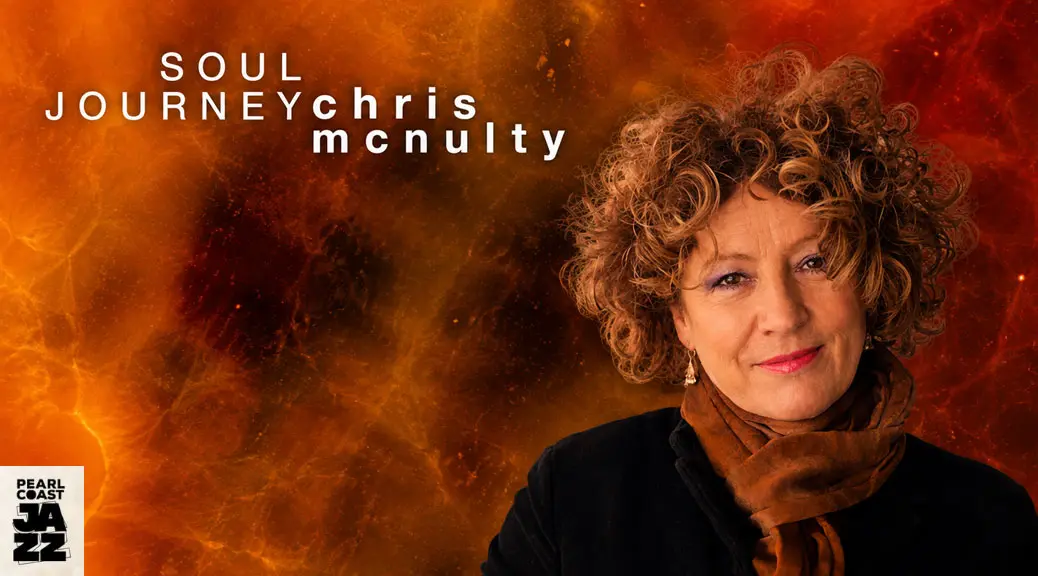
In the sprawling, often cyclical landscape of contemporary jazz vocal recordings, few releases arrive carrying as heavy a ballast of personal history, geographical displacement, and generational mourning as Soul Journey, the eighth studio album by acclaimed Australian-born vocalist Chris McNulty. Recorded in August 2025 at the Brian Brown Studios at the University of Melbourne and issued on her independent imprint, Pearl Coast Jazz, this 13-track compact disc marks a profound homecoming.
For McNulty, the album represents her first recorded project produced entirely on home soil following an illustrious, nearly three-decade career anchored in the fierce creative crucible of New York City. Yet, Soul Journey is far more than a geographical homecoming; it is a deeply reflective sonic monument. The album bears a poignant dedication to six towering figures of the vocal jazz firmament—Andy Bey, Jay Clayton, Nancy King, Sheila Jordan, Carol Sloane, and Mark Murphy—four of whom passed away within a harrowing thirty-month window just prior to the album’s sessions.
Balancing a dual musical identity, the record splits its runtime between a dynamic, textural ensemble featuring horns and a rhythm section, and intimate, exposed piano-vocal duets. While navigating themes of profound personal loss—including the memory of her sister who passed away in 2024 and her son Sam, whose tragic death in 2011 shaped her previous album, Eternal—McNulty delivers a masterclass in interpretive phrasing. Steering clear of traditional scat singing, she embraces an open-throated, wordless lyricism that places her firmly alongside contemporaries like Dianne Reeves, Carmen Lundy, and Rachelle Ferrell. Despite minor sequencing hesitations in its latter half, Soul Journey stands as an authoritative statement from a veteran artist reckoning with the passage of time, the weight of legacy, and the enduring power of song.
Detailed Chronology
The New York Decades and the Weight of History
Chris McNulty’s musical trajectory spans continents, eras, and stylistic boundaries. Her professional roots trace back to the vibrant pop, funk, and R&B bands of Melbourne during the 1970s. By 1978, she had pivoted decisively toward the jazz idiom, co-founding a dedicated jazz group with pianist Paul Grabowsky. However, it was her relocation to New York City in 1988—facilitated by an international study grant from the Australia Council—that forged her international reputation.
During her nearly thirty-year tenure in the global jazz capital, McNulty embedded herself in the upper echelons of the genre. A testament to her compositional and lyricist depth came in 1990, when her specially crafted lyrics for the legendary Miles Davis and Bill Evans ballad "Blue in Green" (from the seminal 1959 album Kind of Blue) were published as the song’s official words—settling, at least lyrically, a long-standing authorship debate.
McNulty’s artistic lineage is inextricably tied to the jazz aristocracy. Her career echoes historical convergences like those of Gary Bartz, who in late 1970 and early 1971 took the NTU Troop into Decca Studios in New York to record the landmark Harlem Bush Music volumes (Taifa and Uhuru), featuring the distinct vocal stylings of Andy Bey. Decades later, McNulty’s creative orbits would intersect with similar luminaries; her 2000s sessions for Dance Delicioso featured an all-star band comprising Mulgrew Miller, Gary Thomas, Billy Hart, Ugonna Okegwo, and Paul Bollenback—with Andy Bey counted among her lifelong peers and inspirations.
The Return to Victoria and Eternal
By 2015, McNulty’s American chapter drew to a close. She returned to her native Australia, settling into regional Victoria. That same year saw the release of her critically lauded Palmetto album, Eternal. Built as a poignant sonic monument around the memory of her son Sam, who passed away in 2011, Eternal featured eleven standards and a single original composition. Anchored by Steve Newcomb’s exquisite chamber orchestrations and a core rhythm section of John Di Martino, Ugonna Okegwo, and Gregory Hutchinson, the record showcased McNulty’s capacity to transmute unimaginable personal grief into transcendent art.
The Genesis of Soul Journey (August 2025)
Ten years after her repatriation, McNulty convened musicians at the Brian Brown Studios within the University of Melbourne in August 2025. Working independently under her Pearl Coast Jazz banner, she engineered an album that dramatically shifts the compositional balance: of the thirteen tracks featured on Soul Journey, seven are entirely her own originals.
The recording process unfolded under a remarkably heavy emotional shadow. The album’s liner notes carry an explicit dedication to six legendary vocalists:

- Mark Murphy: Passed away in October 2015.
- Carol Sloane: Passed away in January 2023.
- Jay Clayton: Passed away on the final day of December 2023.
- Nancy King & Sheila Jordan: Passed away within a week of each other in August 2025—precisely as McNulty was preparing or executing her studio sessions.
- Andy Bey: The sole living member of the dedicated sextet, and a foundational pillar of modern jazz vocal styling.
Additionally, the track "Beneath the Winter Sun" was penned in direct response to the loss of her sister in 2024, cementing Soul Journey as an audit of mortality, resilience, and creative survival.
Supporting Context & Metrics
Structural Anatomy of the Album
Soul Journey is structurally divided into two distinct sonic environments sharing a single compact disc release:
- The Ensemble Tracks (8 Songs): Built primarily around the core rhythm section of Brett Williams on piano and Ben Robertson on bass, supplemented dynamically by Lewis Pierre on drums. These tracks feature an intermittent, highly sophisticated horn section comprising Carl Mackey (tenor and soprano saxophones), Tony Hicks (flutes and clarinets), and Gianni Marinucci (trumpet and flugelhorn).
- The Piano-Vocal Duets (5 Songs): Intimate, stripped-back configurations. Four of these tracks feature pianist John Di Martino—the sole continuing instrumental thread from her previous album, Eternal—while the fifth duets with Brett Williams.
Track-by-Track Musical Breakdown
- "Secrets That We Keep": Serves as a welcoming, propulsive opener. The arrangement evokes the sophisticated harmonic colors of Carmen Lundy alongside the rhythmic and tonal buoyancy of Dianne Reeves during her late-1970s tenure with Caldera.
- "Elegy for Olga": Stripped down to Williams and Robertson, McNulty tackles this piece entirely without words. Eschewing traditional bebop scatting, she utilizes her voice to expose the raw melodic line itself, treating the human vocal cord as a pure, sustained horn.
- "Gratitude": The second and final wordless excursion on the album. It harkens back to the early 1990s jazz revival when artists pulled acoustic ensembles back into the physical room, highlighting a pristine acoustic balance between singer and band.
- "The Waiting Game": Framed exquisitely by Carl Mackey’s soprano saxophone, which eventually takes the lead before seamlessly handing the emotional core back to the vocalist.
- "The Blessing": A high-water mark of the ensemble tracks, cementing McNulty’s technical and emotional parity with any major jazz vocalist of the last thirty years.
- "Nothing Like You": Composed by Bob Dorough with lyrics by Fran Landesman—famously left stranded by Miles Davis at the tail end of his 1967 album Sorcerer—this track injects a welcome Latin-infused tempo and swing into the middle sequence.
- "Beneath the Winter Sun": A devastatingly effective bass-and-piano ballad written in mourning for her sister. It confirms that McNulty’s interpretive powers are magnified at slower, contemplative tempos.
- "Flying Still": Maintains the lingering, melancholic pace, bearing a vocal resonance that directly channels the spirit of the recently departed Sheila Jordan.
- The Duet Sequence ("Estate", "It Never Entered My Mind", "All My Tomorrows", "There’s No Such Thing As Love", "Alfie"): The final stretch transitions entirely into piano-vocal duets. While executed with unimpeachable technical skill, pieces like the Bacharach/David classic "Alfie" and the Anthony Newley/Ian Fraser tune lean into a dense, unbroken sequence of slow melancholy.
Official Statements
While traditional corporate press releases were sparse for this independent, artist-funded release, the liner notes and accompanying documentation of Soul Journey function as direct artistic statements from McNulty herself:
"To walk in the footprints of giants is to understand the fragility and the eternal nature of our shared breath. These songs are built from the ground of memory—for those who shaped our vocabulary, and for those family members whose absence re-draws the map of our daily lives."
Critical reception within the Australian and international jazz communities has underscored the album’s fearless engagement with grief. Reviewers have noted that McNulty’s decision to issue the project exclusively on physical compact disc via her own Pearl Coast Jazz label is a deliberate assertion of artistic sovereignty—refusing to pander to algorithmic streaming environments in favor of a tangible, archival listening experience.
Furthermore, jazz historian and critic perspectives have emphasized the lineage of Soul Journey:
"When you pull Chris McNulty’s catalog off the shelf, you are not simply listening to vocal jazz; you are engaging with an expatriate’s return who brings the hardened lessons of the New York bandstand into dialogue with the reflective, spacious landscapes of regional Australia."
Future Outlook
The release of Soul Journey initiates a fascinating new chapter in Chris McNulty’s fifth decade in music. Having successfully transitioned from the high-octane, competitive ecosystem of late-20th-century New York to the contemplative isolation of regional Victoria, her artistic output has become increasingly distilled, fearless, and self-reliant.
Industry Implications and Archival Legacy
- Independent Publishing Models: By utilizing Pearl Coast Jazz as an exclusive vehicle for physical CD distribution, McNulty signals a growing trend among veteran jazz artists who prioritize direct-to-fan archival permanence over transient digital metrics.
- Live Performance Integration: The intricate arrangements scored for the Melbourne ensemble—featuring players of the caliber of Brett Williams, Ben Robertson, and Carl Mackey—position the material ideally for targeted live suite performances across Australian cultural centers and international jazz festivals seeking authentic, acoustic storytelling.
- Vocal Pedagogy and Influence: As one of the few remaining standard-bearers of her specific generation of jazz interpreters—having outlived or memorialized many of her most cherished peers—McNulty’s approach to wordless melody and lyric translation serves as an essential blueprint for contemporary vocalists.
Ultimately, Soul Journey proves that Chris McNulty is an artist who refuses to coast on past accolades. By staring directly into the losses of her family and her artistic community, she has crafted a work that demands to be shelved alongside the masterworks of Rachelle Ferrell, Dianne Reeves, and Carmen Lundy—securing her enduring place in the global pantheon of jazz vocal art.