Executive Overview
In the contemporary landscape of improvised music, few albums manage to balance the wisdom of veteran mastery with the unpredictable electricity of youth quite like Corners, the latest release from legendary Italian trumpeter Enrico Rava. Recorded in July 2025 at Rome’s prestigious Auditorium Parco della Musica and produced by ECM Records mastermind Manfred Eicher, Corners is far more than a standard jazz recording. It is a masterclass in collective listening, an album built on profound mutual trust, and a living testament to the enduring vitality of European jazz.
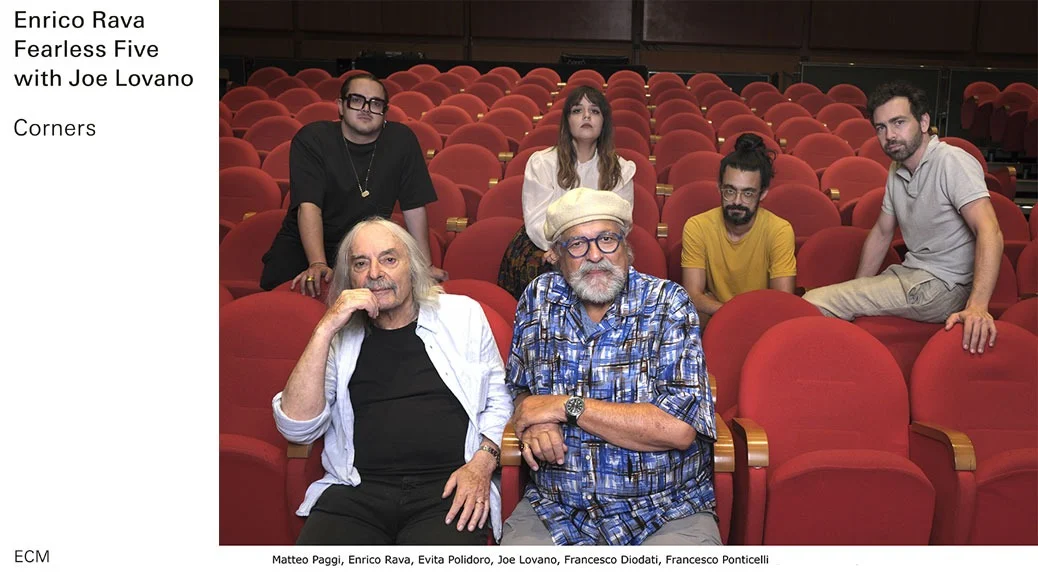
At the heart of the project is Rava, an artist who has spent over half a century defining and redefining the boundaries of lyrical improvisation. Yet, rather than resting on his laurels as a elder statesman of the genre, Rava has chosen to align himself with "The Fearless Five"—a dynamic, younger generation of musicians whose collective identity breathes fresh life into his compositions. Combined with the returning presence of American tenor saxophone titan Joe Lovano, Corners transcends generational divides to present a seamless, highly organic dialogue.
From the opening notes of "Certi Angoli Segreti" to the tender, closing sighs of Matteo Paggi’s "Mamma," the album captures a rare alchemy. It is an exploration of space, texture, and spontaneous composition, engineered with the pristine acoustic clarity that has become synonymous with the ECM catalog. This review provides a comprehensive look at the genesis, musical architecture, and cultural significance of an album destined to be remembered as a high-water mark in modern improvised music.
Detailed Chronology: From Roman Roots to ECM Immortality
To fully appreciate the scope of Corners, one must trace the winding path that brought this specific ensemble together. The story of The Fearless Five does not begin in a corporate boardroom or a rigid conservatory rehearsal room; it began almost by accident in the summer of 2022.
Genesis Outside Rome (2022)
During an open-air concert just outside the Italian capital, Enrico Rava found himself sharing a bill with a cadre of fiercely talented younger players: trombonist Matteo Paggi, guitarist Francesco Diodati, bassist Francesco Ponticelli, and drummer Evita Polidoro. Though separated by decades in age, Rava was immediately struck by the intuitive chemistry and fearless risk-taking of the ensemble. Rather than acting merely as a backing band for a veteran soloist, these four musicians functioned as a unified, telepathic organism. Sensing a rare spark, Rava made the immediate decision to adopt them as his primary touring and recording unit, christening them "The Fearless Five."
The Evolution of a Partnership: The Roma Precedent (2019)
The collaborative dynamic on Corners is also deeply informed by Rava’s ongoing creative partnership with Joe Lovano. Their artistic kinship was codified on the critically acclaimed 2019 ECM release Roma, a live album that showcased how effortlessly their contrasting voices could merge. While Roma proved that Rava’s airy, delicate lyricism could dance alongside Lovano’s earthy, expansive tenor, Corners takes that relationship a step further. It integrates Lovano fully into the ecosystem of Rava’s younger band, transforming a duo-fronted collaboration into a multi-generational summit.
The Recording Sessions at Auditorium Parco della Musica (July 2025)
The culmination of this artistic evolution took place in July 2025. Entering the acoustically revered Auditorium Parco della Musica in Rome, the octet—Rava, Lovano, and the Fearless Five—set out to capture lightning in a bottle. Working under the exacting ears of producer Manfred Eicher, the sessions were designed to prioritize space, dynamic range, and emotional truth over technical perfection. The resulting tracks document a group of musicians listening so intently to one another that composition and improvisation become entirely indistinguishable.
Supporting Context & Metrics: The Musicians, the Instruments, and the ECM Aesthetic
The Ensemble Anatomy
To understand the rich tapestry of Corners, one must examine the specific contributions of each player. The album’s democratic ethos is highlighted by the fact that composition duties are shared across the lineup, giving every member a vested structural interest in the music’s trajectory.

- Enrico Rava (Trumpet): With a career spanning collaborations with Steve Lacy, Gato Barbieri, and the pioneering days of the European free-jazz movement, Rava’s trumpet tone remains unmistakable. Economical, slightly fragile at the edges, yet carrying immense emotional weight, his playing is a masterclass in the power of negative space.
- Joe Lovano (Tenor Saxophone): As one of the most inventive voices in post-bop jazz, Lovano brings an earthy, muscular warmth that contrasts brilliantly with Rava’s celestial heights. His ability to navigate complex harmonic landscapes with organic blues phrasing grounds the ensemble.
- Matteo Paggi (Trombone): Paggi provides a darker, richer brass hue that fills the middle ground between Rava’s trumpet and Lovano’s tenor. His compositions, including the tender album closer "Mamma," demonstrate a mature grasp of melody and emotional resonance.
- Francesco Diodati (Guitar): Diodati weaves shimmering textures and sharp harmonic accents throughout the tracks. Eschewing flashy solos for atmospheric depth, his guitar work acts as the sonic glue holding the horn sections together.
- Francesco Ponticelli (Bass): Providing a rock-solid yet fluid bottom end, Ponticelli anchors the rhythm section while retaining the melodic agility required for avant-garde interaction.
- Evita Polidoro (Drums & Vocals): Polidoro is a revelation on Corners. Moving fluidly between delicate brushwork and explosive propulsion, she also contributes an unexpected vocal texture to her own composition, "Le Mie Gambe," fundamentally shifting the album’s sonic landscape.
Production and Acoustic Metrics
Recorded under the stewardship of Manfred Eicher, Corners adheres to the gold standard of ECM production. The recording prioritizes transient response and natural decay, ensuring that Rava’s breath against the mouthpiece, Lovano’s reed vibrations, and Polidoro’s subtle cymbal rolls are rendered with hyper-realistic fidelity. The acoustic environment of the Auditorium Parco della Musica provides a natural reverberation time that allows the music to "breathe," giving listeners the sensation of sitting directly in the room with the performers.
Track-by-Track Musical Analysis
The structural brilliance of Corners lies in its sequencing, moving fluidly from intricate ensemble interplay to moments of stripped-down intimacy.
- "Certi Angoli Segreti" (Secret Corners): The album opens with a bold statement of purpose. Rava’s melodic clarity sets the theme, quickly enveloped by Paggi’s dark trombone flourishes and Lovano’s weaving tenor lines. The rhythm section establishes a nimble pulse that invites continuous exploration.
- "Sun Rava": Penned by Joe Lovano, this piece acts as an abstract blues. It begins with familiar, reassuring contours before the ensemble systematically deconstructs the framework, allowing the soloists to venture into outer sonic spaces before gracefully returning home.
- "Tone, Shape and Colours": Perhaps the album’s most conversational piece, this track pits all three horn voices (Rava, Lovano, and Paggi) against one another in an agile display of counterpoint and spontaneous dialogue.
- "Hitchcock at the Beach": Injecting a dose of cinematic nostalgia, this track evokes a sense of sun-bleached mystery and gives Lovano ample room to stretch out his improvisational limbs.
- "Le Mie Gambe": Composed by Evita Polidoro, this track introduces a striking textural shift via Polidoro’s own vocal contributions, proving that the Fearless Five are unafraid to bend genre expectations.
- "Bowery Dance": A nod to Rava’s formative years in New York City, this composition marries an earthy, urban groove with the exploratory impulses of contemporary European jazz.
- "Mamma": Written by Matteo Paggi, the album closes on a note of pure, unadulterated tenderness, offering a soothing resolution to an otherwise adventurous sonic journey.
Official Statements and Critical Reception
While traditional press releases for jazz records often rely on hyperbole, the critical consensus surrounding Corners has been remarkably unified in praising its artistic integrity.
Jazz critics have particularly highlighted the seamless integration of generations. In early reviews, commentators have noted that Rava’s decision to hand over compositional space to the Fearless Five is a sign of a master artist secure in his legacy. Rather than dominating the proceedings, Rava acts as a curator of collective energy.
Furthermore, industry insiders have praised the ongoing collaboration between Rava and Manfred Eicher. In statements surrounding the release, Eicher has emphasized the "telepathic listening" required to capture such organic performances. "When musicians stop trying to impress and start genuinely hearing one another," Eicher noted during production notes discussions, "that is when ECM records are born."
Future Outlook: The Legacy of Corners in Modern Jazz
As the jazz world continues to grapple with the tension between hyper-commercialized crossover acts and hermetic academic exercises, Corners points toward a third, infinitely more rewarding path: collective human connection.
The release of this album cements Enrico Rava’s status not merely as a historical monument of European jazz, but as a living, evolving force. By betting on the Fearless Five and inviting Joe Lovano back into his inner circle, Rava has created a blueprint for intergenerational mentorship in music.
Looking forward, the tour supporting Corners is expected to bring these intricate, evolving compositions to major international jazz festivals throughout 2026 and beyond. For audiences fortunate enough to witness this ensemble live, the experience promises to be just as unpredictable and thrilling as the recording sessions in Rome. Corners is not just a collection of songs; it is a masterclass in listening—a reminder that in the right hands, jazz remains the ultimate conversation.