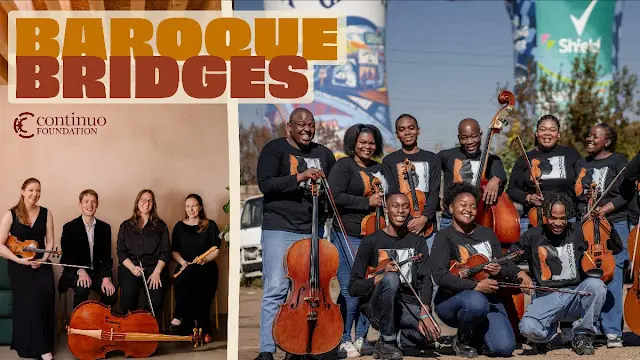
In a remarkable celebration of cross-cultural artistry, historical recovery, and geographical unity, the UK-based period instrument collective Ensemble Hesperi has joined forces with South Africa’s globally acclaimed Buskaid Soweto String Ensemble. Entitled Baroque Bridges, this collaborative concert series represents more than just a meeting of musical minds—it is a profound dialogue spanning centuries, continents, and genres. By juxtaposing the towering monuments of European Baroque music with vibrant African township traditions and works by pioneering Black European composers of the 18th century, the partnership shatters traditional boundaries of classical programming.
The tour features major performances at St Mary’s Church, Bathwick, in Bath on August 18, and St Giles Cripplegate in London on August 20. Additionally, the Buskaid ensemble will present a standalone program, Music Hath no Borders, at London’s historic Foundling Museum on August 21.
At its core, Baroque Bridges seeks to decenter the traditional European narrative of classical music while celebrating its universality. Audiences are treated to an eclectic, emotionally charged repertoire ranging from Johann Sebastian Bach, George Frideric Handel, and Jean-Philippe Rameau to Ignatius Sancho and Joseph Bologne, Chevalier de Saint-Georges. The grand finales of the collaborative concerts bridge the old and the new entirely, culminating in high-energy performances of Kwela—an infectious, groove-laden South African street music genre rooted in the anti-apartheid resistance—complete with dynamic choreography executed by the Buskaid musicians themselves.
Detailed Chronology
The Genesis of a Transcontinental Partnership
The seeds of Baroque Bridges were planted through artistic synergy, mutual respect, and a shared commitment to uncovering forgotten musical histories. Ensemble Hesperi, celebrated for its dynamic interpretations of 17th- and 18th-century repertoire on period instruments (harpsichord, baroque violin, and recorders), sought a partner that could breathe fresh life into historical performance practice.
Meanwhile, the Buskaid Soweto String Ensemble—originating from the heart of Diepkloof, Soweto—has spent over three decades cultivating world-class string players capable of seamlessly transitioning from Bach to contemporary Afro-pop and Amapiano.
The planning for Baroque Bridges involved months of transcontinental coordination, blending Ensemble Hesperi’s historical research into eighteenth-century Black composers with Buskaid’s peerless rhythmic vitality and virtuosic string technique. The resulting program is meticulously curated to demonstrate that music has always been global, interconnected, and porous.
Tour Itinerary and Key Dates
- August 18: St Mary’s Church, Bathwick (Bath)
The tour opened in the architectural splendor of Bath, where the soaring acoustics of St Mary’s Church provided an ideal backdrop for the shimmering textures of period keyboards, recorders, and strings. The opening night established the tone of the tour: an intimate yet exuberant exploration of how Baroque ornamentation and South African string warmth can coalesce. - August 20: St Giles Cripplegate (London)
Bringing the collaboration to the capital, the performance at St Giles Cripplegate drew classical music aficionados, culture critics, and curious listeners alike. The concert highlighted the technical precision of Ensemble Hesperi alongside the searing emotional resonance and razor-sharp ensemble cohesion of the Buskaid players. - August 21: The Foundling Museum (London) – Music Hath no Borders
Concluding the intensive London leg, the Buskaid Soweto String Ensemble took center stage for a standalone afternoon of music-making at the Foundling Museum. This institution, deeply tied to the legacy of Handel and 18th-century philanthropy, served as a poignant setting for a program highlighting the freedom and border-defying nature of musical expression.
Supporting Context & Metrics
The Legacy and Evolution of Buskaid
To fully appreciate the magnitude of the Baroque Bridges collaboration, one must understand the extraordinary origin story of Buskaid. The initiative began in 1991 when British viola player Rosemary Nalden learned about the desperate circumstances facing young string players in Diepkloof, one of the townships of Soweto, South Africa, during the twilight years of apartheid.
Mobilizing her professional network in the United Kingdom, Nalden orchestrated a simultaneous "busk" across sixteen British Rail stations. Exactly 120 professional musicians took part in the grassroots fundraising effort, which raised £6,000—a vital injection of capital that bought instruments, sheet music, and basic necessities for the township youths. The raw, emotional footage of this historic UK-wide busking event remains a testament to the power of artistic solidarity and can still be viewed on YouTube.
Recognizing that long-term transformation required physical presence and sustained mentorship, Nalden relocated permanently to South Africa in 1997. Two years later, in 1999, the dedicated Buskaid Music School was constructed in Diepkloof, providing a safe, state-of-the-art sanctuary for musical education.
What began as an elementary after-school string group has since evolved into the internationally celebrated Buskaid Soweto String Ensemble. Today, its members are recognized globally for their staggering versatility. Their performance portfolio spans:
- Standard Western classical masterworks
- Classic pop arrangements
- Afro-pop grooves
- Traditional South African township "vibes"
- Cutting-edge contemporary sounds, including South Africa’s modern dance music phenomenon, Amapiano
Expanding the Canon: Black Composers of the 18th Century
A defining feature of the Baroque Bridges program is its deliberate expansion of the standard European classical canon. Alongside household names like J.S. Bach, Georg Philipp Telemann, George Frideric Handel, Henry Purcell, and Jean-Philippe Rameau, the ensembles spotlight two brilliant composers of African descent who operated at the height of the European Enlightenment:
.jpg)
- Ignatius Sancho (c. 1729–1780): Born on a slave ship crossing the Atlantic, Sancho rose to become a British composer, actor, and writer of considerable renown. He was the first known Briton of African descent to vote in a parliamentary election and published several collections of popular songs, dance tunes, and keyboard works that captured the polite taste of 18th-century London.
- Joseph Bologne, Chevalier de Saint-Georges (1745–1799): Often dubbed the "Black Mozart," Bologne was a virtuoso violinist, prolific composer, brilliant fencing champion, and colonel of the St. George Legion (the first all-Black regiment in Europe) during the French Revolution. His violin concertos and symphonies concertantes showcase a dazzling Gallic elegance combined with fierce technical demands.
By integrating Sancho and Bologne into a program alongside Bach and Handel, Ensemble Hesperi and Buskaid do not merely diversify the playlist—they actively correct historical erasures, demonstrating that artists of color were integral to the fabric of European classical music centuries ago.
The Phenomenon of Kwela
The emotional crescendo of the collaborative concerts arrives with Kwela. Originating in the 1950s in the townships of South Africa, Kwela is an upbeat, swinging form of street music characterized by the lilting melodies of the pennywhistle, underpinned by driving guitar and bass rhythms.
During the dark decades of apartheid, Kwela served a dual purpose: it was a celebration of community resilience and a vehicle for coded anti-apartheid protest songs. In the hands of the Buskaid Soweto String Ensemble—who arrange the genre specifically for bowed strings and infuse the performance with authentic, high-energy African dance choreography—Kwela transforms the classical concert hall into a space of shared joy, physical liberation, and cultural triumph.
Official Statements & Artistic Perspectives
While specific press releases from Ensemble Hesperi and Buskaid emphasize the spirit of "building musical bridges across time, borders, and cultures," musicologists and cultural critics have been quick to praise the intellectual and artistic depth of the venture.
Artistic leadership from both ensembles has repeatedly stressed that Baroque Bridges is not an exercise in musical tourism or tokenism. Rather, it is an equal exchange of technical mastery and cultural heritage. Ensemble Hesperi brings the rigorous historical research, period-accurate ornamentation, and specific acoustic colorations of 17th- and 18th-century European instruments. In return, the Buskaid Soweto String Ensemble infuses the performance with a vibrant, living performance tradition that honors the rhythmic pulse of African music-making and proves that classical strings can swing, sway, and groove with unbridled authenticity.
Music critics reviewing the London and Bath performances have highlighted the palpable chemistry between the two groups. Observers noted that watching baroque violinists trade musical phrases with township-trained string prodigies offers a powerful visual and auditory metaphor for global harmony.
Future Outlook
The success of Baroque Bridges signals a transformative moment for both Ensemble Hesperi and the Buskaid Soweto String Ensemble, while setting a new benchmark for cross-cultural collaboration within the classical music industry.
As classical institutions worldwide grapple with the imperatives of decolonization, audience diversification, and historical reclamation, projects like Baroque Bridges offer a blueprint forward. Rather than watering down classical masterworks to attract new audiences, this collaboration elevates lesser-known historical narratives while meeting modern listeners with uncompromising artistic excellence and uninhibited joy.
Discussions are already underway regarding future recording projects and potential international tour extensions. For the young musicians of the Buskaid Music School in Diepkloof, platforms such as St Giles Cripplegate and the Foundling Museum represent proof that talent, when nurtured with passion and supported by global solidarity, knows no geographical limits.
Ultimately, Baroque Bridges is more than a fleeting concert series; it is a living testament to the fact that music—whether written in a Parisian salon, a London townhouse, or a Soweto township—remains the ultimate bridge between human souls.
For further information, ticketing details, and ongoing updates regarding Ensemble Hesperi and their collaborators, visit Ensemble Hesperi’s official artist page on Continuo Connect or explore the historical archives and ongoing community work of the Buskaid Trust.