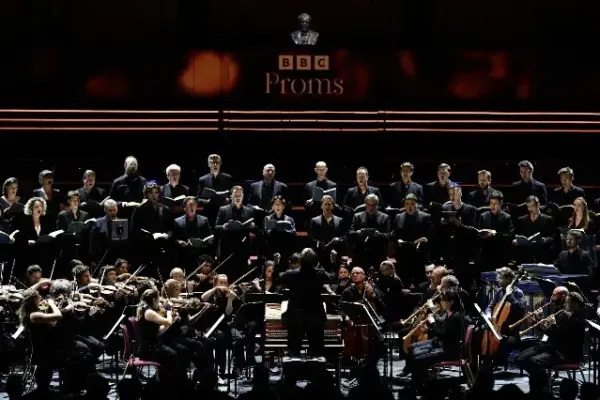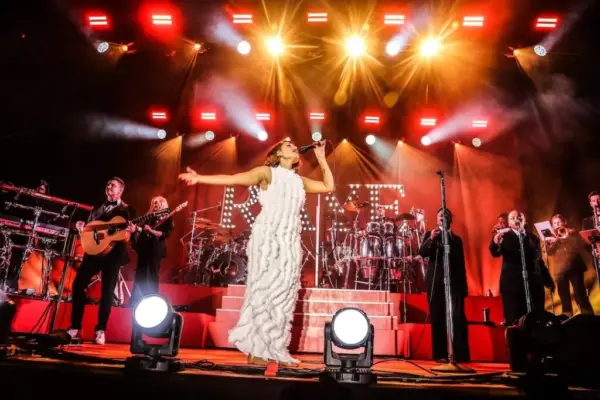
On August 30, 2026, the venerable Royal Albert Hall hosted one of the most intellectually and aurally stimulating events of the contemporary classical calendar: a period-instrument performance of Hector Berlioz’s idiosyncratic dramatic legend, La Damnation de Faust. Brought to the legendary stage by the acclaimed French period-instrument ensemble Les Siècles, under the sensitive yet rigorous baton of conductor Jakob Lehmann, the concert offered London audiences a rare luxury.
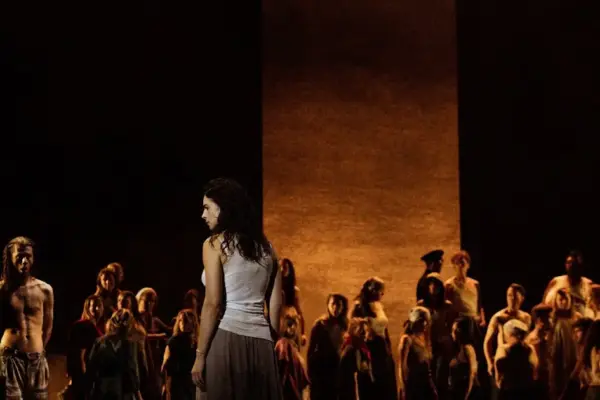
This performance served as a direct translation of the ensemble’s acclaimed staging at the Théâtre des Champs-Élysées in Paris under the direction of Silvia Costa. Yet, shorn of its theatrical trappings for the Proms, this iteration relied entirely on the sonic architecture of Berlioz’s orchestration and the vocal characterizations of a distinguished cast: John Osborn as Faust, Véronique Gens as Marguerite, Gerald Finley as Méphistophélès, and Thomas Dolié as Brander, supported by the formidable forces of the Chœur de Radio France and the Maîtrise de Radio France.
While the evening offered moments of breathtaking orchestral revelation—particularly through the distinct timbre of period instruments and Lehmann’s fastidious attention to dynamic nuance—the performance also invited critical reflection on the tension between concert-hall acoustics and theatrical intent. Navigating the vast, resonant expanses of the Royal Albert Hall without the crutch of physical staging, the ensemble delivered a masterclass in texture, color, and stylistic purity, even if certain philosophical dimensions of Berlioz’s sprawling masterpiece occasionally strained against the unyielding scale of the venue.
Detailed Chronology: From Paris to the Proms
The journey of La Damnation de Faust to the 2026 BBC Proms is intrinsically linked to the recent, tumultuous evolution of Les Siècles itself. Founded in 2003 by François-Xavier Roth, the orchestra carved a niche as a revolutionary force in period-performance practice, executing repertoire from the 17th century to the modern era on instruments appropriate to each epoch. However, institutional stability was shaken when allegations of inappropriate behavior led to Roth’s departure. Mirroring the structural resilience shown by institutions like the Monteverdi Choir and Orchestras under similar crises, Les Siècles swiftly restructured its governance.
.jpg)
The appointment of Italian maestro Antonello Manacorda as the new artistic director and conductor in June 2026 signaled a new dawn for the ensemble. Though Manacorda’s tenure will truly take flight later in the year, a coterie of guest conductors has maintained the orchestra’s exacting standards. Among them, Jakob Lehmann has emerged as a vital collaborator, praised widely for his historical insight and natural rapport with the players.
The Genesis of this specific performance traces back to the autumn of 2025, when Les Siècles and Lehmann premiered their collaboration on Berlioz’s score in Paris. Translating that conceptual rigor to the BBC Proms on August 30, 2026, required an artistic pivot. Stripped of Silvia Costa’s theatrical direction, the performance at the Royal Albert Hall was forced to stand purely on the merits of musical storytelling.
The evening’s chronology unfolded as a masterclass in atmospheric progression:
- Part I & II: Lehmann prioritized clarity over sheer bombast, guiding the ensemble through the pastoral openings into the brilliant, militaristic fervor of the Hungarian March.
- Part III: The intimate dialogues between Faust and Marguerite unfolded against a backdrop of gossamer-light orchestral accompaniment, highlighted by the aching lament of the cor anglais in “D’amour l’ardente flamme”.
- Part IV & Finale: The performance culminated in a spine-tingling descent into Hell, utilizing period brass and percussion to achieve a terrifyingly vivid, unvarnished sonic landscape that left the Proms audience spellbound.
Supporting Context & Metrics: Berlioz, Les Siècles, and the Royal Albert Hall
To fully appreciate the significance of this performance, one must examine the unique structural DNA of La Damnation de Faust and the logistical metrics surrounding its realization.
.jpg)
The Peculiar Genius of Berlioz
Berlioz’s relationship with the Parisian theatrical establishment was famously fraught. Never fully securing the mainstream commercial success his genius warranted, Berlioz frequently bypassed traditional operatic norms. La Damnation de Faust is a prime casualty—and beneficiary—of this artistic independence.
Originally conceived in 1829 as Eight Scenes from Faust, Berlioz vastly expanded and reworked the material in 1845 into what he designated a légende dramatique. Crucially, Berlioz did not intend the work to be staged; it was designed as a concert piece, freeing his imagination to traverse geographical and metaphysical boundaries without regard for theatrical staging constraints. The disastrous premiere at the Opéra-Comique in 1845 proved that contemporary audiences were unprepared for its genre-defying hybridity. It was only posthumously, following a triumphant complete concert performance in Paris in 1877, that the work secured its rightful place in the canon.
Proms History and Instrumentation Metrics
At the BBC Proms, complete performances of La Damnation de Faust remain comparatively rare. Before Sir Colin Davis led the London Symphony Orchestra in the work’s first complete Proms outing in 1962, programmers favored isolated orchestral excerpts such as the Hungarian March or the Dance of the Sylphs. The August 30, 2026 concert marked only the eighth complete performance in Proms history—a lineage that includes Sir Mark Elder’s legendary 1985 account.
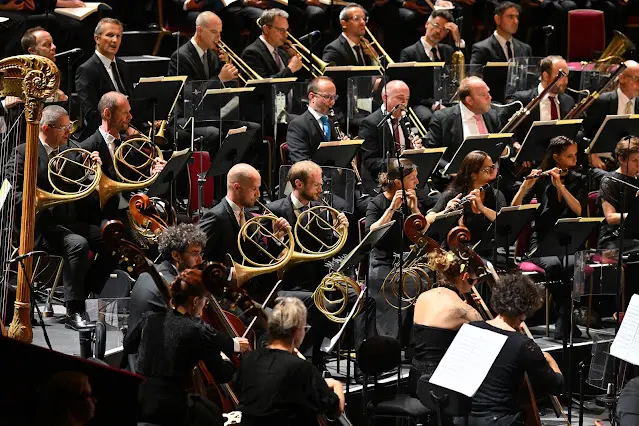
From an organological standpoint, Les Siècles brought a historically informed approach that reshaped the listener’s relationship with Berlioz’s orchestration:
.jpg)
- Harps: While Berlioz famously requested an opulent complement of eight to ten harps in his score, logistical realities and historical fidelity led Les Siècles to deploy four magnificent period Erard harps. Their distinct, silvery resonance provided an ethereal foundation to the celestial vocal writing.
- Wind and Brass: The use of 19th-century French instruments—characterized by narrower bores, distinct valve systems, and more direct, vocal tone qualities—allowed the brass to puncture the orchestral texture during the descent into Hell with razor-sharp intensity rather than modern, wall-of-sound bluster.
- String Section: Operating without modern heavy vibrato, the string section generated a transparent web of sound, rendering moments like the Dance of the Sylphs translucent and weightless.
Official Statements and Critical Perspectives
The critical reception of the concert highlighted the dichotomy between the peerless instrumental execution and the interpretive challenges faced by the vocal soloists within the cavernous acoustics of the Royal Albert Hall.
Conductor and Ensemble Vision
Jakob Lehmann, reflecting on his ongoing partnership with Les Siècles, has frequently emphasized the importance of erasing artificial divisions between historical performance and Romantic-era symphonic demands. In interviews leading up to the concert series, Lehmann noted:
"When you work with an orchestra whose instruments breathe the same chemical air as the ink on the composer’s manuscript, the score ceases to be an instruction manual and becomes a living dialogue. Berlioz demands absolute transparency, and period instruments naturally prune away the excess fat of late-19th-century performance traditions."
Vocal Performances Analyzed
The vocal casting offered a fascinating study in stylistic contrast, though critics noted that the transition from a staged Parisian run to an un-staged Proms concert exposed minor interpretive frictions.
.jpg)
- John Osborn (Faust): Osborn delivered a heroic, tireless vocal display, producing soaring, admirable lines throughout the evening. However, critics observed that in the opening philosophical soliloquies—prior to Méphistophélès’ entrance—Osborn occasionally lacked the focused intensity required to convey Faust’s profound mal d’isolement (isolation sickness). His performance gained dramatic traction in the third and fourth acts, culminating in a visceral response to the character’s transportation to damnation.
- Gerald Finley (Méphistophélès): Finley embraced the role with visible relish, walking the delicate stylistic tightrope between theatrical villainy and sophisticated irony. Eschewing pantomime, Finley utilized micro-nuances in text delivery to animate set pieces like the Song of the Flea with a sharp, satirical twinkle, ultimately anchoring the drama with chilling authority in Part Four.
- Véronique Gens (Marguerite): Casting Gens was widely hailed as an act of profound inspiration. Known primarily for her mastery of 17th- and 18th-century French repertoire, Gens brought a tremulous, highly vulnerable quality to Marguerite. Her rendition of “D’amour l’ardente flamme” was an exercise in subtle melancholy, prioritizing youthful naivety over grand operatic bombast, even if the vast expanse of the Albert Hall occasionally swallowed her most delicate pianissimos.
- The Choirs: Special commendation must be directed toward the Chœur de Radio France and Maîtrise de Radio France. Singing with impeccable French diction, the choruses negotiated Berlioz’s awkward, angular choral writing with extraordinary elan. The women and children created an unearthly, ethereal atmosphere in the final scenes, while the male contingent delivered a resonant, earth-shaking manifestation of the damned.
Future Outlook
The triumphant execution of La Damnation de Faust at the BBC Proms marks a pivotal milestone for Les Siècles as they consolidate their artistic identity under their new post-Roth operational model. By demonstrating that they can successfully transport large-scale, conceptually complex French masterworks from continental theatrical settings to major international festival stages without a loss of stylistic integrity, the orchestra has reaffirmed its status as a premier global ensemble.
Looking forward, the remainder of 2026 holds immense promise. With incoming Artistic Director Antonello Manacorda poised to take up the baton in December, the orchestra is expected to further cement its exploration of 19th- and 20th-century French masterworks. Collaborative partnerships with visionary guest conductors like Jakob Lehmann ensure that Les Siècles will continue to challenge orthodox approaches to standard orchestral repertoire.
For those who missed the live broadcast inside the Royal Albert Hall, the performance remains accessible via BBC Sounds for a limited window of 42 days—a digital archival footprint of an evening where Berlioz’s kaleidoscopic vision was granted its truest, most historically luminous iteration in decades. As period-instrument performance increasingly encroaches upon Late-Romantic territory, Les Siècles has set a formidable benchmark for authenticity, daring contemporary audiences to hear familiar masterpieces with entirely uncorrupted ears.