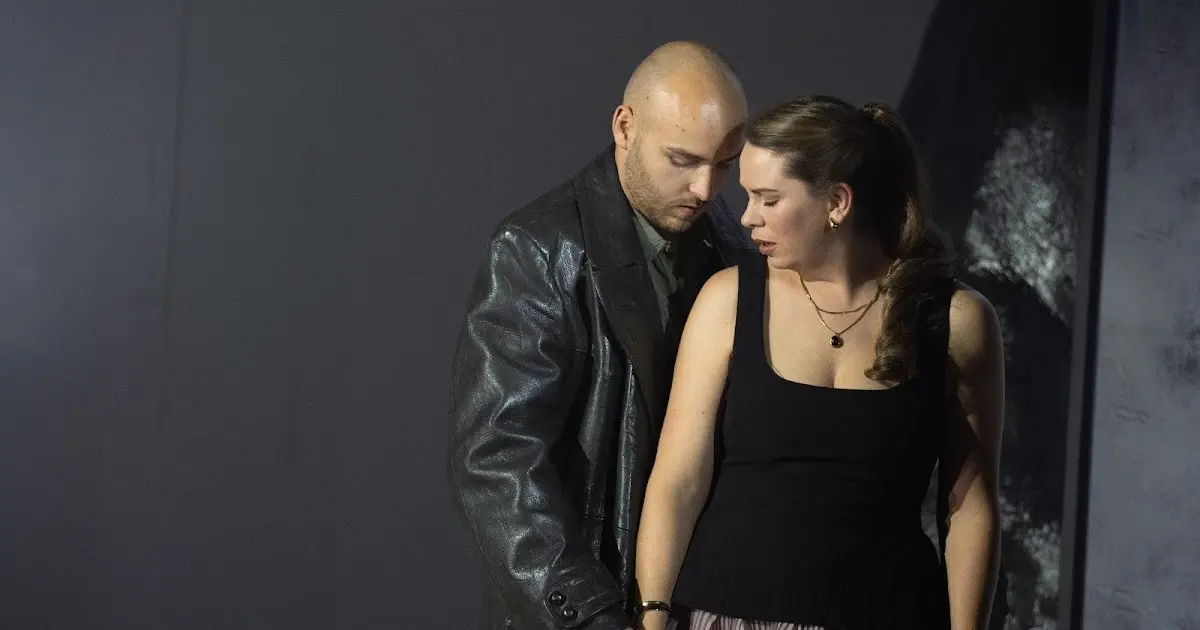
In its ambitious autumn touring season, the English Touring Opera (ETO) has firmly cemented its reputation for breathing vibrant, contemporary life into early masterworks. Following its striking modern staging of Gluck’s Orpheus & Eurydice, the company presented a compelling, emotionally charged double bill at the Hackney Empire on 17 October 2026. Pairing Elena Langer’s contemporary 2002 mono-drama Ariadne with Henry Purcell’s quintessential Baroque tragedy Dido & Aeneas, the ETO delivered a masterclass in conceptual cohesion, dramatic minimalism, and powerhouse ensemble performance.
Anchored by transcendent lead performances from Jessica Cale as Ariadne and Samantha Price as Dido, the double bill explored the psychological fallout of abandonment across an abstract, mythic present. Eschewing literal historical interpretations in favor of timeless theatricality, directors Anna Morrissey and Rebecca Meltzer collaborated with designer Alex Berry and lighting designer Joseph Hornsby to construct a shared visual language. The result was a seamlessly integrated evening of opera that tested the emotional boundaries of its tragic heroines while showcasing the extraordinary versatility of a multi-talented core ensemble.
Detailed Chronology & Production Analysis
Part I: Elena Langer’s Ariadne (2002)
The evening opened with Elena Langer’s striking Ariadne, a 2002 work originally commissioned during the composer’s residency at the Almeida Theatre, featuring a libretto by poet Glyn Maxwell. Conceived as a modern psychological counterpart to classical settings like Haydn’s Arianna a Naxos, Langer’s work is essentially a concentrated mono-drama. The action unfolds almost entirely within the fractured consciousness of Ariadne after she discovers the sudden, unexplained departure of her lover, Theseus.
Staging and Conceptual Design
Director Anna Morrissey and designer Alex Berry framed the psychological torment within a stark white box set, anchoring the musicians on a raised platform at the rear. The opera commenced with Ariadne (Jessica Cale) and Theseus (Kieron-Connor Valentine) sharing a bed on a movable platform. Without warning or fanfare, Theseus slipped silently away into the shadows.

While Valentine’s vocal contribution was restricted to a brief, haunting hallucination of Theseus’s voice in the final moments, his physical presence loomed large throughout the first half. Prowling the stage and periodically shifting Ariadne’s bed platform, Valentine embodied the intrusive, inescapable ghost of an ex-lover still occupying precious real estate in the protagonist’s mind.
Musical Execution and Performance
Jessica Cale delivered a tour-de-force performance as Ariadne. Holding the audience’s complete attention across a tightly wound, 15-to-20-minute monologue, Cale charted Ariadne’s trajectory from disbelief to deep distress without ever overplaying her hand. Her delivery was intensely personal, emotionally raw, and exquisitely paced.
Crucially, the instrumental ensemble acted almost as additional characters within the drama. Comprising just four musicians—Hannah Conliffe (oboe), Gary Ngan (violin), Hannah Gardiner (viola), and James Heathcote (cello)—the group brought Langer’s vibrant, inventive score to life. Led by the expressive capabilities of the oboe, the quartet functioned as a dynamic, musical Greek chorus, commenting on and amplifying Cale’s psychological destabilization with devastating accuracy.
Part II: Henry Purcell’s Dido & Aeneas
Following the interval, the evening shifted focus from the mythic island of Naxos to the legendary court of Carthage. Directed by Rebecca Meltzer and conducted by Alex Robinson, this production of Purcell’s Dido & Aeneas offered a distinct stylistic contrast to Ariadne, while maintaining the overarching theme of abstract, timeless myth-making.

Conceptual Vision and Aesthetics
In conversation ahead of the tour, mezzo-soprano Samantha Price noted that the production consciously avoided rigid Roman iconography in favor of a clean, universal aesthetic. Meltzer cleverly infused the staging with a subtle theatrical self-awareness, drawing inspiration from the opera’s earliest known performance at Josiah Priest’s boarding school for girls. Alex Berry’s costumes successfully nodded to this historical footnote while remaining distinctly stylish and modern.
The set design utilized the same white box from Ariadne, modified with a central platform and encircled by translucent screens. Meltzer made brilliant use of this architecture: Dido and Aeneas were almost perpetually visible, either center-stage surrounded by the court or lurking as silhouettes behind the glowing screens. This pervasive visual surveillance created a palpable undercurrent of claustrophobia and doom.
Vocal and Dramatic Masterclass
Samantha Price’s portrayal of Dido was a triumph of vocal control and emotional depth. Portraying a queen whose inner anxiety continually threatens to undermine her sovereignty, Price brilliantly mapped out Dido’s hesitant entry into her romance with Michael Lafferty’s Aeneas. Because a significant portion of Dido’s role relies on recitative and reaction, Price mined every line for psychological subtext.
In her iconic final scene, "When I am laid in earth," Price and Meltzer embraced a "less is more" philosophy. By allowing the stage to remain stark and still, the gravity of Dido’s despair was allowed to wash over the auditorium unchecked.

Michael Lafferty brought a grounded, steadfast inner strength to the role of Aeneas, a character often sidelined in traditional interpretations. By incorporating instrumental music from Purcell’s Diocletian immediately following the couple’s first scene, the production carved out vital dramatic space to establish genuine chemistry between Dido and Aeneas. Lafferty convincingly portrayed a figure whose protective presence briefly offered Dido sanctuary from her internal demons.
Supporting Roles and Ensemble Dynamics
The supporting cast delivered formidable work across the board. Isabelle Atkinson (Belinda) and Alexandra Meier (Second Woman) portrayed courtiers whose sycophantic cheerfulness slyly pressured Dido, denying her true isolation. Meanwhile, Lydia Shariff commanded the stage as a rich-voiced, deeply threatening Sorceress. Eschewing cartoonish villainy, Shariff’s Sorceress exercised authority through quiet menace, ably supported by Atkinson and Meier as her coven of witches—transforming into dark forces simply by donning dark glasses.
Kieron-Connor Valentine returned as a put-upon Spirit, while Guy Elliott injected levity as a charming sailor during a brilliantly anarchic sequence. In this scene, the male ensemble discarded their formal wear down to vests and boxer shorts, culminating in an exuberant, celebratory shower sequence celebrating their departure from Carthage—a masterclass in movement direction by Meltzer, who successfully wove physical choreography into the rhythmic fabric of Purcell’s score.
Supporting Context & Metrics
To fully appreciate the scope and logistical triumphs of the ETO’s autumn season, one must examine the collaborative infrastructure driving these productions:

- Touring Footprint: Bringing a technically demanding double bill to regional venues like the Hackney Empire requires a highly disciplined, flexible touring apparatus. The minimalist "white box" design by Alex Berry served as a brilliant economic and artistic solution, allowing instantaneous scene transitions while unifying two disparate operas under a single visual umbrella.
- Ensemble Economy: The core ensemble of eight singers handled all solo and choral duties in Dido & Aeneas, rotating seamlessly between courtly attendants, scheming witches, and unruly sailors. This repertory approach maximizes vocal consistency and theatrical synergy.
- Pit Mechanics: Under the baton of Alex Robinson, the Baroque ensemble drew out the dance rhythms inherent in Purcell’s writing. While acoustical challenges in a theater the size of the Hackney Empire inevitably left the continuo (harpsichord and theorbo) sounding slightly subdued, Robinson’s pacing allowed vocalists ample room to navigate complex recitatives.
Official Statements & Artistic Perspectives
The conceptual framework of the ETO’s autumn tour reflects a broader trend in contemporary opera toward stripping away historical ornamentation to reveal timeless human truths.
Discussing her approach to her debut run as Dido, Samantha Price emphasized the collaborative nature of the rehearsal room:
"The production is not specific to Roman mythology and they are aiming for a timeless feel. They want to present the plot as clearly as possible, particularly as there is not a lot of story."
This sentiment was mirrored in the directorial choices of Anna Morrissey and Rebecca Meltzer, whose background in movement direction profoundly influenced both stagings. Rather than relying on static tableaux or dated conventions, both directors utilized physical space, posture, and spatial relationships to exteriorize the internal conflicts of Ariadne and Dido. The integration of movement directors as primary conceptual drivers signals a healthy evolution in how early opera is adapted for modern theatrical audiences.

Future Outlook
The success of the ETO’s autumn double bill signals an exciting trajectory for the company as it continues its tenure as one of the UK’s most vital touring organizations. By proving that 17th-century Baroque masterworks and 21st-century contemporary mono-dramas can comfortably—and meaningfully—coexist on the same bill, the company has set a high benchmark for interpretive daring.
As the ETO looks toward future seasons, the methodologies tested in this production—namely, employing minimalist multi-use set design, leveraging rotating core ensembles, and placing physical movement at the heart of character development—offer a blueprint for sustainable, high-impact opera production. For audiences fortunate enough to catch the tour, the Hackney Empire performances will be remembered as a triumphant exploration of love, abandonment, and the enduring resilience of the human voice.