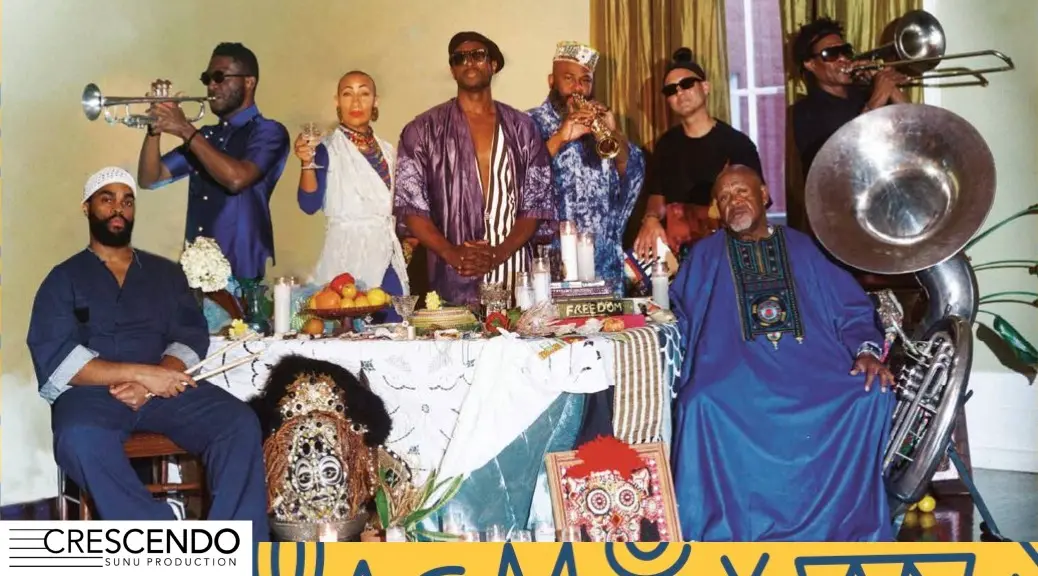
In the sprawling, interconnected landscape of contemporary global groove, few artists operate with the historical depth, technical mastery, and transnational vision of Senegalese bassist, composer, and bandleader Alune Wade. With the release of his seventh solo album, Family Affair, Wade delivers a masterclass in musical genealogy, drawing a direct, resonant line from the brass bands of his childhood in Dakar to the historic squares of New Orleans. Released on vinyl and CD on October 23, the album serves as the brilliant second chapter of a profound cultural exploration that began with his critically acclaimed 2025 project, New African Orleans, and its companion documentary, Tukki (the Wolof word for journey).
Coinciding with the drop of Family Affair, Wade has expanded his creative footprint through a companion print publication titled A Family Affair: Conversations Across the Atlantic—a bilingual book edited alongside New Orleans ethnographer Rachel Breunlin and published via the University of New Orleans Press. This multi-pronged release cements Wade’s status not merely as a virtuoso bassist who has held down the low end for global icons like Ismaël Lo, Joe Zawinul, and Marcus Miller, but as a vital cultural historian. By weaving together West African rhythms, American funk, Caribbean jazz, and New Orleans second-line traditions, Wade has crafted a sprawling, cohesive auditory testament that bridges centuries of diaspora, resilience, and artistic innovation.
Detailed Chronology
The Roots of a Transatlantic Journey: From Dakar to Louisiana
To understand Alune Wade’s sweeping sonic vision, one must first look to his formative years in Senegal. Long before the music of New Orleans entered his artistic lexicon, Wade was entirely immersed in a living brass band tradition within his own home. His father, Serigne Fallou Wade, was a celebrated French horn player and a standout star in the elite Senegalese Army band. Growing up surrounded by the rigorous discipline and soaring melodies of military brass, Wade internalized a sonic vocabulary that would later allow him to converse effortlessly with the marching bands and jazz pioneers of Louisiana.
When Wade eventually turned his attention toward the brass traditions of the American South, he was not adopting a foreign sound; rather, he was actively tracing both a family line and a sweeping historical continuum. This realization catalyzed his deep dive into the African roots of New Orleans music, culminating in the 2025 release of New African Orleans and the visual journey captured in the documentary Tukki. Family Affair takes its title directly from the network of master musicians, poets, and cultural ambassadors Wade gathered along his path, serving as the logical and exhilarating next chapter in his ongoing exploration.
Building a Global Pedigree: Lô, Zawinul, and Miller
Wade’s journey to becoming a global bandleader is anchored by a staggering apprenticeship alongside some of the most demanding and visionary architects of modern music. His professional life began in earnest when he was hired by legendary Senegalese singer-songwriter Ismaël Lô at the tender age of eighteen. Wade spent eight formative years under Lô’s tutelage, honing his stage presence, harmonic ear, and deep-pocket groove across international tours and recording sessions.
That foundational experience opened doors to the upper echelons of the global jazz fusion scene. The legendary Austrian keyboardist Joe Zawinul—co-founder of Weather Report—recognized Wade’s preternatural talent and brought him into the fold of the Zawinul Syndicate. Touring with Zawinul exposed Wade to complex, polyrhythmic jazz-fusion landscapes that demanded absolute technical precision and improvisational fearlessness.
In 2015, the trajectory of Wade’s career aligned with a lifelong dream when his boyhood hero, master bassist and producer Marcus Miller, tapped him to contribute to the Grammy-nominated album Afrodeezia. Working alongside Miller deepened Wade’s appreciation for the historical dialogue between African American jazz and its ancestral African roots, laying the groundwork for the conceptual frameworks that would eventually govern New African Orleans and Family Affair.
Track-by-Track Chronology and Sonic Analysis
Family Affair is an ambitious, structurally diverse record that demands active listening while offering immediate, infectious dancefloor appeal. The sonic journey unfolds across meticulously sequenced movements:
- “Damonzon”: The album opens with an epic historical celebration honoring Da Monzon, the early nineteenth-century Bambara king of Ségou. The track begins with Malian vocalist Mamani Keita singing passionately in her native tongue before New Orleans poet Sunni Patterson steps in. The music shifts gears, locking into a warm, soulful riff reminiscent of Curtis Mayfield. As the pace quickens, it lifts back into full-throated song driven by an unmistakable West African rhythm. In its final phase, Patterson returns with the urgency and poetic gravity of The Watts Prophets, filling the remaining minutes with spoken-word fire. For listeners seeking a synthesis of Wade’s entire aesthetic, this epic opener serves as the ultimate summary.
- “Black Booty”: The atmosphere pivots instantly as the rhythm explodes. Propelled by a high-octane charge from the horn section and keys, the track cuts loose without a moment wasted on polite introductions. Wade manages to slip in a street-schooled vocal introduction delivered in Wolof, setting up a collision between loose New Orleans swagger and a wall of soaring vocals. It is an undeniable party anthem destined to ignite live audiences.
- “Asase Yaa”: Named after the Akan earth goddess of fertility and earth, and dedicated to mothers everywhere, this track features the exceptional Ghanaian singer-guitarist Kyekyeku. Bouncy drums and West African coastal rhythms lay the foundation for a vibrant, multi-layered sonic tapestry that radiates warmth and reverence.
- “No One Like You”: Co-written and performed alongside bilingual vocalist Hindi Zahra, this track is tailor-made for international music festivals. Featuring a seamless interplay between male and female lead vocals, its universal melodic appeal ensures it will travel far beyond standard jazz and world music circles.
- “Escalade”: Wade’s profound musical debt to Marcus Miller resurfaces vividly here. The composition builds explicitly upon the harmonic and rhythmic themes of “Jean Pierre,” the iconic Miles Davis tune whose legendary bass line was famously carried by a 22-year-old Miller on the seminal 1982 live album We Want Miles. For a bass player, this represents a brilliant personal tribute nested inside a broader historical homage. The track opens with the resonant voice of Fela Kuti foreseeing the unstoppable rise of urban music across Nigeria, Congo, and South Africa. A dark, electric-bass-driven groove punctuated by sharp horn hits then takes hold in the unmistakable style of Stanley Clarke, unfolding into a masterclass of funk and Fender bass mastery.
- “Twelve Bells Chime Before Leaving Gorée Island”: A deep, resonant baritone shakes the album’s foundations as soaring Wolof lyrics float gracefully over a sparse, atmospheric sprinkling of piano and drums. Soon, a muscular electric bass and English spoken-word delivery take over, with Sunni Patterson recounting the agonizing fate of the captives forced through Gorée Island’s infamous "House of Slaves"—now Senegal’s most poignant memorial to the transatlantic slave trade. The sheer power of the delivery, backed by thunderous bass lines, makes it abundantly clear why Marcus Miller sought out Wade’s talents.
- “From Congo to Square”: Carried over as a thematic and spiritual continuation from New African Orleans, this track features soaring vocal performances by Tonya Boyd-Cannon. Driven by an interplay of acoustic piano and crisp drums, Boyd-Cannon’s voice dances around a robust jazz core, evoking the historic energy of Congo Square in New Orleans, where enslaved and free people once gathered on Sundays to drum, sing, and dance. The composition evokes memories of Salif Keita’s groundbreaking fusions, offering a deeply original and captivating arrangement.
- “Créolez-moi ça”: The album closes with a joyful reunion between Wade and Cuban pianist and composer Harold López-Nussa, his creative partner from their 2015 collaborative project Havana-Paris-Dakar. The title nods playfully to Édouard Glissant’s philosophical concept of Tout-Monde (the Whole-World). A shimmering layer of synthesizers introduces the track as the keyboard expertly navigates shifting rhythmic currents. A quirky reed instrument—sounding simultaneously like an acoustic clarinet and a synthesized tone—introduces a playful twist, leaning heavily into a Cuban montuno-inspired cadence. It serves as a brilliant, palate-cleansing conclusion to a massive auditory journey.
Throughout the album, the kinetic energy of legendary West African troupes like Touré Kunda is palpable. Every track delivers an uncompromising fusion that feels equally at home in an intimate jazz club, a sweaty dancehall, or a sprawling open-air festival ground.

Supporting Context & Metrics
The Transatlantic Dialogue: Music as Historical Archivism
To fully appreciate Family Affair, one must examine the socio-historical metrics underpinning Alune Wade’s creative output. The physical distance between Dakar, Senegal, and New Orleans, Louisiana, spans roughly 4,500 miles across the Atlantic Ocean—the very maritime highway traversed by millions of enslaved Africans during the horrific centuries of the transatlantic slave trade. Wade’s artistic mission is essentially an act of sonic repatriation. By mapping the shared DNA of West African rhythmic patterns and Louisiana second-line brass traditions, Wade demonstrates that these cultures were never truly separated; they merely evolved along parallel, converging tracks.
Production and Publishing Metrics
- Album Family Affair
- Catalog Placement: 7th Solo Album
- Release Date: October 23 (CD and Vinyl formats)
- Preceding Chapter: New African Orleans (Album, 2025) and Tukki (Documentary film)
- Companion Print Publication: A Family Affair: Conversations Across the Atlantic (Bilingual book, edited by Alune Wade and Rachel Breunlin, University of New Orleans Press)
- Key Collaborators: Sunni Patterson, Mamani Keita, Kyekyeku, Hindi Zahra, Tonya Boyd-Cannon, Harold López-Nussa.
- Notable Historical Mentions: Serigne Fallou Wade, Miles Davis, Marcus Miller, Fela Kuti, Stanley Clarke, Curtis Mayfield, Édouard Glissant.
Official Statements
While Alune Wade has historically allowed his compositions and basslines to speak on his behalf, the conceptual rigor behind Family Affair and its companion book, A Family Affair: Conversations Across the Atlantic, is clearly articulated through his collaborative and archival endeavors. Co-editor Rachel Breunlin of the University of New Orleans Press emphasizes the importance of oral histories and cross-cultural dialogue in grounding the musical project:
"This partnership is not merely about tracing notes on a page or rhythms across a map; it is about documenting the living, breathing human stories that survived the Middle Passage and continue to thrive in the modern musical landscape. Alune’s bass acts as a connective tissue, pulling together voices from Dakar, Paris, Havana, and New Orleans into a single, unified cultural conversation."
In interviews surrounding his relentless international touring schedule, Wade has frequently reflected on the ancestral duty incumbent upon African artists working within global jazz and improvised music:
"When you pick up an instrument in West Africa, you are carrying the weight of generations who used rhythm and song to preserve their dignity, their memory, and their joy. Going to New Orleans wasn’t discovering something new for me; it was looking across the ocean and finally seeing family waving back from the other shore."
Future Outlook
With the official release of Family Affair on vinyl and CD, alongside the publication of his bilingual book with the University of New Orleans Press, Alune Wade enters a new zenith of his international career. The project has successfully expanded the boundaries of what modern world-jazz and pan-African fusion can achieve, earning critical acclaim for its fearless blending of historical gravity and contemporary dancefloor energy.
Looking ahead, Wade’s touring schedule is set to bring these complex sonic tapestries to life across the globe. He is slated to headline a high-profile performance at London’s iconic Ronnie Scott’s Jazz Club on November 20, where fans can expect to witness the explosive energy of tracks like “Black Booty” and “Escalade” rendered in real-time.
As Wade continues to tour Family Affair and New African Orleans, his work points toward an increasingly interconnected future for global music—one where genre boundaries dissolve entirely in the face of shared ancestral rhythms. For scholars, bass enthusiasts, and festival-goers alike, Alune Wade has firmly established himself as an essential sonic historian of our time, proving that the transatlantic bridge he walks is stronger, louder, and more vibrant than ever before.