Executive Overview
After a grueling, half-decade-long wait that tested the patience of electronic music producers, hardware enthusiasts, and modular tinkerers alike, Behringer has finally opened pre-orders for the BCR32 MIDI Controller. First teased on social media back in 2021 as a spiritual and technological successor to the legendary BCR2000, the BCR32 modernizes a cult-classic design that originally debuted over two decades ago.
Priced accessibly at £142 (inclusive of VAT) via major European retailers like Thomann, the BCR32 bridges the gap between vintage charm and contemporary workflow efficiency. The unit’s headline feature is a direct, officially integrated collaboration with ZAQ Audio, bringing the celebrated Zaquencer firmware natively to the hardware. This integration allows users to seamlessly pivot between a traditional parameter-mapping MIDI controller and a powerful, standalone 32-step hardware sequencer without requiring complex software workarounds or third-party modifications.
As the industry shifts back toward tactile, hands-on control surfaces away from mouse-and-keyboard grid clicking, the arrival of the BCR32 could not be more timely. This comprehensive report explores the chronological development of the project, the technical specifications that make the BCR32 a formidable studio asset, its deep-rooted connection to electronic music history—including its association with French electronic music royalty Daft Punk—and what this release signals for the future of budget-friendly music production gear.
Detailed Chronology: From the BCR2000 Legacy to the BCR32 Genesis
To understand the immense anticipation surrounding the BCR32, one must look back at the instrument’s lineage. Released in 2004 by Behringer, the original BCR2000 (alongside its sibling, the motorized-fader BCF2000) arrived at a transitional time in music technology. As Digital Audio Workstations (DAWs) and virtual instruments (VSTs) began dominating production setups, producers found themselves yearning for tactile physical control over software parameters.
The Cult Classic of the 2000s
The BCR2000 answered this call with an army of 32 endless rotary encoders, illuminated LED rings, and a litany of programmable buttons, all wrapped in a robust, utilitarian plastic chassis. While Behringer was sometimes viewed through a different lens by the purist audiophile community at the time, the BCR2000 achieved undisputed cult-classic status. Its appeal stemmed from a rare combination of rock-bottom pricing, deep programmability, and MIDI implementation flexibility that rivaled units costing three times as much.
Crucially, the BCR2000 found its way into the touring and studio rigs of some of the world’s most elite electronic music acts—most notably Daft Punk. The French duo utilized modified BCR2000 units during their legendary Alive 2007 tour era, cementing the controller’s reputation as a serious, professional-grade performance tool despite its budget-friendly pedigree.
The Five-Year Development Odyssey
By the late 2010s, the BCR2000 had been discontinued for years, leaving a gaping void in the market for an affordable, high-density rotary controller. Aging units suffered from failing USB ports, wear-and-tear on encoders, and incompatibility with modern operating systems.
- The 2021 Announcement: In a surprise social media post, Behringer announced it was officially revisiting the classic design. The company revealed it was developing the BCR32, promising a modern overhaul.
- The ZAQ Audio Partnership: Crucially, Behringer announced a partnership with ZAQ Audio, the masterminds behind the "Zaquencer"—an enormously popular third-party alternative firmware that transformed the original BCR2000 into a fully-fledged 32-step sequencer.
- The Protracted Silence: Following the 2021 teaser, the project entered a period of prolonged radio silence. Component shortages, global supply chain disruptions, and the massive logistical hurdles faced by Behringer’s parent company, MusicTribe, pushed the release window further and further out, testing the patience of the electronic music community.
- The 2025/2026 Pre-Order Breakthrough: Five years after its initial announcement, the BCR32 has finally materialized on retail platforms like Thomann, with stock expected to land within a 12-to-15-week delivery window.
Supporting Context & Technical Metrics
The Behringer BCR32 is not merely a cosmetic dusting-off of a 2004 mold; it has been systematically updated under the hood to meet the demands of modern hybrid setups, modular synthesizers, and DAW-centric studios alike.
Hardware Architecture and Interface
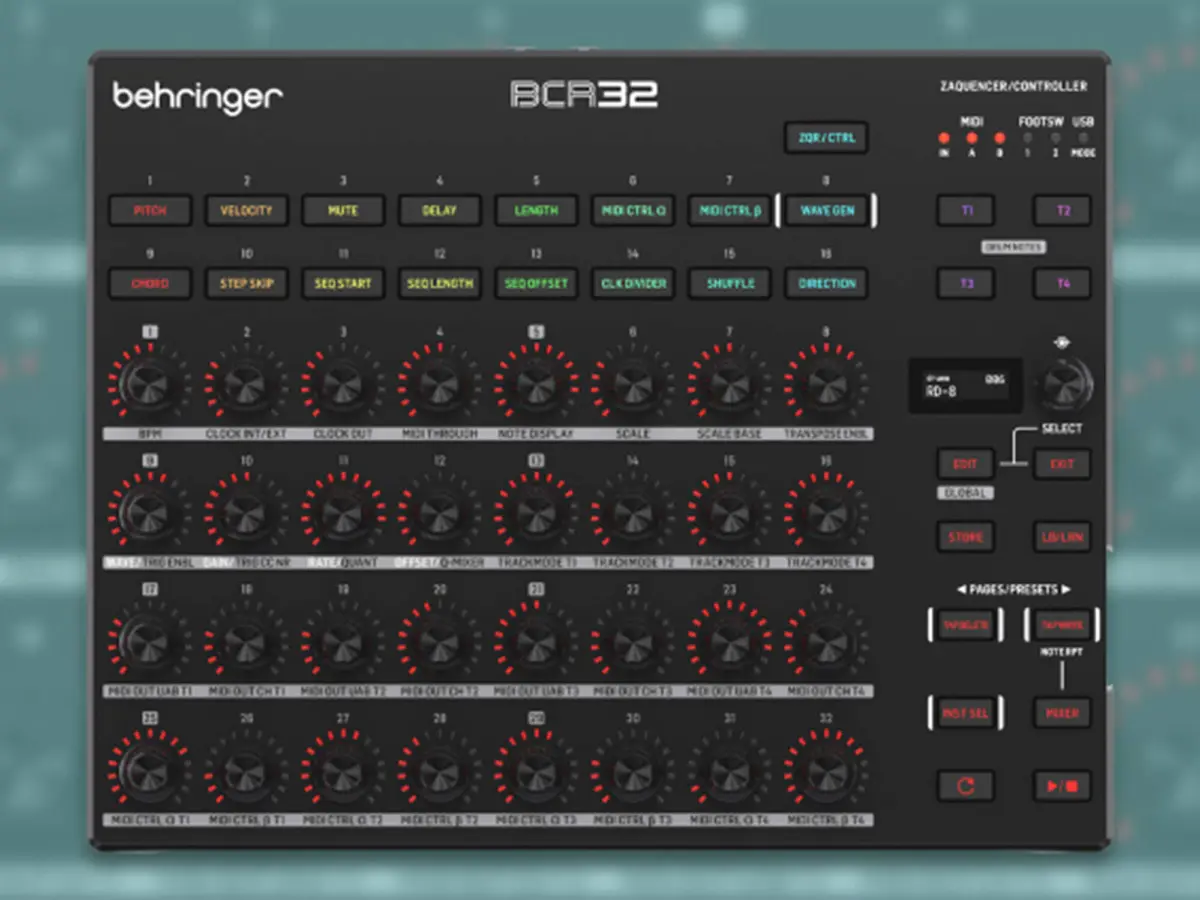
At the core of the BCR32’s interface are 32 freely assignable multifunction rotary controls. Each encoder is encircled by an LED color-coded ring, providing immediate visual feedback of parameter values, patch states, or sequence steps. This visual acuity is vital in dark club environments or complex live performance rigs where glancing at a computer monitor breaks the creative flow.
Complementing the main encoder matrix are:

- Eight push encoders equipped with dual functionality for deep menu diving and secondary parameter assignment.
- 20 fully programmable buttons for triggering clips, muting tracks, switching banks, or executing macro commands.
- A crisp, high-contrast OLED display that provides essential parameter feedback, bank locations, and routing data without cluttering the workflow.
The Zaquencer Integration: Best of Both Worlds
The most revolutionary aspect of the BCR32 hardware is the native implementation of the Zaquencer firmware. Historically, users of the original BCR2000 who wanted to use the Zaquencer had to manually flash the device’s EPROM, voiding standard workflows and dedicating the hardware exclusively to sequencing.
With the BCR32, ZAQ Audio’s legendary 32-step sequencer architecture is built directly into the DNA of the machine. Users can seamlessly switch between Traditional Controller Mode (ideal for mapping to VST plugins, hardware synth CCs, and DAW mixers) and Sequencer Mode (transforming the 32 encoders and buttons into a powerful pattern-based composition tool) on the fly, without altering system files or rebooting the hardware in maintenance modes.
Under-the-Hood Specifications
- Pattern Storage: The BCR32 allows users to store up to 192 patterns internally, making it a robust standalone compositional scratchpad.
- MIDI Routing Capabilities: The unit supports two independent MIDI controls per track (encompassing Program Change, Aftertouch, Pitch Bend, and continuous controllers/CCs).
- Virtual Encoder Groups: To maximize the utility of the 32 physical knobs, the device features four virtual encoder groups, effectively multiplying the controller’s physical surface area into a massive matrix of assignable parameters.
Official Statements and Industry Impact
While Behringer has traditionally relied on community-driven forums and social media channels to gauge interest and roll out product updates, the collaborative nature of the BCR32 project highlights a notable shift in how major budget-gear manufacturers interact with independent firmware developers and third-party innovators.
Bridging the Corporate and Open-Source Divides
When third-party developers like ZAQ Audio create alternative firmware for hardware instruments, it typically exists in a legal and technical gray area. Developers write code out of passion, often unsupported by the original corporate entity. By officially collaborating with ZAQ Audio for the BCR32, Behringer has set an intriguing precedent: acknowledging, legitimizing, and financially compensating the independent developer ecosystem that keeps legacy hardware relevant.
Industry analysts have noted that the BCR32 arrives at a unique moment in the gear market. While boutique synthesizer and controller manufacturers frequently target high-end, luxury pricing tiers—often pushing MIDI controllers well past the £500 to £1,000 mark—Behringer continues to aggressively target the accessible market. At £142 inclusive of VAT, the BCR32 undercuts nearly all direct hardware competition that offers a comparable density of endless encoders and integrated sequencing power.
Future Outlook: What the BCR32 Means for Hybrid Production
As electronic music production increasingly adopts a "hybrid" methodology—combining the flexibility and recall of software plugins with the tactile joy of hardware synthesizers and analog rhythm boxes—the demand for high-capacity control surfaces is skyrocketing.
The Ergonomic Renaissance
For years, producers have complained about the ergonomic limitations of modern MIDI keyboards, which often only feature eight rotary knobs and nine basic faders. While modular synthesizers offer ultimate hands-on control, the financial barrier to entry is steep. Devices like the BCR32 democratize deep parameter control, allowing bedroom producers and live performers to map cutoffs, resonances, envelope timings, effects sends, and mixer channels to dedicated physical controls without staring at a screen.
Market Availability and Rollout
As of writing, the Behringer BCR32 is live on Thomann (operating under MusicTribe’s broader retail and distribution network), with estimated delivery windows hovering between 12 and 15 weeks. Given the pent-up demand accumulated over the five-year development cycle, initial production runs are expected to move swiftly. Prospective buyers are advised to monitor retail channels closely to secure units from the first wave of manufacturing.
Conclusion
The Behringer BCR32 is far more than a delayed product release; it is the resurrection of an industry icon equipped for the modern era. By honoring the legacy of the BCR2000, integrating the genius of ZAQ Audio’s Zaquencer, and maintaining an aggressively affordable price point, Behringer has delivered a tool that will likely find a home in studios and live rigs across the globe for the next decade. Whether you are seeking a master controller for your software plugins, a tactile mixing surface, or a standalone MIDI sequencing brain for a hardware-heavy live setup, the five-year wait for the BCR32 appears to have been well worth it.