Executive Overview
When modern minds wander back to the landscapes of medieval England, a familiar cast of characters usually steps forward: armored knights clashing on horseback, towering stone fortresses draped in banners, and mud-splattered peasants tilling the feudal soil. Yet, historical orthodoxy is continuously challenged by the relentless excavation of forgotten archives and long-buried bones. New interdisciplinary research combining archaeological science, radiocarbon dating, and deep archival analysis reveals a startling addition to the medieval British menagerie: the bear.
Long before Elizabethan playhouses hosted the gruesome spectacles of bear-baiting that rivaled Shakespearean theater, the ursine presence was already growing across English towns and villages. While wild bears had vanished from the British Isles by the Bronze Age, they made a dramatic, highly managed return in the wake of the 1066 Norman Conquest.
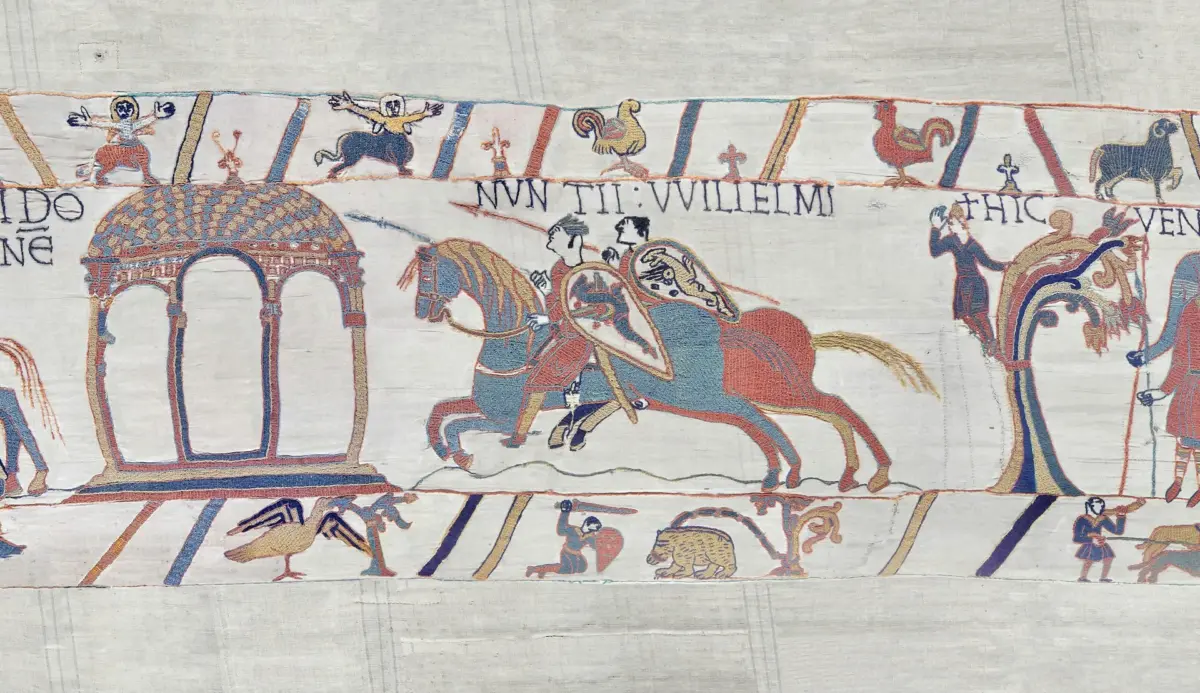
Hidden in plain sight on the margins of the world-famous Bayeux Tapestry—inscribed in the illuminated borders of medieval manuscripts and recorded in early financial rolls—the bear was far from a mere mythical fancy of medieval illustrators. It was a living, breathing creature imported from continental Europe, integrated into aristocratic pageantry, and woven into the socioeconomic fabric of post-conquest Britain. This investigation explores how the Norman invasion catalyzed a sweeping ecological and cultural shift, paving the way for centuries of brutal animal-baiting traditions and altering our fundamental understanding of medieval life.
Detailed Chronology: From Extinction to the Norman Renaissance
To understand the trajectory of bears in England, historians must look across millennia, tracking a narrative that swings wildly from prehistoric native extinction to high-medieval importation and early modern commercial entertainment.
Prehistoric Roots and Roman Resurgences
Thousands of years ago, wild brown bears (Ursus arctos) roamed the dense, untamed forests of Britain. However, a combination of shifting climates, expanding human settlements, and relentless hunting drove the native population to extinction by the Bronze Age.
While historical and archaeological traces suggest that the Roman occupation may have briefly reintroduced bears to the island for use in amphitheater blood-sports, these populations failed to establish a permanent, self-sustaining wild ecosystem once the Roman legions withdrew. For centuries, the island remained entirely bear-free, existing as a place where the creature lived on only in inherited folklore, distant rumors, and travelers’ tales.
The 1066 Watershed and the Domesday Clues
The tectonic geopolitical shift of 1066—when William the Conqueror successfully invaded England—did more than rewrite the ruling class and restructure land ownership; it also transformed the island’s fauna management. The Normans brought with them continental tastes, continental administration, and continental animals.
The earliest documentary proof of this post-conquest shift is preserved in the Domesday Book, the grand survey commissioned by William the Conqueror in 1086. The record reveals that the city of Norwich was obligated to provide the monarch, King Edward the Confessor (and subsequently the Norman crown), with an annual tribute consisting of one bear and six dogs. This single administrative entry provides a vital historical anchor: bears were being imported, maintained, and utilized by the highest echelons of power in immediate post-conquest England.
The 12th to 16th Century: Dancing Bears and Aristocratic Feasts
By the 12th century, the presence of bears had expanded from exclusive royal tributes into a broader aristocratic and urban phenomenon. Archival records from northern France and Anglo-Norman England describe bears being paraded alongside boars and bulls during royal weddings, military victories, and aristocratic feasts.
These events featured bear-dancing—where animals were trained to stand on their hind legs and move to music—and early forms of animal baiting. Illuminated manuscripts from the era frequently depict bears in the margins, playing musical instruments, walking upright, or tumbling. Far from being random doodles, these marginalia reflect an increased public familiarity with captive bears performing in town squares, churchyards, and marketplaces.
The Early Modern Peak: Celebrity Bears and Elizabethan Spectacle
By the 1500s, the practice of bear-baiting had matured into a booming commercial entertainment industry. English towns from London to Yorkshire boasted their own "celebrity" bears, hauled from town to town by professional handlers known as bearwards.
These animals—often referred to in contemporary accounts as "Russian bears"—were imported as young cubs from Eastern Europe, specifically raised and conditioned to fight packs of specially bred mastiffs. Names like George Stone and Little Bess of Bromley echo down through the sixteenth-century records, testifying to the individual fame these animals achieved among spectators who paid standard admission fees of one to two pence.
The sport reached the highest levels of statecraft. In July 1575, Queen Elizabeth I was famously entertained by a magnificent, multi-day spectacle of bear and bull baiting hosted by Robert Dudley at Kenilworth Castle. The popularity of the Southbank bear gardens in London eventually rivaled, and frequently eclipsed, the burgeoning theatrical scene of the era, cementing the bear’s place in early modern British culture until shifting moral sensibilities ultimately forced the blood-sport underground.
Supporting Context & Metrics: The Science of the Bear
The rewriting of this historical narrative relies heavily on cutting-edge interdisciplinary science. For decades, historians debated whether medieval artistic depictions of bears were allegorical symbols or accurate reflections of reality. The integration of archaeology, zoology, and advanced dating techniques has definitively settled the debate.
Interdisciplinary Analysis of the Archaeological Record
Recent scientific breakthroughs have successfully identified and dated medieval bear remains across England and northern France. A cornerstone of this research involved advanced radiocarbon dating applied to a bear shoulder blade unearthed at Richmond Castle in North Yorkshire.
[Timeline of Bear Presence in Britain]
-----------------------------------------------------------------
 Bronze Age          : Native wild bear populations go extinct
 Roman Era           : Sporadic, temporary imports for arenas
 1086 (Domesday)     : First post-conquest record (Norwich tribute)
 12th Century        : Established aristocratic baiting & dancing
 16th Century        : Peak commercial industry (Southbank, Elizabethan era)
-----------------------------------------------------------------
The results demonstrated beyond doubt that captive bears were present in the immediate post-conquest north of England. Similar osteological evidence has been recovered from high-status administrative and aristocratic sites, such as the palace of Les Hallettes at Compiègne in France, proving an interconnected Anglo-Norman network of animal trade and transport.
Economic and Logistical Metrics of Bear-Baiting
The scale of the early modern bear industry reveals a complex logistical network:
- Importation Costs: Cubs were captured in Eastern Europe and transported thousands of miles across land and sea to be raised in English stables.
- Ticket Pricing: By 1562, general admission to urban bear-baiting events in London was standardized at one to two pence, making the spectacle accessible to a broad cross-section of society.
- Asset Value: Bears were valuable economic assets for bearwards. During the catastrophic Great Fire of Nantwich in Cheshire during the winter of 1583, local handlers hurriedly unlocked stables to rescue their bears from the flames, prioritizing the survival of these expensive working animals over other property.
Official Perspectives & Academic Insights
The resurgence of medieval bear studies stems from collaborative research spearheaded by leading historians and archaeologists specializing in human-animal relations.
Dr. [Lead Researcher], co-author of the recent study published in Antiquity, emphasizes that modern perceptions of the Middle Ages are often distorted by the sanitizing lens of fiction and selective preservation.
"When we look at historical artifacts, we tend to see what we expect to see—knights, castles, and religious devotion," notes the research team. "But the small, overlooked details, like the bear tucked away in the lower margin of the Bayeux Tapestry, speak to a much richer, stranger ecological reality. Medieval England was a place where citizens could—and frequently did—encounter exotic, imported apex predators in their local marketplaces."
Art historians studying the Bayeux Tapestry—an embroidered masterpiece over 70 meters long detailing the events leading up to the Norman Conquest—have long debated the symbolic function of its marginal figures, known as fables or drolleries. Scene 11, which features a man raising a sword toward a rearing bear directly beneath the main political negotiations between Duke William and Guy Turold, has historically been dismissed as whimsical border decoration.
However, current historical consensus posits that these marginal vignettes frequently functioned as sly commentaries, moral satires, or direct reflections of contemporary elite culture. By aligning the tapestry’s imagery with the newly uncovered Domesday entries and archaeological bone fragments, researchers have demonstrated that the bear in the tapestry was an early artistic nod to the rising cultural currency of the animal under Norman rule.
Future Outlook: Re-imagining the Middle Ages
As museums and heritage organizations prepare for major cultural exhibitions—including the anticipated public display of the Bayeux Tapestry in London—the implications of this research extend far beyond academic journals.
The integration of zooarchaeology and historical archives challenges curators and educators to present a more visceral, complex, and environmentally dynamic Middle Ages. Visitors walking through gallery exhibitions will be encouraged to look past the romanticized tropes of chivalry and chivalric romance, confronting instead a world where globalized trade networks—even in the 11th century—facilitated the movement of dangerous, exotic wildlife across European borders.
Future research initiatives will continue to utilize stable isotope analysis and ancient DNA (aDNA) testing on recovered bear bones to pinpoint the exact geographic origins of these imported medieval beasts, tracking migration routes from the forests of Scandinavia and Eastern Europe straight to the heart of English shires.
Ultimately, this ongoing historical excavation serves as a humbling reminder of how much remains unknown about our past. The next time history enthusiasts visualize the muddy tracks and bustling courtyards of a medieval English town, they must populate the scene not only with merchants, monks, and squires, but with the heavy, shuffling gait of a Norman bear.