By Danai Molocha
Published: October 22, 2026
Executive Overview
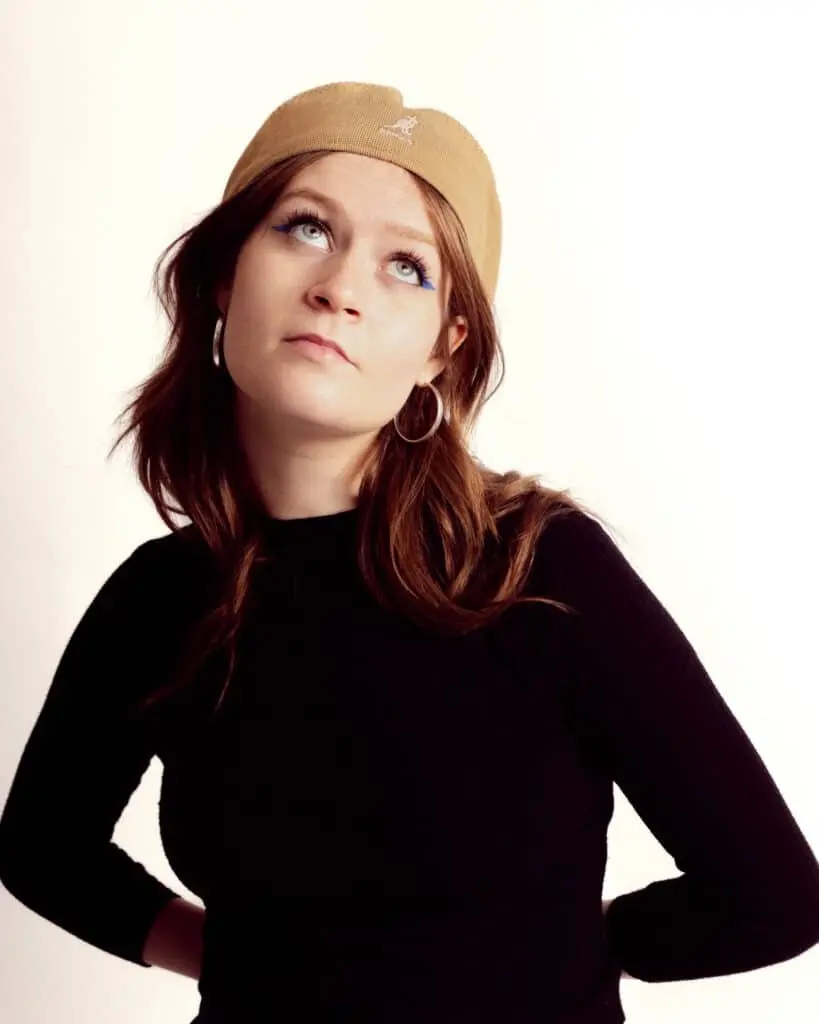
In the rapidly shifting landscape of modern pop music, authenticity often feels like a manufactured commodity—a carefully curated aesthetic designed to generate short-form video traction. Yet, every so often, an artist emerges whose work resists this algorithmic homogenisation entirely. Enter Daisy Veacock: a London-based singer-songwriter whose sound sits comfortably at the crossroads of classic jazz orchestration, 2000s indie-pop nostalgia, and the unfiltered emotional chaos of early adulthood.
With her breakout viral moment arriving via 2022’s TikTok-propelled, floaty ballad “Pickle Juice,” Veacock has steadily built a reputation as a chronicler of urban heartbreak. Her songwriting maps the eccentricities of city life—from wine-fueled nights in Clapham corners to balmy bossa nova breezes drifting through high-rise windows—all captured on her debut EP, a drunk thought from a night bus in november.
As she prepares to embark on her upcoming headline UK tour this November—humorously titled The “Isn’t This Just London, Manchester & Glasgow?” Tour—Veacock sat down for an exclusive interview to discuss her musical pedigree, the logistical nightmares of touring with a full horn section, the vulnerability of public art, and how she translates the gritty realities of late-night London into timeless, sophisticated pop.
Detailed Chronology: From Conservatory Roots to Viral Success
Veacock’s entry into music is rooted in a lifelong immersion in sound. As the daughter of a professional jazz saxophonist who performs in Jools Holland’s renowned band, she grew up surrounded by the mechanics of big-band arrangement.
Formative Influences and Musical Pedigree
"My dad is obviously a musician; he’s a saxophone player in Jools Holland’s band. It’s my one little nepotism thing, I guess!" Veacock laughs. Growing up, the background hum of her home life was defined by live instrumentation, horn sections, and complex jazz arrangements.
This early exposure bred a deep admiration for the bridge between classic orchestration and accessible pop—a blueprint mastered by artists in the 2000s. She cites Norah Jones’s Come Away With Me—discovered in her grandparents’ house—as a foundational touchstone, noting its structural similarities to the whimsical, complex chord progressions of Randy Newman’s Toy Story soundtrack. Similarly, the brass-infused, reggae-tinged pop of Lily Allen and the soulful grit of Amy Winehouse helped shape Veacock’s vocal dexterity, allowing her to pivot effortlessly from blissful melodies to wistful, narrative-driven verses.

The Pandemic Pivot and TikTok Breakout
Before securing her footing as a vital new voice in the UK music scene, Veacock studied at the prestigious BRIT School—the legendary academy that nurtured talents like Adele, RAYE, and Amy Winehouse. However, the path from student to touring artist was far from linear.
During the height of COVID-19 lockdowns, Veacock spent countless hours navigating grueling hour-and-a-half commutes across London to write and record, reflecting on the period with characteristic humor: "I don’t think I’ve ever been more tired or carried more things in my life!"
Her breakthrough arrived in 2022 with the release of "Pickle Juice," a track that showcased her ability to pair conversational, razor-sharp lyricism with lush, jazz-inflected instrumentation. The single resonated deeply on TikTok, turning a modest indie-pop release into an introduction to a growing, dedicated fanbase.
Supporting Context & Metrics: The Anatomy of Modern Songwriting
The Geography of London as a Character
In Veacock’s discography, London is not merely a backdrop; it is an active participant. Her songs function as vivid snapshots of youth across Tottenham, New Cross, and Shoreditch. Her lyrical style—which she jokingly describes as "situationships and the city"—deals frankly with modern romance, anxiety, and the transient nature of twenty-something relationships.
Her songwriting ritual itself defies convention. While most writers struggle with verse structures, Veacock writes her songs backward.
"I always write the second verse first. Always!" she explains. "I speak to songwriters about this… they’re like, ‘No, that’s the hardest bit!’ I think because it’s the hardest bit of the song, it almost feels like, by writing the second verse, you know imagery-wise where you need to get to. And then once you’ve got the chorus, you can link it with the second verse."
This unconventional method results in tracks like "big lonely house," a mature reflection written during a turbulent family year marked by loss and her father’s cancer diagnosis. Despite the heavy emotional weight, the track maintains an observational innocence that contrasts sharply with more playful releases like "BOO!", demonstrating an impressive emotional range for an emerging artist.

The Financial and Logistical Realities of Indie-Band Touring
Running counter to the modern trend of minimalist, track-backed live performances, Veacock insists on bringing live musicians—including a full horn section—to her shows wherever possible. In an era where grassroots touring is economically perilous, maintaining a large ensemble requires creativity.
"For an artist of my level to have a band as big as I do, it’s rare," she admits. "Everyone’s going, ‘How are you funding this?’ And I’m like, ‘I don’t know! I cook them dinner?!’ They’re the most talented, incredible group of people."
While the cost-effectiveness of touring a full horn section across the entire UK prevents her from taking the complete ensemble outside of London, Veacock remains committed to ensuring every venue receives a tailored, high-energy live experience.
Official Statements & Industry Insights
The Vulnerability of Public Art
Discussing the psychological weight of putting deeply personal art into the world, Veacock rejects the notion that artists must possess unbridled vanity to succeed. Instead, she frames performance as an act of radical emotional exposure.
"You’re not just putting a bit of art out in the world; you’re putting a bit of yourself into the ether, and that can feel really scary sometimes," she notes. "I’ve definitely had songs I’ve put out and been like, ‘I don’t know about this, I’m a bit nervous!’ But that’s part of the power of it."
Surviving the "Worst Gig" Test
Every touring musician accumulates horror stories, and Veacock is no exception. Though she declines to name the specific venue, she recalls a grueling support slot that tested her resilience:
"I travelled for about six hours, didn’t have a dressing room, couldn’t find any water. Didn’t have anywhere to get changed… and it was freezing cold. I went on stage, and I just thought, ‘This is just completely wrong!’ Cause it was a pretty big audience. But I was like, ‘They don’t get me, and I don’t get them. And that’s okay.’"
Finding solace in the fact that the headliner’s audience reacted with the same cold energy, Veacock walked off stage, shrugged off the disastrous atmosphere, and rewarded herself with a post-show curry. "A win’s a win!"
Future Outlook: The Road Ahead and November Tour
Looking toward the horizon, Veacock’s musical evolution is shifting toward slower, more contemplative arrangements. Buoyed by her recent explorations into string orchestration and a return to bossa nova rhythms, her upcoming material promises a deeper dive into jazz-pop sophistication.
Long-term, her ambitions remain sky-high. Having already experienced London’s iconic Royal Albert Hall as a support act—stepping onto the historic stage just a week after RAYE’s landmark debut album release—Veacock harbors dreams of headlining the legendary venue with a full live orchestra.
For now, however, her immediate focus is on connecting with audiences face-to-face. The “Isn’t This Just London, Manchester & Glasgow?” Tour kicks off in the north of England this November, offering fans an intimate look at one of the UK’s most exciting emerging talents before she inevitably transitions to much larger stages.
The "Isn’t This Just London, Manchester & Glasgow" Tour Dates:
- Manchester: Early November
- Glasgow: Early November
- London: Mid/Late November
Tickets and further information are available via Ticketmaster.