Executive Overview
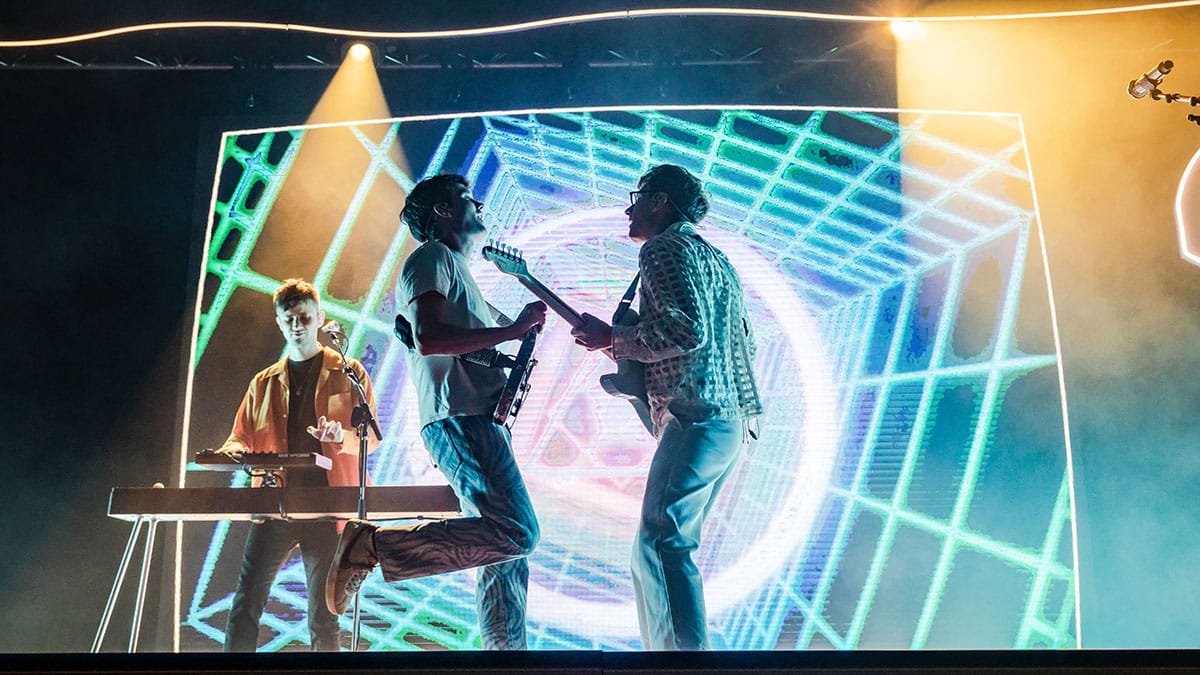
Few modern indie-pop acts have traversed the chaotic spectrum of live performance quite like Glass Animals. The Oxford-born quartet—comprising frontman Dave Bayley, lead guitarist Drew MacFarlane, bassist/keyboardist Edmund Irwin-Singer, and drummer Joe Seaward—have mastered the elusive art of translating deeply idiosyncratic, psychedelic bedroom production into stadium-sized euphoria.
As the band prepares for their monumental *I LOVE YOU SO F**ING MUCH album cycle and the expansive GLASS ANIMALS: TOUR OF EARTH, they remain delightfully grounded. In an exclusive interview, Bayley and MacFarlane reflect on a decade-plus touring history defined by stark contrasts: playing to empty rooms in Leeds, facing aggressive crowds of pre-teens in Kansas City, accidentally summoning lightning at Red Rocks, and commanding over 100,000 festival-goers at Lollapalooza.
This retrospective explores the trajectory of a band that achieved global superstardom through the RIAA diamond-certified phenomenon "Heat Waves," while never losing the self-deprecating humor and raw humility forged in the fires of disastrous early gigs.
Detailed Chronology: The Gig History of Glass Animals
The Genesis: Churches, Cover Bands, and Catastrophic Firsts
Every legendary live act has an origin story littered with technical failures and mortifying moments, and Glass Animals is no exception. Long before headlining international festivals, the members were cutting their teeth in vastly different musical environments.
Drew MacFarlane’s introduction to performance was deeply traditional. "My mom always took us to church," MacFarlane recalls. "When I was a kid, I ended up singing and playing the organ in church… that was kind of the beginning of music for me." When asked if he would ever return to ecclesiastical performance, MacFarlane jokes about revisiting the organ in his seventies, while Bayley dryly notes, "No shade to church musicians, who are so good! I just don’t know if we’d have time to do it."
Bayley’s formative concert memory, conversely, was purely secular and profoundly transformative. At 13 years old, he traveled unchaperoned to London’s legendary Brixton Academy to see Bloc Party. "I just remember being in awe of live music… I thought, ‘Wow, music is powerful. The togetherness in this room is awesome,’" Bayley shares.
However, translating that inspiration into their own live debut was a rocky endeavor. Their very first outing—at a friend’s 16th birthday party—involved playing covers of The Strokes with MacFarlane on lead vocals, resulting in immediate heckling. Things did not improve when they played a proper venue: a pub across the street from Bayley’s house.
Playing first out of a five-band bill, the fledgling group faced a severe lack of space—with Joe Seaward forced to sit on the floor playing a drum machine. Compounding the disaster, they had failed to soundcheck or coordinate with the house audio engineer. When the guitar kicked in, the unmixed volume caused immediate physical pain to everyone in the room. "Steep learning curve," Bayley remarks.
The Wilderness Years: Empty Rooms and "Big Jeff"
The journey from local pubs to international recognition was paved with humbling milestones. During their maiden UK tour, the band arrived in Leeds to find that not a single ticket had been sold.
"We had a little rider that was just some hummus and pita bread—basically just enough food for us to eat—but they couldn’t get it for us because we didn’t sell any tickets," Bayley remembers. "It really was quite a sad moment… We all thought we were going back to our day jobs at that point."
Another infamous low point occurred in Bristol, where the entire audience consisted of one legendary local fixture known as "Big Jeff." Renowned for supporting underground music scenes, Big Jeff stood barely a foot away from the band in an empty room, moshing furiously by himself.
The Peaks: Red Rocks, Suburban Garages, and Accidental Zeus Moments
When Glass Animals transitioned to playing celebrated venues, they encountered magic of a different magnitude. Chief among their favorite destinations is Red Rocks Amphitheatre in Colorado. Nestled in the mountains and overlooking Denver, the venue has played host to some of their most climactic shows—most notably an evening interrupted by a ferocious lightning storm.
"I said the word ‘Thunder,’ and then lightning hit the stage. I felt like Zeus," Bayley laughs. MacFarlane adds that spectators genuinely believed the pyrotechnics were intentionally staged. The band was eventually forced offstage for safety, cementing a mythic piece of concert lore.
Equally memorable, though entirely different in scale, was an unexpected booking in an Oklahoma suburban cul-de-sac. Welcomed by a young fan who had somehow independently organized the event, the band played inside a domestic garage stripped of standard staging, relying on a single speaker and a small lamp. "It was very family-friendly, but it popped off," Bayley notes, with MacFarlane describing the atmosphere as "feral."
The Extremes: Lollapalooza, Surprise Pyrotechnics, and Feral 11-Year-Olds
Scaling up to massive crowds brought its own surreal challenges. At Lollapalooza, Glass Animals performed immediately before music icon Paul McCartney to a staggering audience of over 100,000 people. Exhausted from the final night of a gruelling tour, the band relied entirely on the kinetic energy of the colossal crowd to push through.
Conversely, things took a dangerous turn during a festival performance in Mexico. Unbeknownst to the band, local organizers had repurposed $10,000 worth of heavy-duty pyrotechnics left behind by an EDM act the previous night. Bayley found himself standing directly over an unannounced flamethrower: "I thought I was gonna die—when it went off, it was so loud and the flames just missed the insides of my thighs."
Perhaps their weirdest gig, however, remains a house party in Kansas City populated entirely by eleven-year-olds celebrating a birthday. Beyond enduring a second round of childhood heckling, the band was pelted with hats and sunglasses before experiencing an enthusiastic stage invasion. "All the kids flooded the stage and tried to take our instruments and play them, which is very sweet, but also quite confusing," MacFarlane recalls.
Supporting Context & Metrics: The Cultural Footprint of "Heat Waves"
To fully contextualize Glass Animals’ current touring power, one must examine the unprecedented trajectory of their 2020 anthem, "Heat Waves." The track became a historic streaming juggernaut, spending a record-shattering 91 weeks on the US Billboard Hot 100 chart.

Key Commercial and Digital Milestones:
- RIAA Diamond Certification: "Heat Waves" crossed the elite threshold of 10 million equivalent units sold in the United States, placing the band in an exclusive tier of modern pop acts.
- Virtual Innovation: During COVID-19 pandemic lockdowns, the track’s cultural footprint expanded into the digital realm when a Sim version of Dave Bayley performed the song in "Simlish" during a virtual music festival inside The Sims 4.
- Streaming Dominance: The track propelled the band past tens of millions of monthly listeners on Spotify, transforming their catalog from cult indie-psych favorites into a globally recognized powerhouse.
This streaming renaissance laid the foundation for larger headline capacities, shifting their trajectory from 20,000-capacity venues in North America to multi-night arena runs across continents.
Official Statements and Industry Insights
The band’s enduring appeal lies in their refusal to sanitize their past. By speaking candidly about zero-ticket shows, near-miss pyrotechnic disasters, and awkward house parties, Glass Animals humanize the often-sterile machinery of modern pop touring.
Industry analysts point to this authenticity as a core driver of their fan loyalty. Unlike manufactured pop acts engineered in writing camps, Glass Animals built their foundation through organic word-of-mouth, relentless touring through sticky indie clubs, and a distinct aesthetic that blends organic instrumentation with futuristic electronic textures.
As Dave Bayley noted regarding their evolutionary journey:
"The ones that are my favourites are the ones that slightly kind of catch you off guard."
This philosophy underscores their upcoming creative output, proving that whether they are performing before 100,000 festival-goers or navigating a chaotic garage gig, the core DNA of the band remains rooted in spontaneity and connection.
Future Outlook: *I LOVE YOU SO F**ING MUCH and the Tour of Earth
As Glass Animals steps into the next chapter of their career, anticipation surrounding their fourth studio album, *I LOVE YOU SO F**ING MUCH, is at an all-time high. The record serves as a sonic exploration of human connection within an increasingly vast and disconnected universe—a thematic continuation of the introspective song-writing that defined Dreamland.
Simultaneously, the GLASS ANIMALS: TOUR OF EARTH promises to shatter their previous live benchmarks. Building upon headline milestones like their 20,000-capacity Kansas City show, the arena and amphitheatre routing signals a significant step up in production design, visual storytelling, and sonic scale.
Armed with a repertoire that spans from early underground cuts like "Black Mambo" to global anthems like "Heat Waves," Glass Animals are uniquely positioned to bridge the gap between intimate indie beginnings and epoch-defining arena spectacles. If their storied gig history has taught them anything, it is that no matter how large the stages become, the most memorable moments are born out of the unexpected.