In the lush, verdant grounds of The Vache, arts collective Vache Baroque has once again pushed the boundaries of period performance, mounting an ambitious and visually arresting production of The Tempest. Staged on September 6, 2026, this bold collaboration with the physical theatre company Out of Chaos sought to revitalize one of Baroque England’s most eccentric and historically elusive theatrical forms: the semi-opera.
Under the sharp directorial vision of Paul O’Mahony and the precise musical leadership of Jonathan Darbourne, the production interwove William Shakespeare’s text with a rich tapestry of seventeenth-century music. Drawing primarily upon the theater scores of Matthew Locke, Henry Purcell, and Pelham Humfrey—alongside instrumental and vocal gems by John Blow, John Dowland, Thomas Morley, Robert Johnson, Giovanni Battista Draghi, Alessandro Kapsberger, François Couperin, and Marin Marais—the creative team constructed an immersive acoustic and visual landscape.
Yet, translating the Restoration semi-opera (or "dramatick-opera") for a contemporary audience remains a formidable theatrical puzzle. The genre’s historical DNA—which delegates spoken dialogue to actors while restricting vocal performance exclusively to supernatural or comic characters—creates an inherent structural divide. Vache Baroque’s staging boldly tackled these divisions by utilizing a multi-talented, hyper-engaged ensemble where actors, singers, and instrumentalists frequently broke conventional boundaries. While Part One occasionally stumbled through an over-reliance on amplification and an undercooked dramatic momentum, Part Two blossomed into a theatrical tour de force. Bolstered by a stunning masque, dynamic physical theatre, and rich character work, the production ultimately delivered a vivid, highly engaging evening that successfully challenged contemporary perceptions of early music theatre.
Detailed Chronology: Staging the Island’s Magic
Part One: Establishing the Storm and the Strife
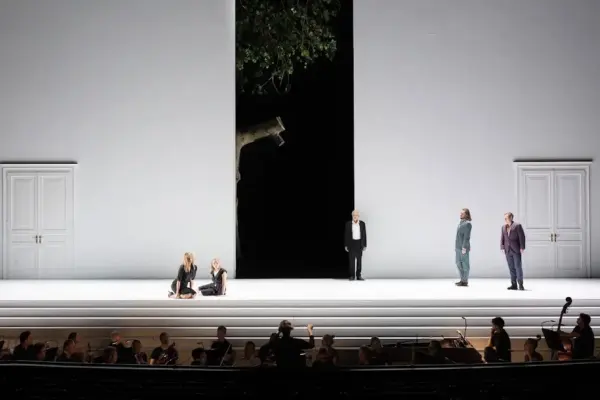
From the opening moments inside the intimate performance tent, Vache Baroque established a raw, earthy aesthetic. Caitlin Mawhinney’s set design, lit with atmospheric precision by Ben Pickersgill, placed the audience on three sides in an almost-in-the-round configuration that immediately drew spectators into the heart of Prospero’s enchanted isle.
The production opened with a stark reminder of the challenges inherent to the semi-opera format. Nearly half an hour elapsed before the first sung note pierced the air. During this extended prologue, spoken drama dominated, driven by Tim Delap’s fierce, commanding portrayal of Prospero and Leah Haile’s luminous Miranda. While Jonathan Darbourne’s nine-piece instrumental ensemble provided a continuous, reactive layer of musical commentary from the sidelines—seamlessly weaving period instruments into the physical choreography of the scene—the initial dramatic pacing felt somewhat tentative.
Compounding these structural hurdles was a heavy reliance on sound design. Engineered by sound artist Dan Samsa, the production integrated an array of ambient, found-noise soundscapes designed to evoke an island "full of noises, / Sounds and sweet airs, that give delight and hurt not." However, within the compact acoustics of the tent, the vocal amplification of the actors occasionally felt excessive. The dialogue ran the risk of becoming overly sharp and shouty, stripping the natural intimacy from Shakespeare’s verse and suggesting that the performers’ raw vocal projections could have easily carried the space unassisted.

Despite these early frictions, standout performances quickly anchored the production. Tré Medley cut a dashing, earnest figure as Ferdinand, while Hannah Barrie delivered a magnetic, deeply sympathetic turn as Caliban, deftly avoiding the grotesque caricature that often plagues the role. As the royal interlopers washed ashore, Isabelle Peters’ commanding Alonso, supported by Dom Swain’s Sebastian, Conor Prendiville’s Antonio, and Darbourne himself doubling as Gonzalo, established a palpable atmosphere of political corruption and disorientation. The first half closed with a poignant vocal ensemble underscoring Prospero’s reluctant blessing of the young lovers, bridging the gap between spoken tragedy and musical grace.
Part Two: The Masque and the Metamorphosis
If Part One navigated the structural growing pains of the semi-opera genre, Part Two soared. The second half capitalized on the inherent theatricality of the form, leaning heavily into interpolated masques and heightened musico-dramatic confrontations.
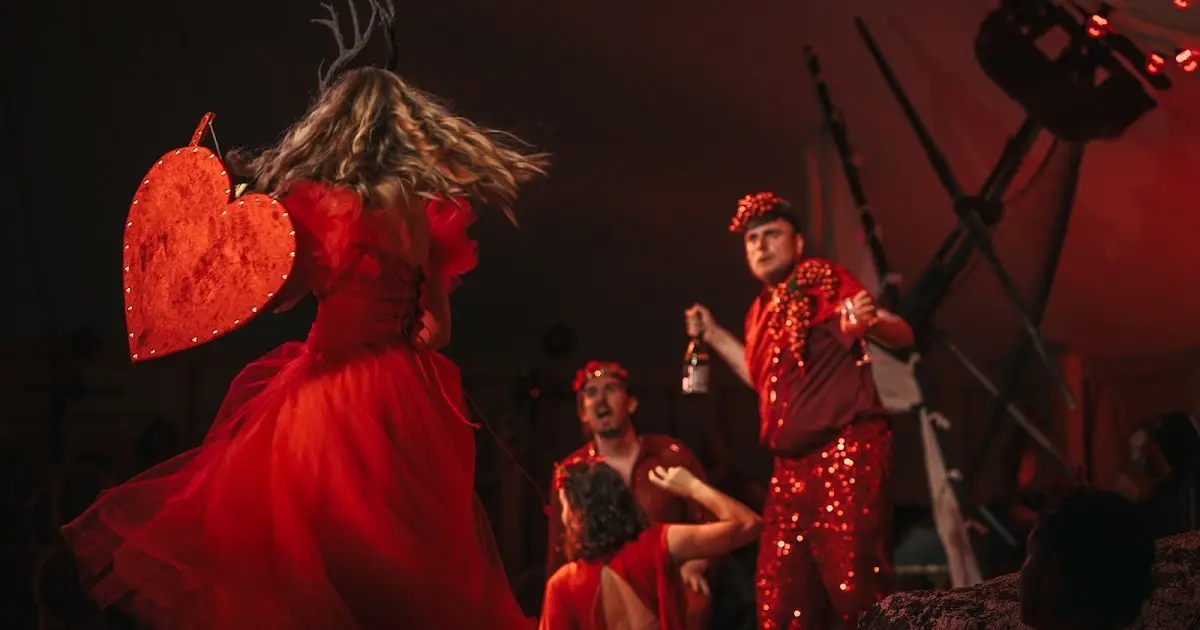
The emotional and sonic centerpiece of the evening was an extended wedding masque celebrating the union of Ferdinand and Miranda. Here, the production fully justified its embrace of Restoration-era spectacle. Stephanie Hershaw, who dominated the evening with a tireless, luminous performance as the spirit Ariel, took on the role of Cupid with dazzling vocal agility. She was brilliantly matched by baritone Ross Cumming as a rousing, wine-soaked Bacchus, alongside vocal contributions from Peters, Camilla Seale, and Prendiville.
The musicianship broke free from the pit throughout Part Two, spilling directly into the dramatic action. The instrumentalists abandoned passive accompaniment to actively torment Cumming’s Trinculo and Seale’s Stephano in a sequence of brilliant physical comedy. Seale and Cumming forged a delightful, drunken double act, extracting maximum comedic value from their scenes of low-comic subversion.
As the narrative hurtled toward its resolution, Tim Delap’s Prospero transitioned from a cold, calculating tyrant of the mind into a figure of profound, trembling humanity. His final renunciation of his magical art was handled with delicate emotional resonance. Though the production concluded with a touching vocal ensemble piece, some critics noted a minor missed opportunity: failing to unite the entire company—actors, musicians, and singers alike—in a grand, all-encompassing vocal finale that might have permanently cemented the community of the island. Nevertheless, the final image of a solitary, de-powered Prospero left a lingering, resonant impression.
Supporting Context & Metrics: Decoding the Semi-Opera
To fully appreciate Vache Baroque’s undertaking, one must examine the historical anomaly that is the English semi-opera.

+-------------------------------------------------------------------------+
       THE RESTORATION THEATRICAL ECOSYSTEM (1660 – 1712)
+-------------------------------------------------------------------------+
  Fully Sung Opera       -> Failed to gain cultural traction (e.g., Cambert)
  Spoken Playhouses      -> Dominant commercial and cultural force
  The Semi-Opera         -> Hybrid compromise: Spoken drama + Musical masques
+-------------------------------------------------------------------------+
During the English Interregnum (1649–1660), public theatrical performances were officially banned by the Puritan government. However, clever entrepreneurs managed to stage early, covert musical entertainments (such as Sir William Davenant’s The Siege of Rhodes) under the guise of musical recitals to circumvent political restrictions. When the monarchy was restored in 1660 under Charles II, the theatrical floodgates reopened, bringing with them a taste for French-style spectacle. Yet, unlike their continental neighbors, English audiences never fully embraced fully sung-through opera; Italian and French imports struggled to find sustainable commercial footing.
The pragmatic compromise was the "semi-opera" or "dramatick-opera." Emerging in the early 1670s—with early musical contributions from Matthew Locke for productions like Macbeth (1673)—this hybrid form preserved the spoken English play while expanding musical interludes, supernatural visitations, and elaborate masques. Henry Purcell later perfected the genre with works like The Fairy Queen (1692) and King Arthur (1691), before the form faded from popularity around the premiere of John Eccles and Daniel Purcell’s setting of The Tempest in 1712.
Production Metrics & Ensemble Architecture
- Performance Date: September 6, 2026
- Venue: The Vache (Buckinghamshire, UK)
- Presenting Companies: Vache Baroque in collaboration with Out of Chaos
- Creative Leadership: Paul O’Mahony (Director), Jonathan Darbourne (Musical Director)
- Design Team: Caitlin Mawhinney (Design), Annie-Lunnette Deakin-Foster (Choreography), Ben Pickersgill (Lighting), Dan Samsa (Sound Design)
- Instrumental Forces (9 players):
- Harpsichord (Jonathan Darbourne)
- Violins (Naomi Burrell, Christiane Eidsten Dahl)
- Viola (Charlotte Fairbairn)
- Bass Violin / Viola da Gamba (Gavin Kibble)
- Bass (Carina Cosgrave)
- Oboes / Recorders (Oohagh Lee, Joel Raymond)
- Theorbo / Lute / Guitar (Toby Carr)
- Percussion (Louise Anna Duggan)
- Cast Breakdown: 5 Actors (Prospero, Miranda, Caliban, Ferdinand, Sebastian), 5 Vocalists (Ariel, Alonso, Stephano, Antonio, Trinculo), with significant cross-disciplinary casting (e.g., Darbourne doubling as Gonzalo, Isabelle Peters taking the non-singing role of Alonso).
Official Statements & Creative Vision
Reflecting on the challenges of bringing a seventeenth-century hybrid form to life for modern audiences, the creative team emphasized the necessity of risk-taking in early music performance.
Director Paul O’Mahony, speaking on the integration of physical theatre and classical text, noted:
"The semi-opera is a fascinating, frustrating beast. It asks us to accept a world where characters speak prose and verse until the supernatural takes hold, at which point they burst into glorious song. By working closely with Out of Chaos, our goal was not to paper over these stylistic cracks, but to lean into them—to make the physical, musical, and dramatic worlds bleed into one another until the boundaries between actor, singer, and musician entirely dissolve."
Musical Director Jonathan Darbourne highlighted the eclectic musicological approach adopted for the production:

"While Matthew Locke provides the vital historical anchor for Restoration stagings of The Tempest, we wanted to expand the sonic palette to capture the psychological breadth of Shakespeare’s island. By weaving in Purcell, Blow, Dowland, and continental masters like Marais and Kapsberger, the music stops being mere incidental decoration. It becomes the very weather of the island—shifting, seductive, and deeply unstable."
Future Outlook: The Revival of Early English Performance
Vache Baroque’s staging of The Tempest arrives at a crucial juncture for early music festivals across the United Kingdom. As major houses increasingly retreat to risk-averse programming dominated by nineteenth-century standard repertoire, independent collectives like Vache Baroque are proving that historical musicology, when paired with fearless contemporary staging, can captivate modern audiences.
The production points toward a promising methodological template for future revivals of Restoration theatre. By collapsing the traditional hierarchy between pit and stage—having instrumentalists march into the action and forcing actors to navigate complex physical choreography—the company demonstrated that the structural eccentricities of the semi-opera need not be viewed as dramatic flaws. Instead, when handled with imaginative staging and rigorous musicianship, these quirks can be transformed into the genre’s greatest asset: a dizzying, multi-sensory hallucination of sound and movement.
As Vache Baroque looks toward future festival seasons, the success of this Tempest cements its reputation as a vital laboratory for early opera. If they continue to untangle the historical knots of the seventeenth-century stage with this level of theatrical bravery, audiences can eagerly anticipate further excavations of an era whose musical riches remain too long buried.