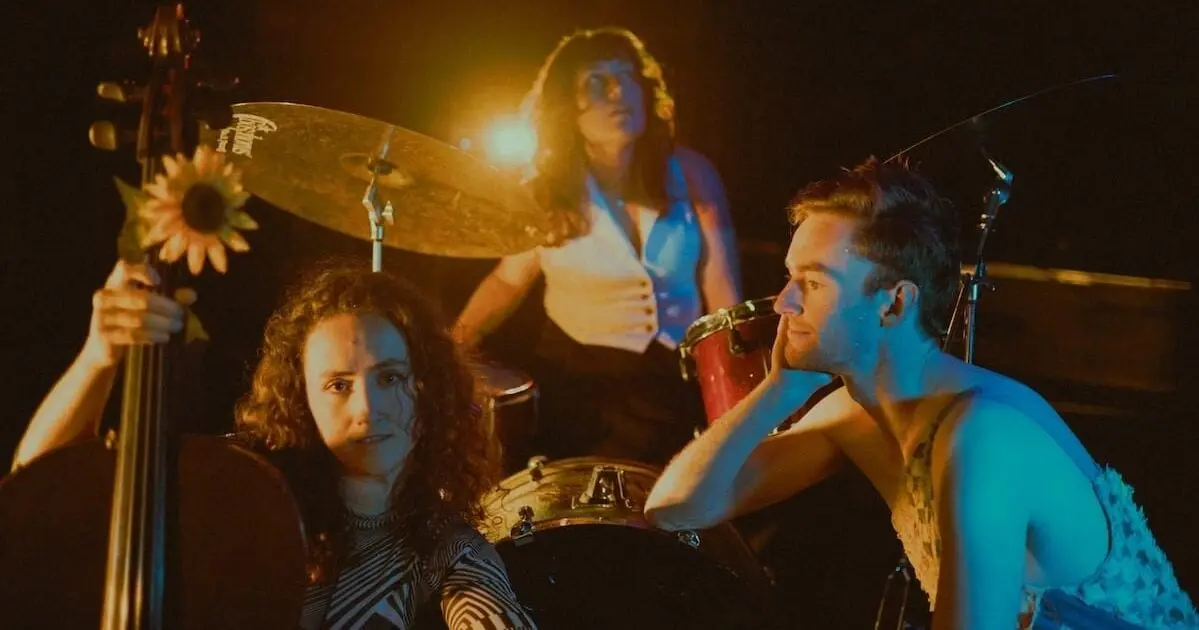
To some extent, a person is an entity forged entirely from the cumulative weight of their lived experiences. The same can be said of a musical ensemble, and few contemporary acts embody this philosophy quite as succinctly as Good Habits. The core songwriting and performance duo—comprising Bonnie Schwarz on cello and vocals, and Pete Shaw on accordion and synths—first began forging their distinct sonic identity under remarkably unusual circumstances: they were stranded together in New Zealand during the global upheavals of the COVID-19 pandemic.
Those initial, high-pressure forays into collaborative songwriting birthed a singular artistic trajectory. It began with the 2020 single Lullaby From the Rain, an intimate meditation on sisterly love and geographical separation, followed shortly thereafter by their debut full-length album, Going For Broke. From their earliest days in the studio, it was evident that physical travel, relentless geographical movement, the systemic chaos of disrupted lives, and the sheer, unbridled joy of human experience were the driving engines behind their freewheeling compositions.
Now operating out of Manchester with an expanded live lineup and a string of critically acclaimed releases trailing in their wake, Good Habits continue to alchemise their personal and professional journeys into a vibrant, genre-defying cocktail. Their sound effortlessly bridges traditional folk, pop structures, electronica, and a form of unfettered, jazz-infused chamber music. Following their ambitious 2024 breakout album Quarter-Life—which featured guest appearances from folk luminary Angeline Morrison and composer-violinist Alex Garden—the duo returns with their most daring statement yet.
Their upcoming full-length project, Better for Now, scheduled for release on October 9, 2026, via Colour Plum Records, sees the band continuing their outward geographical and sonic migration. The album explores the absolute outer boundaries of their expansive musical palette, sliding effortlessly from festival-ready, locked-in trance-folk to deeply intimate, stripped-back acoustic balladry. It is a masterclass in tension and release, proving that Good Habits are not merely participants in the modern British folk revival, but chief architects shaping its future.
Detailed Chronology
The genesis of Good Habits is a narrative defined by serendipity, isolation, and creative resilience. Trapped in New Zealand by international border closures during the height of the pandemic, Schwarz and Shaw found themselves with an abundance of time and a desperate need for creative expression. What started as a coping mechanism rapidly evolved into a professional partnership characterized by an insatiable appetite for exploration.
- 2020: The duo releases their debut single, Lullaby From the Rain, capturing the emotional zeitgeist of pandemic-era separation and familial longing.
- Late 2020 – 2021: Building on the momentum of their debut, they record and self-release their first full-length album, Going For Broke, cementing their reputation for pairing folk instrumentation with unconventional rhythmic structures.
- 2024: Returning to the UK and expanding their touring lineup, Good Habits release their sophomore-adjacent third album, Quarter-Life. Hailed as their most expansive and ambitious project to date, it showcases collaborations with prominent names in the UK folk and contemporary classical spheres, including Angeline Morrison and Alex Garden.
- October 9, 2026: The slated release date for Better for Now via Colour Plum Records, marking a new pinnacle in their studio craftsmanship and compositional maturity.
Supporting Context & Metrics
The pre-released tracks from Better for Now offer a fascinating glimpse into the dual hemispheres of the band’s creative output. Lead single Ideas showcases the duo at their most raw and human. Here, Schwarz’s plucked cello lays a delicate, gossamer groundwork for her fluttering, emotive vocals. Yet, true to form, the track refuses to remain neatly compartmentalized. A sinuous, serpentine accordion part supplied by Shaw introduces an unexpectedly solid structural backbone, allowing the vocals to blossom outward like celebratory fireworks. The resulting energy is both surprising and exalted.
By sharp contrast, the track Uetze roots itself in subtle, lightly pulsing electronic soundscapes. Across a backdrop of minimal disco and driving synthesizers, Schwarz’s widescreen vocals soar with effortless authority. Listening to Uetze feels akin to imagining ABBA—at the absolute height of their existential introspection—hotwiring a camper van, ram-raiding an accordion shop, and legging it at full speed toward a rural German trance festival.
Despite their apparent stylistic divergence, these tracks ultimately converge under the banner of an overriding thematic positivity. Both songs lyrically dissect the friction-filled yet deeply rewarding terrain of human relationships—spanning both professional partnerships and romantic entanglements—and ultimately arrive at a firm philosophical defense of companionship and creative collaboration.
This thematic thread echoes throughout the nine-track runtime of Better for Now. Reading Song, for instance, pays homage to the vital importance of external creative works and the distinct psychological sanctuary that reading provides—a rare intersection of mental downtime and intellectual engagement. Anchored by a loping bassline and crisp drumming from guest percussionist Jen Walinetski, the track touches on themes of nostalgia and familial roots, while Schwarz leans heavily into her regional accent, allowing her natural speech cadence to lend distinct shape and texture to the lyrics. Shaw’s accordion weaves fluidly in and out, providing a jaunty, irrepressible accompaniment.
Crucially, Better for Now is not a record characterized by unyielding, monotonous optimism. Schwarz and Shaw demonstrate a mature understanding of emotional dynamics: moments of soaring exhilaration are invariably made sharper when played in relief against hardship, crisis, and vulnerability. The album’s more restrained compositions provide the necessary shadows against which the light shines with blinding clarity.
Take, for example, Body of Mine, a composition that navigates the treacherous waters of body image. It functions simultaneously as an intensely personal, gut-wrenching internal meditation and a razor-sharp, sophisticated takedown of the societal hierarchies that perpetuate body dysmorphia and self-doubt. Similarly, What Will Become of Me? manages the herculean task of encapsulating the grinding stresses of consumerism, the looming psychological spectre of ecological collapse, and modern burnout—all within the compact framework of a three-minute folk-pop song that bounces forward with astonishing joie de vivre.
This ability to weave deeply political, weighty commentary into peppy, buoyant melodies is a rare gift. It is precisely this deliberate juxtaposition that forces the listener back to the turntable for a second or third spin, ensuring no lyrical barb goes unnoticed beneath the lush arrangements.
The tension between solemnity and unadulterated fun manifests in myriad ways across the tracklist. The meticulous attention to detail in the opening track, Different Eyes—which builds steadily in both musical complexity and lyrical intensity toward a cinematic climax—reveals an abiding reverence for the craft of songwriting. Yet, its lyrical content gives voice to a profoundly articulated personal trauma and frustration.
A similar thematic exploration underpins Keeping an Eye, though its musical architecture takes a series of dizzying, unexpected detours. Restless, shifting percussion gives way to swooping, orchestral cello lines, while Shaw’s accordion injects a relentless rhythmic drive into the verses. During this track, Schwarz wields her cello less like a traditional classical instrument and more like an electric guitar, unleashing a fiery, acrobatic solo that commands attention.
Further into the record, The Point of No Return builds from sparse, minimalist ingredients. It opens with isolated vocals accompanied only by a delicate filigree of pizzicato cello before subtle electronic textures and drums swell to push the song into lush, languid territory. A pair of wonderfully expressive, nearly expressionistic accordion solos by Shaw introduce an entirely separate layer of emotional complexity.
The album concludes with So Easy, a deliberate and welcome shift in tempo. It is a slow-burning, tender ode to love, shared affection, and the grounding pleasures of physical and emotional intimacy. Representing a state of absolute, unmitigated bliss in recorded form, the track features delicate, wandering keys floating alongside lacy cello arrangements as Schwarz sings of her "serene abject wonder."
Later in the same song, she delivers the striking line: "Laid bare I am light / I see the sun in your hair." The motif of light here is multifaceted: it is light that banishes emotional darkness, but it is also a testament to their lightness of touch and fleetness of foot.
Official Statements & Industry Reception
While industry commentators and critics have long lauded Good Habits for their technical proficiency, the reception surrounding the rollout of Better for Now highlights a maturation in their artistry. Critics have pointed out that the band’s willingness to cross-pollinate disparate genres—melding the structural rigor of chamber music with the populist appeal of folk-pop and electronic production—places them in an elite tier of contemporary British acts.
Speaking on the collaborative ethos that drives the album, the duo has consistently emphasized that their music is inextricably tied to community, movement, and shared human endurance. The decision to record and self-produce significant portions of the project while maintaining an ambitious touring schedule reflects a band hitting its stride. By leaning into the extremes of their musical capabilities—from the meditative tranquility of So Easy to the pulse-pounding kinetic energy of Uetze—Good Habits have successfully articulated a manifesto for modern folk survival: adapt quickly, collaborate deeply, and never lose your sense of wonder.
Future Outlook
As Good Habits prepare for the official October 9, 2026 release of Better for Now via Colour Plum Records, the trajectory for the Manchester-based duo points decisively upward. Armed with an expanded live ensemble, a critically lauded discography, and an expanding international fanbase, the band is well-positioned to cement its status as one of the most exciting and technically accomplished acts on the modern circuit.
The challenges ahead—navigating an increasingly fragmented music industry while maintaining the intricate, labor-intensive production standards displayed on tracks like Different Eyes and The Point of No Return—are substantial. However, if their pandemic-forged origins and subsequent trajectory are any indication, Good Habits thrive precisely where uncertainty meets creativity.
With pre-orders currently live via their official platform and an extensive run of live dates scheduled to support the album’s release, audiences can expect a dynamic, genre-bending live show that mirrors the restless energy of the new record. For Good Habits, the journey is far from over; indeed, as Better for Now proves, they are only just beginning to map the outer limits of what folk music can achieve.