Executive Overview
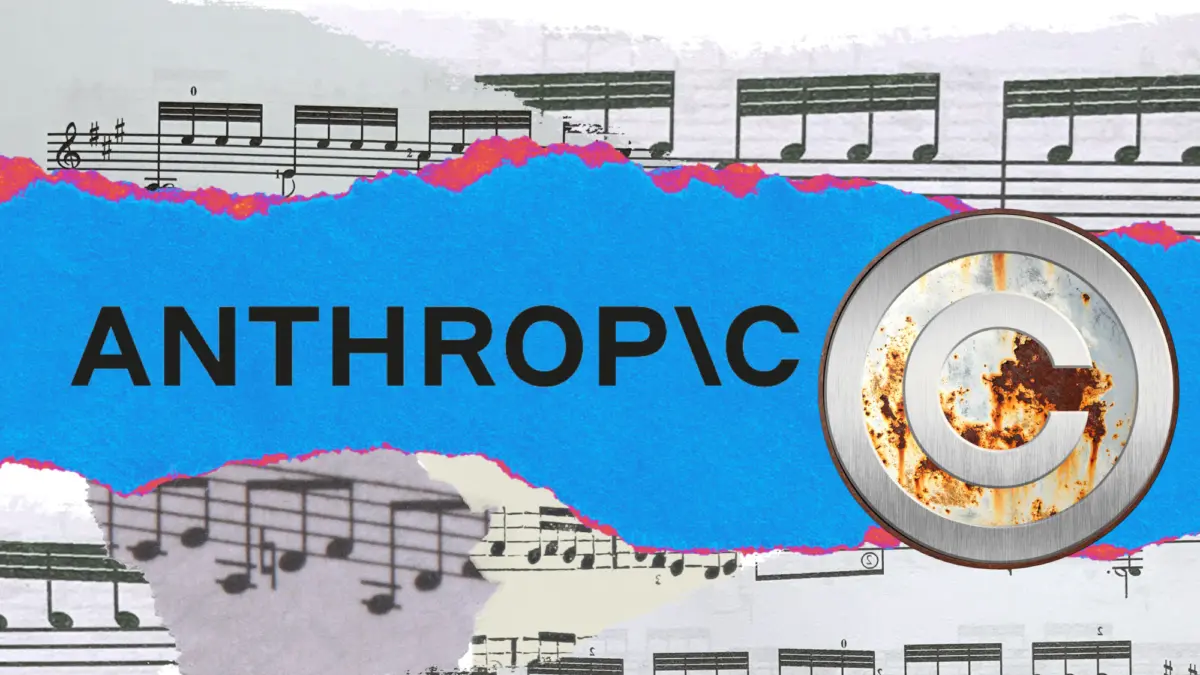
The high-stakes legal battleground surrounding generative artificial intelligence and American copyright law shifted back to a US courtroom, marking a critical milestone as the debate finally intersected with the music industry—specifically, through the medium of lyrical composition. In this closely watched dispute, major music publishers Universal, Concord, and ABKCO are locked in a fierce legal duel with AI developer Anthropic. Both legal teams are actively pressing US District Judge Eumi Lee for decisive summary judgments in their respective favors, a move that could bypass a full jury trial and set a massive nationwide precedent.
At the absolute center of this litigation is the defining legal question of the decade: Does training a large language model (LLM) constitute "fair use" under US copyright law? If the court ultimately rules that AI training is protected under fair use, Anthropic will be legally empowered to ingest and reproduce existing copyrighted works to construct its training datasets. This would occur entirely without permission from—and without financial compensation to—copyright holders, including the massive catalogs of lyrics owned by Universal, Concord, and ABKCO.
This case is not happening in a vacuum. It represents just one front in an escalating war between creative industries and Big Tech. Dozens of parallel copyright lawsuits have been filed across the United States against various AI companies, creating a high-pressure environment where the outcome of this specific hearing will reverberate through other major music industry litigation, including lawsuits targeting music-generation platforms Suno and Udio. As Judge Lee weighs the arguments, the ultimate decision threatens to reshape the economic foundations of human creativity, intellectual property, and technological innovation.
Detailed Chronology and Legal Arguments: The Showdown Before Judge Lee
The most compelling and fiercely contested segment of the recent court hearing revolved around a nuanced copyright doctrine: market dilution. Specifically, the court examined whether Anthropic’s AI model, Claude—having been trained on human-created lyrics owned by Universal, Concord, and ABKCO—subsequently outputs new lyrics that actively dilute the market value of the original, human-authored songs.
Market dilution stands as one of the four foundational statutory criteria courts evaluate when determining whether a challenged use of copyrighted material qualifies for the fair use exemption. Under this doctrine, if the deployment of a copyrighted work negatively impacts its commercial value or market viability, the defense of fair use becomes significantly harder to maintain. In this context, the court must decide whether the synthetic lyrics generated by Claude inflict economic harm on the commercial value of the underlying, human-created lyrics originally copied during the AI training phase.
The Publishers’ Case: Scale and Threat of Market Overwhelm
Arriving at the podium for the music publishers, attorney Matthew J. Oppenheim delivered a stark warning to Judge Lee. Oppenheim forcefully argued that Claude’s lyrical outputs are already inflicting measurable damage on the broader music publishing ecosystem and the highly lucrative streaming market. Furthermore, Oppenheim contended that Anthropic’s systemic refusal to secure commercial licenses for its training data is actively undermining and eroding the music industry’s nascent, highly anticipated AI licensing market.
According to reporting from Law360, Oppenheim pushed the court to look at the sheer scale of generative AI outputs. He pointed out that while Claude serves a multitude of general-purpose tasks, empirical evidence demonstrates that Anthropic’s AI received nearly 120,000 requests for what he termed "synthetic lyrics" over a compressed six-month window.
"What’s crucial is Claude’s scale here," Oppenheim emphasized during the proceedings, warning the court that unchecked, AI-generated music and lyrics "could easily overwhelm the market" and marginalize human songwriters.
Anthropic’s Counter-Defense: Modest Volumes and Contradictory Statements
Anthropic’s legal counsel, Sonal Mehta, forcefully pushed back against the publishers’ apocalyptic framing of the technology. Mehta maintained that the publishers’ catastrophic predictions lacked empirical backing.
"There isn’t anything in the record that shows doom for the music industry," Mehta told Judge Lee, as cited by Courthouse News.
Mehta argued that the publishers had completely failed to discharge their legal burden of demonstrating that Claude exerts a demonstrable, negative impact on either the broader music licensing market or traditional digital lyric platforms that formally partner with the music industry, such as LyricFind and Genius.
To put the 120,000 synthetic lyric requests cited by Oppenheim into proper perspective, industry analysts note that Anthropic currently boasts an estimated user base of approximately 30 million weekly active users. Viewed through that statistical lens, 120,000 requests spread across half a year amount to a remarkably modest fraction of the platform’s total activity—roughly 0.00004 requests per user per week.
Adding fuel to Anthropic’s defense, Mehta highlighted a striking internal contradiction in the music industry’s public posture: Universal Music Group has repeatedly assured its own investors and shareholders that generative AI is, on balance, "overwhelmingly a net positive" for the future of the commercial music industry. Judge Lee appeared visibly unconvinced by the publishers’ sweeping claims, repeatedly pressing Oppenheim’s team for tangible, hard evidence of market dilution—evidence that legal observers note has been conspicuously absent from the record thus far.
Supporting Context & Metrics: Precedents, Piracy, and the Parallel Battlefronts
To understand the weight of yesterday’s hearing, one must look at the broader landscape of generative AI jurisprudence in the United States. In the first two major generative AI copyright cases to reach trial stages—both involving book authors, with one targeting Meta and the other targeting Anthropic—presiding federal judges ultimately accepted the fair use defenses raised by the tech companies. However, those victories came with critical, restrictive caveats that continue to haunt AI developers.
The Piracy Problem and Procedural Hurdles
In the Anthropic author lawsuit, the presiding judge established a major condition: AI training can only be considered fair use if the AI company acquired legitimately sourced copies of each protected work to build its dataset. The ruling proved problematic for Anthropic because its early development phase involved scraping and utilizing millions of pirated ebooks, a cache that notably included pirated literary works containing the music publishers’ lyrics.
Armed with this ruling, Universal, Concord, and ABKCO attempted to formally amend their existing Anthropic lawsuit to zero in on this illicit, pirated source material. However, the presiding judge rejected the proposed amendments, leaving the publishers with no procedural option other than filing an entirely separate, secondary lawsuit earlier this year—a mega-lawsuit carrying a staggering $3 billion in damages claims. That specific piracy-focused complaint was deliberately excluded from yesterday’s hearing, which remained strictly tethered to the original, broader copyright claims.
Meanwhile, in the landmark Meta author case, the judge accepted the fair use defense while explicitly noting that the argument could easily be defeated on market dilution grounds if plaintiffs presented more robust economic models and evidentiary support. This precise legal vulnerability explains why the market dilution debate is the absolute centerpiece of the current music industry versus Anthropic litigation.
Suno, Udio, and the Streaming Royalty Pool
While proving market dilution is an uphill battle for lyric publishers, legal analysts suggest that establishing economic harm will be significantly easier in parallel copyright cases involving record labels and dedicated AI music-generation platforms like Suno and Udio.
The mechanics of the music streaming economy make economic tracing far more direct for audio generators. When platforms like Suno or Udio generate complete audio tracks, users frequently upload those AI-generated songs onto commercial streaming services like Spotify and Apple Music. Once live, these tracks capture a fractional share of the finite, aggregate streaming royalty pool every time a user streams them.
This creates a zero-sum economic displacement: every stream captured by an AI-generated track directly diverts micro-royalties away from human-created tracks. While this form of market dilution remains somewhat indirect—because an AI track does not compete in a direct one-to-one substitution with every single human track used to train the model—it is mathematically straightforward to demonstrate how generative audio platforms are siphoning income away from human musicians en masse.
By contrast, Anthropic’s Claude generates written lyrics, not audio files. For those lyrics to extract money from the streaming royalty pool, they must undergo a multi-step transformation: they must be set to music, recorded as audio, produced, and ultimately uploaded to a streaming platform. Because of this multi-layered separation, the market dilution caused by Claude’s text outputs is considerably more indirect and difficult to prove.
Consequently, legal experts suggest that while the music publishers may struggle to prove market dilution in their initial Anthropic suit, their secondary lawsuit focusing on Anthropic’s ingestion of pirated source materials may offer a much cleaner, more reliable path to victory. Conversely, in the legal trenches against Suno and Udio—where labels must definitively prove that "stream-ripping" copyrighted tracks off platforms like YouTube constitutes actionable piracy—the traditional market dilution arguments will likely form the decisive weapon to secure a win.
Official Statements and Industry Reactions
The stakes of the legal showdown have drawn sharp commentary from key stakeholders across the legal, technological, and creative sectors.
-
Matthew J. Oppenheim, Counsel for the Music Publishers:
"What’s crucial is Claude’s scale here. Generative AI outputs could easily overwhelm the market. Anthropic’s refusal to secure licenses for its training is actively damaging the music industry’s emerging AI licensing market."
-
Sonal Mehta, Counsel for Anthropic:
"There isn’t anything in the record that shows doom for the music industry. The publishers have failed to show that Claude is having a negative impact on the licensing market, or on lyric platforms like LyricFind and Genius. Universal has even told its investors that AI is overwhelmingly a net positive for the music industry."
Industry trade bodies have also weighed in, with representatives from the National Music Publishers’ Association (NMPA) arguing that tech companies are attempting to normalize industrial-scale intellectual property theft under the guise of technological progress. Meanwhile, Silicon Valley advocates maintain that imposing licensing fees on public data ingestion would create an insurmountable monopoly barrier, crushing open-source innovation and favoring only mega-corporations capable of affording sweeping legal settlements.
Future Outlook: What Lies Ahead for AI and Copyright
As Judge Eumi Lee deliberates over the oral arguments presented in yesterday’s marathon hearing, the broader entertainment and tech sectors find themselves holding their collective breath.
Crucially, this legal battle between the music publishers and Anthropic holds a temporal advantage over other major AI cases, having been filed nearly a full year before the lawsuits targeting Suno and Udio. Because it is the most mature music-centric generative AI case in the United States, Judge Lee’s forthcoming summary judgment ruling will effectively serve as a foundational stress-test for the entire legal architecture governing machine learning and copyright.
If Judge Lee rules in favor of Anthropic on the fair use question, AI developers will be handed a massive legal shield, significantly lowering their litigation exposure and validating the premise that training foundational models on copyrighted text and lyrics is legally permissible. However, if she rules in favor of the publishers—or punctures Anthropic’s fair use defense on the grounds of market dilution or commercial scale—the floodgates will open for unprecedented liability across the entire tech sector.
Regardless of the immediate outcome in Judge Lee’s courtroom, the war lines have been definitively drawn. With a $3 billion companion piracy lawsuit waiting in the wings against Anthropic, and parallel trials looming for Suno and Udio, the intersection of artificial intelligence and copyright law is barreling toward a historic reckoning. For songwriters, publishers, and technologists alike, the future of digital expression hangs in the balance.