Executive Overview
Long before the fateful clash at the Battle of Hastings in 1066—where the trajectory of English history was violently rewritten by an arrow and a sword—William of Normandy and Harold Godwinson were not yet mortal adversaries. They were companions, allies, and brothers in arms.
This lesser-known, deeply tragic chapter of their relationship is meticulously woven into the fabric of the legendary Bayeux Tapestry. As the iconic 11th-century masterpiece prepares for a landmark exhibition at the British Museum in London this September, medieval historians and visitors alike are presented with an opportunity to look beyond the bloody climax of the conquest. At the heart of the embroidery lies an extraordinary, perilous episode near Mont Saint-Michel in Normandy, where Harold—then an English nobleman shipwrecked on foreign shores—risked his life to save his Norman hosts from the treacherous, shifting quicksands of the Couesnon River.
What began as an uneasy alliance of circumstance morphed into a political trap, sealed by a fateful oath on holy relics that would ultimately justify William’s bloody invasion. This article explores the dramatic backstory of camaraderie and betrayal, retracing the steps of two men whose shared survival in the mudflats of northern France foreshadowed a devastating national catastrophe.
Detailed Chronology: From Shipwreck to the Shadow of Hastings
To understand how two future kings transitioned from saving one another’s lives to meeting on opposite sides of a lethal battlefield, one must trace the timeline of events beginning in the turbulent middle decades of the 11th century.
1. The Succession Crisis and the Shipwreck of 1064
In the early 1060s, England was governed by the aging and childless King Edward the Confessor. With no direct heir to secure the line of succession, the political landscape of Northern Europe grew increasingly volatile. Among the most powerful and influential nobles in Anglo-Saxon England was Harold Godwinson, Earl of Wessex.
In 1064, Harold’s fortunes took a sudden, dramatic turn. While journeying across the English Channel, his vessel was caught in treacherous waters, resulting in a shipwreck off the coast of Ponthieu in northern France. Seizing the strategic opportunity, Guy, Count of Ponthieu, captured the high-ranking English lord and held him captive. Sensing both a geopolitical prize and leverage regarding the disputed English crown, William, Duke of Normandy, swiftly intervened, demanding that Harold be handed over to his custody.
2. The Campaign in Brittany and the Quicksand Disaster
Upon his arrival in Normandy, Harold found himself in a delicate, ambiguous position. He was simultaneously a guest, a political hostage, and an active participant in William’s military campaigns.
Later that year, William mobilized his forces for a punitive expedition against Duke Conan II of Brittany. Bringing Harold along served a dual purpose: it integrated the powerful English lord into the Norman military machine while keeping him securely under watch.
The campaign brought the combined army to the borderlands dividing Normandy and Brittany, specifically the marshy expanses surrounding the tidal island of Mont Saint-Michel and the mouth of the Couesnon River. Today, as then, the estuary is infamous for its deceptive flats and unpredictable tides.
As the Norman army attempted to cross the river, disaster struck. The marching boots of the heavily armored soldiers disturbed the water-saturated sand, setting off a phenomenon known locally as sables mouvants. Soldiers stumbled and fell into the slurry; heavy horses lost their footing, throwing their panic-stricken riders into the mud as the quicksand began to swallow them whole.
3. Harold’s Heroism
Amid the sudden panic and disarray, it was Harold Godwinson who stepped forward to prevent a military catastrophe.
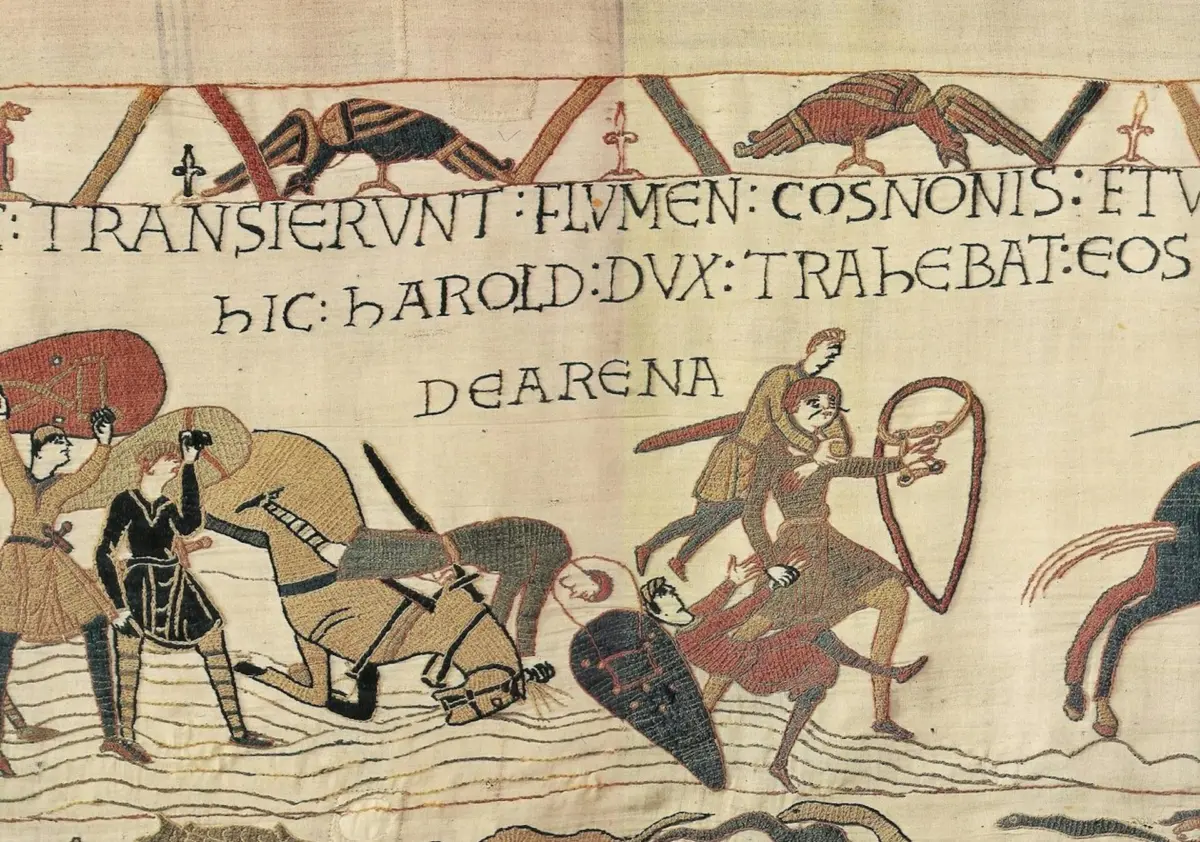
Eyewitness accounts immortalized in the Bayeux Tapestry—specifically the Latin caption “hic Harold dux trahebat eos de arena” (“Here Duke Harold dragged them from the sand”)—depict the English lord performing acts of extraordinary bravery. Distinguished from his clean-shaven Norman counterparts by his luxuriant moustache, Harold is shown gripping his shield with one hand while using the other to hoist a floundering soldier from the grasping mud. Another foot-soldier clings desperately to Harold’s back as he wades through the slurry to safety.
Chronicles from the period, such as those penned by the Norman historian Orderic Vitalis, noted Harold’s imposing physical stature, eloquence, and bravery, describing him as a man remarkable for his physical strength and acts of courage—even if contemporary chroniclers later questioned his ultimate honor.
4. Victory at Dol and Dinan
With the immediate crisis averted, the combined forces pushed deeper into Brittany. Harold fought valiantly alongside William, helping to rout Duke Conan’s forces from the fortified town of Dol and forcing a subsequent surrender at the clifftop citadel of Dinan, where Conan symbolically surrendered the city keys on the tip of a lance.
The military partnership yielded tactical success and cemented a temporary bond of mutual respect between the Norman Duke and the English Earl.
5. The Oath at Bayeux and the Road to 1066
Following the successful Breton campaign, William brought Harold back to Bayeux to celebrate their victory and cement their political alignment. It was here that the tragedy of their relationship deepened.
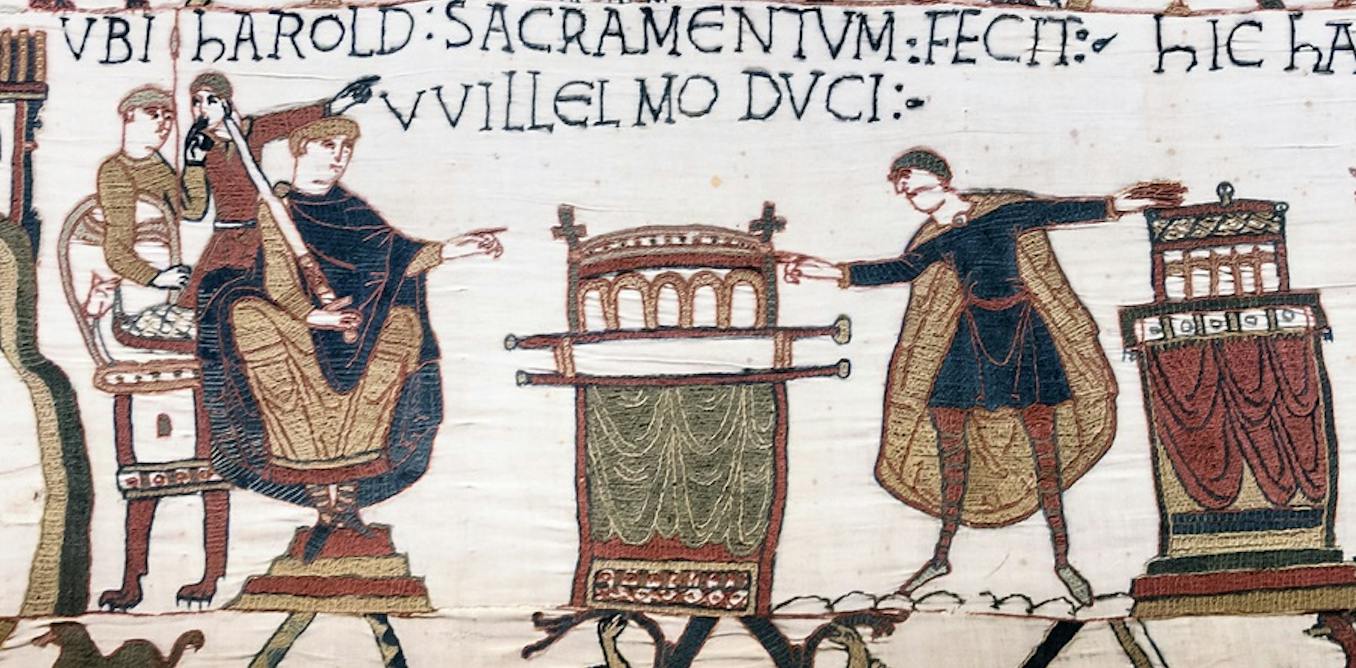
In a ceremony depicted vividly on the tapestry, Harold was pressured into swearing a solemn oath of loyalty to William, placing his hands upon sacred holy relics. While accounts differ regarding whether Harold fully understood the implications of the vow—or the true nature of the holy objects concealed beneath the altar cloth—the oath bound him to support William’s claim to the English throne.
When King Edward the Confessor died in January 1066, Harold broke this oath, accepting the crown of England for himself. For William, this act of perceived perjury provided both the moral justification and the righteous fury needed to assemble an invasion fleet, cross the Channel, and meet Harold on the blood-soaked ridge of Hastings on October 14, 1066.
Supporting Context & Metrics: Decoding the Bayeux Tapestry
Measuring approximately 68.3 meters long and 50 centimeters wide, the Bayeux Tapestry is not a true woven tapestry, but rather an embroidered masterpiece crafted with woolen yarns on a linen background. Commissioned likely by Bishop Odo of Bayeux, William’s half-brother, the artifact serves as a piece of Norman propaganda designed to legitimize the Conquest. Yet, beneath its primary narrative lurks a wealth of subtle symbolism.
The Border Subplot: Eels, Predators, and Omens
To fully appreciate the narrative genius of the Bayeux Tapestry, historians advise looking away from the central action and focusing instead on the upper and lower decorative borders. These marginal spaces are populated by animal motifs, scenes from Aesop’s fables, and symbolic commentary that foreshadows the tragedy to come.
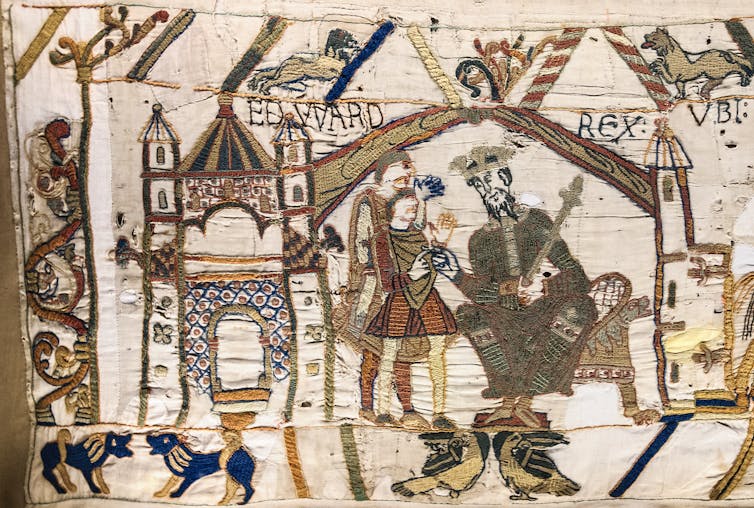
- The Quicksand Borders: In the margins surrounding the dramatic rescue scene at the Couesnon River, the embroidered fauna mirrors the natural biodiversity of the Bay of Mont Saint-Michel, featuring birds, fish, and—most notably—writhing, twisting eels.
- The Slippery Metaphor: Throughout the border, a human figure attempts to grasp the eels, only for them to slip repeatedly through his fingers. Medieval art historians interpret this as a wry, pointed commentary on Harold Godwinson himself: charismatic, charming, yet ultimately as slippery and unttrustworthy as an eel in the eyes of his Norman chroniclers.
- Predatory Foreshadowing: Flanking the eels are depictions of eagles and wolves—symbols of violence, predation, and impending doom. Even at the height of Harold’s heroism, the tapestry’s borders construct a chilling premonition of betrayal and death.
Archaeological and Geographical Realities
Re-tracing the steps of William and Harold across the Bay of Mont Saint-Michel reveals the timeless lethality of the landscape. Modern guides continue to warn visitors against traversing the tidal flats without expert supervision. The interplay of the Atlantic tides produces one of the fastest rising water levels in Europe, transforming seemingly solid sand flats into drowning traps within minutes. The tactile reality of the sables mouvants—where a simple shifting of weight causes the earth to liquefy beneath one’s boots—lends profound authenticity to the panic captured by the 11th-century artisans.
Official Statements & Museum Perspectives
As preparations accelerate for the historic loan and public exhibition of the Bayeux Tapestry at the British Museum this September, cultural leaders and curators have emphasized the cultural and historical weight of the artifact.
"The Bayeux Tapestry is much more than a historical record of a battle; it is a human document filled with nuance, psychological tension, and profound tragedy," noted a senior curatorial spokesperson for the upcoming London exhibition. "By bringing this magnificent work to the British Museum, we invite contemporary audiences to look beyond the simplistic narrative of conqueror and conquered, and to examine the complex personal relationships that preceded the tragedy of 1066."
Medieval historians collaborating on the exhibition have similarly stressed the importance of contextualizing the artifact’s minor scenes.
"When visitors trace the tapestry from its beginning to its harrowing conclusion—marked by the iconic arrow in the eye and the mutilation of the fallen—they are looking at the final act of a Shakespearean drama," explained a leading medieval scholar. "The rescue at Mont Saint-Michel is the pivot point where friendship and mutual survival curdled into suspicion and war. It reminds us that history is forged by complex human choices, not predestined enmity."
Future Outlook: The Tapestry’s Journey and Scholarly Legacy
The upcoming exhibition at the British Museum represents a monumental milestone in international cultural exchange. Transporting an artifact of such staggering historical value and fragility requires unprecedented conservation measures, structural monitoring, and security protocols.
For decades, the tapestry has remained permanently housed in its specialized gallery in Normandy, drawing millions of international tourists annually. The temporary relocation to London not only underscores the enduring diplomatic and cultural ties between France and the United Kingdom, but also guarantees a surge in academic research and public engagement.
As conservationists utilize advanced multispectral imaging and textile analysis to uncover new secrets locked within the linen fibers and wool threads, our understanding of the Norman Conquest continues to evolve. Future historical inquiries will undoubtedly continue to probe the gray areas of 1066—separating Norman propaganda from Anglo-Saxon reality.
When visitors stand before the Bayeux Tapestry in London this autumn, tracing the embroidered threads from the heroic rescue in the quicksands of the Couesnon River to the devastating carnage at Hastings, they will witness a timeless human truth. History is rarely a simple tale of black and white, good and evil. At its core, the story of 1066 remains a tragedy of two extraordinary men who were once brothers in arms, undone by ambition, politics, and the relentless march of fate.