Executive Overview
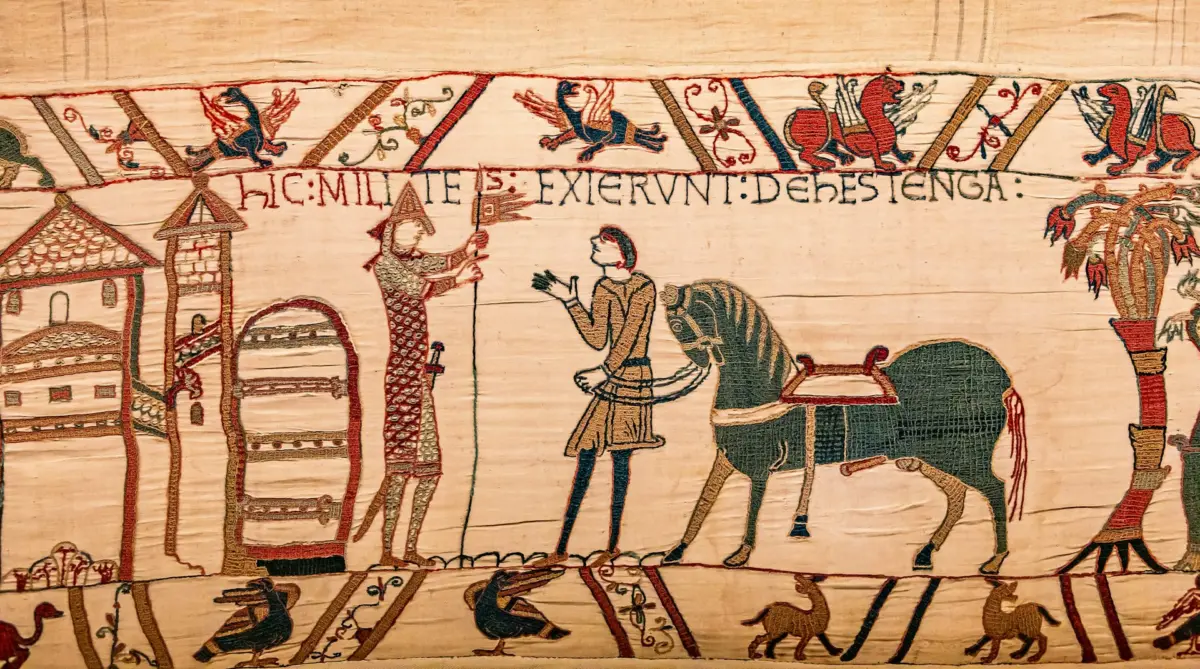
For nearly a thousand years, the Bayeux Tapestry has occupied a foundational space in the teaching and understanding of British and European history. Spanning an astonishing 70 meters in length, the embroidered cloth meticulously documents the sweeping narrative of the Norman Conquest, culminating in the pivotal events of 1066: the fateful Battle of Hastings and the dramatic death of King Harold II. Yet, beneath its status as a staple of historical education and a monumental work of collaborative art lies a profound misconception. The artifact is not a tapestry at all—it is an embroidery.
This distinction is far more than a matter of textile semantics. By miscategorizing the work, generations of historians and art critics have inadvertently obscured its rightful place in the continuum of women’s creative labor, political dissent, and visual storytelling. When viewed through the analytical lens of modern visual culture, the Bayeux embroidery emerges not merely as a piece of medieval propaganda, but as a direct historical ancestor to the modern comic book and graphic novel.
Like sequential art, the embroidery utilizes panels, recurring characters, visual pacing, and symbolic imagery to convey a complex political narrative to a predominantly non-literate public. Furthermore, when positioned alongside later traditions of narrative needlework—such as the politically defiant arpilleras of Pinochet-era Chile and the poignant story cloths of the Hmong people during the Laotian Civil War—the Bayeux embroidery reveals a deeper, global lineage. It stands as a testament to how marginalized communities, particularly women, have historically utilized needle and thread to claim a stake in historical record-keeping, weaponizing visual narratives for nation-building, trauma processing, and political defiance.
Detailed Chronology: From 11th-Century Conquest to Modern Visual Medium
To fully grasp the magnitude and mechanics of the Bayeux embroidery, it is necessary to trace its origins, its physical construction, and the milestones of its ongoing historical interpretation.
The Mid-to-Late 11th Century: Creation of the Monument
- c. 1066–1082: Following the Norman Conquest of England, preparations for the monumental embroidery begin. While traditional historiography often linked its commissioning to Queen Matilda, wife of William the Conqueror, modern scholarly consensus suggests it was likely commissioned by Odo, Bishop of Bayeux and half-brother of William, to adorn his newly rebuilt cathedral in Normandy.
- The Medium: Anonymous Anglo-Saxon or Norman craftspeople—predominantly women, given the high skill level of English needlework at the time—utilize worsted wool yarn (known historically as crewel) to stitch images onto a continuous strip of bleached linen cloth measuring approximately 0.5 meters wide by 70 meters long.
- The Visual Narrative: The work unfolds across roughly 58 distinct scenes, utilizing eight distinct shades of wool (primarily terracotta, blue-green, dark green, yellow, and buff) to depict the lead-up to the invasion, Halley’s Comet in 1066, the crossing of the English Channel, and the chaotic violence of the Battle of Hastings.
The Enlightenment to the 19th Century: Rediscovery and Categorization
- 1729: The embroidery is "rediscovered" by French scholar Antoine Lancelot, drawing renewed academic and public interest after centuries of remaining largely localized to Bayeux Cathedral, where it was traditionally displayed annually during the Feast of Relics.
- 19th Century: As nationalist movements sweep Europe, the artifact is systematically studied, categorized, and unfortunately misnamed as a "tapestry"—a technical error that persists in popular culture for the next two centuries, despite tapestries being woven on looms and the Bayeux piece being hand-embroidered onto a pre-existing foundation cloth.
The Late 20th Century to Present: Re-evaluating the Medium
- 1960s–1980s: Historians such as George Wingfield Digby begin analyzing the work not just as a static textile, but as a dynamic visual narrative designed for a public largely incapable of reading Latin text.
- Modern Era: Contemporary comic scholars and media theorists recognize the embroidery as the oldest surviving continuous graphic narrative, sharing direct DNA with modern sequential art, instructional manuals, and political cartoons.
Supporting Context & Metrics: The Anatomy of a Medieval Masterpiece
To understand the Bayeux embroidery as a piece of sequential art, one must examine its structural composition and the sophisticated techniques employed by its anonymous creators.
Visual Storytelling and Sequential Pacing
Art historian George Wingfield Digby famously described the embroidery as being "designed to tell a story to a largely non-literate public; it is like a strip cartoon, racy, emphatic, colourful, with a good deal of blood and thunder and some ribaldry."
Much like panels in a modern comic book, the scenes are separated by architectural motifs, trees, or shifting background colors. The narrative relies on visual continuity: key figures, such as King Harold and Duke William, reappear across multiple panels, allowing the viewer to track their movements, moral trajectories, and eventual downfalls across physical space and chronological time. Motion lines, spatial compression, and directional gazes guide the reader’s eye effortlessly from left to right, mirroring modern reading methods in Western comics.
+-----------------------------------------------------------------------+
|                       THE VISUAL CONTINUUM                            |
|                                                                       |
|   [Panel 1: Oath] ---> [Panel 2: Voyage] ---> [Panel 3: Battle]       |
|   (Setting terms)       (Action in transit)     (Climax & Demise)     |
+-----------------------------------------------------------------------+
Metrics of the Artifact
- Total Length: ~68.38 meters (224 feet)
- Current Height: 0.5 meters (20 inches)
- Number of Scenes: 58 distinct narrative panels
- Color Palette: 8 primary shades of worsted wool yarn
- Characters Depicted: Over 600 human figures, 762 horses, 41 dogs, numerous other animals, and various mythical beasts.
- Anatomical Eccentricities: 93 visible penises, predominantly belonging to horses, showcasing the subversive humor and artistic license injected by the makers into the margins (drolleries) of the official political narrative.
Comparative Universal Visual Languages
The use of pictures to convey complex, universal information without the barrier of literacy is a strategy utilized across civilizations and epochs.
| Monument / Artifact | Historical Era | Medium | Primary Narrative Function |
|---|---|---|---|
| Trajan’s Column (Rome) | 113 CE | 30-meter marble column with 190m frieze | Commemorates military prowess in the Roman-Dacian Wars; accessible to multi-ethnic traders and citizens regardless of Latin literacy. |
| Bayeux Embroidery (Normandy/England) | c. 1066–1082 | 70-meter wool-on-linen cloth | Legitimize the Norman Conquest and William’s claim to the English throne for a largely illiterate feudal public. |
| Chilean Arpilleras (Chile) | 1973–1990 | Burlap scraps and textile remnants | Document state-sponsored violence and memorialize the "disappeared" under General Pinochet’s dictatorship. |
| Hmong Story Cloths (Laos/Diaspora) | 1959–1975 | Colorful embroidered cotton and thread | Record the displacement, agrarian life, and trauma of the Laotian Civil War ("Secret War"). |
Official Statements & Academic Perspectives
The re-evaluation of the Bayeux artifact bridges historical textiles, feminist art history, and comics scholarship. Academics and researchers working at the intersection of these fields emphasize the necessity of reclaiming the terminology and recognizing the hidden voices woven into the fabric of power.
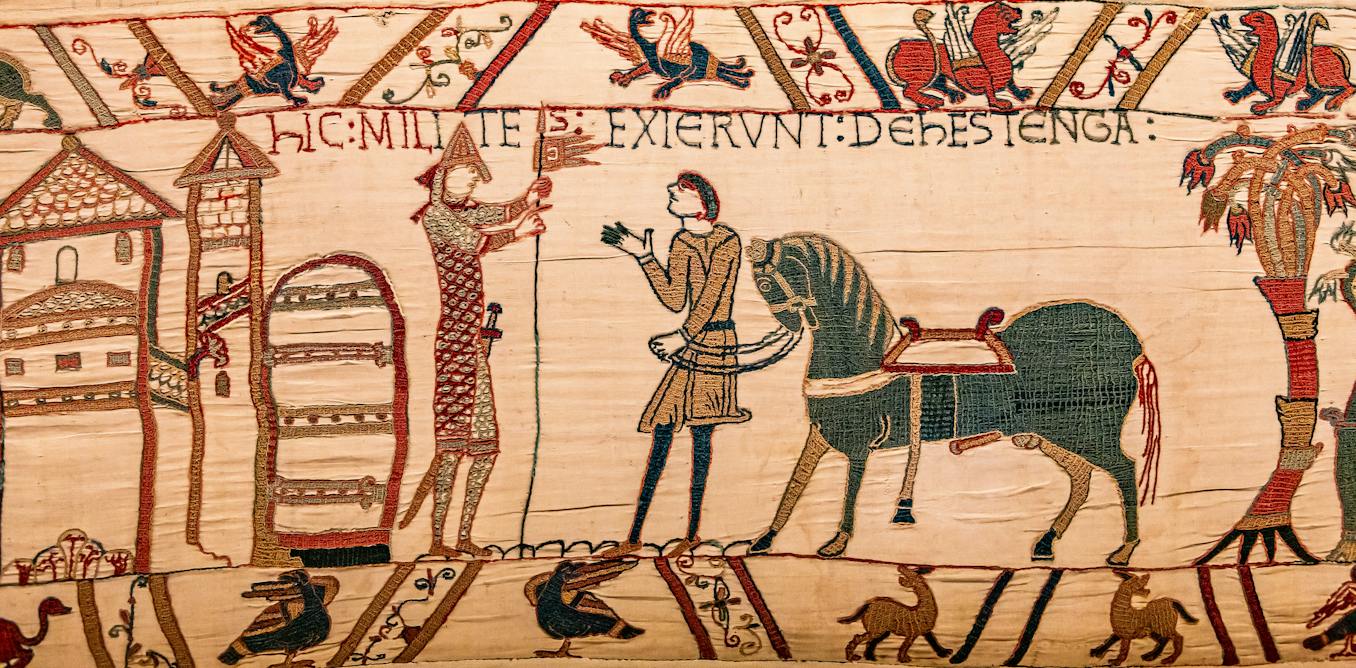
"We should use the correct terminology if we are going to place this piece into its rightful place in the history of women’s creative labour and especially embroidery. Embroidery may be typically considered a solo pursuit of little political importance but this is not the case, as the Bayeux creation clearly shows."
— Academic and Comics Researcher
Scholars focusing on the sociology of creative labor point out that while the Bayeux embroidery serves a top-down political function—glorifying the triumph of William I—its execution fell entirely into the hands of skilled craftspeople operating behind the scenes.
"While the Bayeux tapestry was created as a narrative of victory, it was still created by women who would have had very little voice in their own communities and whose labour sits in the background of the work itself. The work of the women who embroidered the greatness of William I could be seen as the creative precursor of that of the women who embroidered their murdered loved ones in Chile and Laos."
— Research Excerpt on Narrative Needlework
Furthermore, experts in sequential art argue that expanding the definition of comics beyond commercial superhero fiction allows us to recognize graphic narratives as a fundamental human instinct.
"Comics is not just superheroes and spandex; it can be public art, telling public stories. And if we widen the definition just a little bit, there are many more stories waiting to be discovered."
— Commentary on Visual Narratives and Public Memory
Future Outlook: Expanding the Canon of Graphic Literature
As academic disciplines become increasingly interdisciplinary, the boundaries separating fine art, popular culture, and historical textiles are dissolving. The future of comics studies and medieval historiography points toward a more inclusive understanding of how human beings have historically recorded trauma, political transition, and collective memory.
1. Re-centering Needlework in Art History
Future research initiatives are focusing heavily on the technical methods of narrative reading embedded within textiles. By analyzing how stitch direction, color juxtaposition, and spatial division operate as "gutter spaces" (the blank spaces between panels in modern comic theory), researchers can better understand how medieval viewers consumed visual stories. This approach elevates embroidery from a domestic craft to a sophisticated communicative technology.
2. Global Parallels in Resistance Art
The connection established between the Bayeux embroidery, Chilean arpilleras, and Hmong story cloths opens new avenues for studying grass-roots archival practices. In an era marked by digital ephemera, contemporary artists and activists continue to turn to tactile, hand-crafted media to bear witness to systemic injustice. Recognizing the medieval craftspeople of 1066 as artistic ancestors to modern political quilters and graphic novelists validates the enduring power of manual labor in political discourse.
3. Broadening the Definition of Comics
Museum curators and educational institutions are increasingly rethinking how they display and contextualize ancient visual artifacts. By presenting the Bayeux embroidery alongside modern sequential art, exhibitions can bridge the gap between antiquity and contemporary culture. This pedagogical shift encourages students and museum-goers alike to look past the "superhero" monopoly on the word comics and recognize that visual storytelling is as old—and as vital—as human civilization itself.