Executive Overview
What happens if the sun disappears?
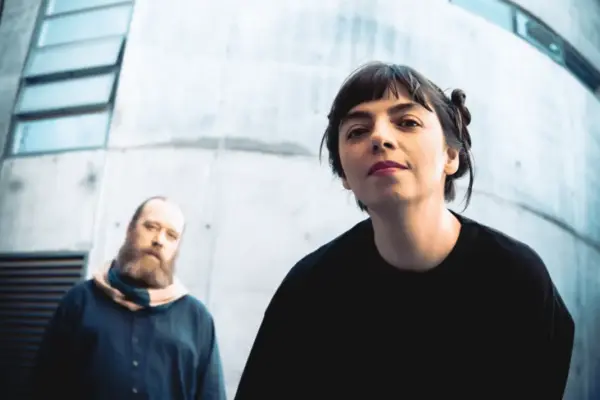
It is an existential question, an apocalyptic thought experiment, and the ethereal prompt that hung heavy over the stage at the Viljandi Folk Music Festival on the morning of its closing day. As festival-goers gathered in the crisp Estonian air, genre-defying quartet Tell Your Birds stepped forward to debut a suite of material from their heavily anticipated, yet-unreleased sophomore record.
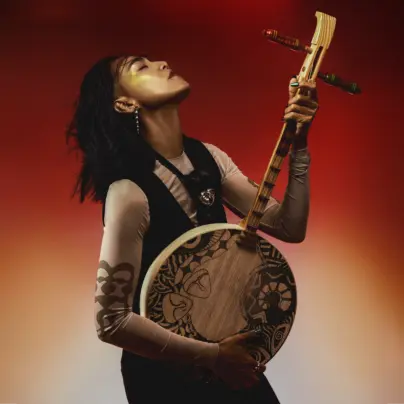
The performance was a masterclass in modern folk deconstruction. Kristāne Tukre’s concert kokle wove intricate geometric patterns through the morning atmosphere; Vija Moore’s balafon provided a warm, percussive undercurrent; and Kärt Tambet’s bowed hiiu kannel cut through the mix like a sharp gust of wind. All of this acoustic resonance was channeled directly into Simone Spampinato’s digital processing unit, bridging ancient European box zithers with contemporary electronic manipulation. Singing simultaneously in Estonian and Latvian—each artist stubbornly and poetically retaining their native tongue—the band blurred the lines between historical preservation and sonic futurism.
Minutes after stepping off the stage, in the final hour before the quartet dispersed for the summer, we sat down with the band. Surrounded by the lingering hum of the festival grounds and battling a temperamental audio recorder that cut out every few minutes, our conversation naturally mirrored the band’s own working rhythm: a sudden burst of intense creativity, a hard stop, and a scattering across Northern Europe.
With members currently split across Helsinki, Viljandi, and Riga, Tell Your Birds operate not as a traditional touring unit, but as a nomadic creative collective. Their music exists at the intersection of geography, linguistics, and deep-rooted mythologies. As they prepare for a major album release in April 2027—following the June drop of their single "Pa saulei"—the band is redefining what it means to be a modern folk ensemble in the Baltic-Nordic region.
Detailed Chronology: The Anatomy of a Transnational Collaboration
To understand the sound of Tell Your Birds is to understand the map of Northern Europe. The band’s existence is defined by physical distance, cross-border migration, and a deliberate rhythm of reunion and separation.
The Nordic-Baltic Triangle
The quartet’s daily reality is mapped across three distinct urban centers:
- Helsinki, Finland: Home to Kristāne Tukre and electronic sound designer Simone Spampinato.
- Viljandi, Estonia: Home to hiiu kannel player Kärt Tambet.
- Riga, Latvia: Home to balafon player Vija Moore.
Because of this dispersion, the band’s creative process is intensely compressed. They do not enjoy the luxury of weekly garage rehearsals or casual jam sessions. Instead, they operate in hyper-focused residency blocks. They gather for a few short days, write furiously, track everything they can, and then scatter back to their respective cities until the next window opens.
This rhythmic isolation seeps directly into their music. The tracks carry the urgency of a fleeting moment—a recognition that their time together in the same room is strictly limited, forcing every melody and arrangement to earn its place.
The Evolution of the Zither Family
Tukre’s musical lineage provides a crucial anchor for the band’s cross-border ethos. Her journey began with the classical kantele, though her primary instrument at home is the Latvian kokle.
Across the Baltic and Nordic regions, box zithers exist in a fascinating state of acoustic kinship. The Estonian kannel, the Latvian kokle, and the Finnish kantele are literal cousins, sharing a structural DNA that spans national borders despite carrying different names and minor structural variations. For Tukre, this regional phenomenon is a wellspring of inspiration rather than a barrier.
"We have a very interesting phenomenon here in the Baltics and in Finland," Tukre reflects. "We have these string instruments; they’re similar, but at the same time very different. They have different names, but we, musicians, try to come together."
This spirit of cross-border curiosity ultimately brought Tukre to Finland, where she studied the kantele at the prestigious Sibelius Academy in Helsinki. It was within those academic halls that the geographical and musical threads of Tell Your Birds finally intersected, allowing a Latvian kokle player in Finland to link up with Estonian and Latvian counterparts to forge an entirely new sonic lexicon.
Supporting Context & Metrics: Deconstructing Tradition and Language
The musical output of Tell Your Birds resists easy categorization. While it draws heavily on the rich cultural tapestries of Estonia and Latvia, it refuses to serve as a mere museum piece.
Building a Self-Sourced Songbook
According to Kärt Tambet, the vast majority of the band’s repertoire is entirely original.
"Most of the music is actually original music that we have composed together, or separately, but brought to this group," Tambet explains.
Interwoven with these original compositions are fragments of traditional folk melodies, ancient myths, local folklore, and textual poetry delivered as raw syllables. However, the band exercises rigorous academic and artistic stewardship over how historical material is handled. Before introducing a traditional motif into their avant-garde arrangements, Tambet insists on absolute clarity regarding its provenance and original intent.
"There’s a lot of using a tradition in music," Tambet notes. "You have to be aware of it, and translating it to others. It’s highly important that we’re aware where it’s coming from and what the original intention behind that tradition is, so we can translate it into our own musical language."
Linguistic Alchemy: Estonian and Latvian on the Same Stage
One of the most striking aspects of a Tell Your Birds performance is the vocal interplay. Rather than adopting a lingua franca like English or selecting a single Baltic language for a song, the vocalists sing in Estonian and Latvian simultaneously.
Each artist clings fiercely to the language they grew up speaking, allowing the cadence, vowel shapes, and glottal stops of two distinct Finno-Ugric and Baltic language families to rub against one another. The syllables themselves often dictate the trajectory of a song—determining whether a melody takes on a melancholic Estonian minor hue or a brighter, rolling Latvian cadence. The result is a bilingual tapestry where language is treated as a texture as much as a vehicle for storytelling.
Official Statements & Insights
During our hurried, recorder-plagued interview in the final hour before their summer parting, the members of Tell Your Birds articulated a shared philosophy regarding their art, time, and heritage.
-
On Instrument Cross-Pollination (Kristāne Tukre):
"We live in a region where instruments have different names, but the same soul. By crossing borders—taking the kokle to Helsinki to study the kantele—we realized that our musical borders are entirely artificial. The instruments want to talk to each other; we just have to get out of the way and let them."
-
On Respecting Historical Roots (Kärt Tambet):
"You cannot simply raid tradition for cool sounds without understanding why those songs were sung. Was it a harvest song? A lament for the dark months? A warding-off ritual? Knowing the original intention allows us to reinvent it honestly, translating history into a language for a time that hasn’t happened yet."
-
On Transnational Workflows (Collective Insight):
"Our music is shaped by our absence from one another. Because we only have days at a time in Helsinki, Viljandi, or Riga, there is no room for hesitation. The songs are written for a future we are trying to invent before the clock runs out."
Future Outlook: The Road to April 2027
As Tell Your Birds scatter back to their respective urban bases for the remainder of the summer, the momentum behind the project is palpable.
The release of their single "Pa saulei" in June served as a critical waypoint, signaling a more mature, electronically infused evolution of their acoustic roots. Fans and ethnomusicologists alike have been tracking the band’s progress via their active dispatches on Instagram, where visual snippets of residency sessions and live improvisations offer a glimpse into their rigorous creative engine.
With their debut full-length album officially slated for release in April 2027, Tell Your Birds are positioning themselves at the vanguard of modern European folk fusion. By refusing to choose between acoustic purity and digital processing, between Estonian and Latvian, or between historical reverence and forward-looking speculation, they have crafted a sound that transcends borders.
And if the sun really does disappear one day? You can rest assured that Tell Your Birds will already have written the soundtrack for it—composed across three cities, played on ancient box zithers, and sung in a language that belongs to tomorrow.