Executive Overview
The landscape of software-based wavetable synthesis has reached a fascinating inflection point. For over a decade, Xfer Records’ Serum—conceived and engineered by Steve Duda—held an almost unassailable crown as the go-to soft synth for electronic music producers worldwide. Its intuitive workflow, immense flexibility, and punchy, upfront sonic signature made it a universal standard across genres from bass music to commercial pop. However, the paradigm shifted dramatically in 2020 with the arrival of Vital, a spectral warping wavetable powerhouse developed by Matt Tytel. Offering a stunningly polished interface and, crucially, a fully functional free tier, Vital proved that pro-grade synthesis could be democratized without compromising on depth.
Fast-forward to 2025, and Xfer Records has responded with the long-awaited release of Serum 2. Boasting an expansive array of next-generation features, refined audio architecture, and modernized workflows, Serum 2 reclaims its position at the cutting edge of sound design. Yet, this technological leap introduces a formidable financial and philosophical dilemma for producers: with Serum 2 commanding a $249 price tag, do modern creators genuinely need to invest in a flagship ecosystem, or can the free (or $80 Pro) iterations of Vital fulfill all professional demands?
This comprehensive analysis delves deep into the architectural makeup, sonic capabilities, modulation frameworks, and workflow paradigms of both heavyweights to answer the ultimate question: Is it still worth paying top dollar for pro-grade synthesis?
Detailed Chronology: The Evolution of Wavetable Supremacy
To understand the current battleground between Serum 2 and Vital, one must trace the historical trajectory that brought these two titans into direct competition.

2013–2019: The Serum Monopoly
When Xfer Records introduced Serum in 2013, the virtual studio technology (VST) market was heavily fragmented. While software like Native Instruments’ Massive dominated the dubstep and electro-house scenes, Serum changed the game by offering a WYSIWYG (What You See Is What You Get) visual workflow. Producers could visually manipulate wavetables, observe real-time modulation assignments, and enjoy pristine, aliasing-free audio engines driven by advanced oversampling. Serum quickly became a fixture in professional studios, spawning an entire micro-economy of third-party preset packs, wavetable expansions, and tutorial ecosystems. For years, requests for a "Serum 2" were met with continuous, feature-rich updates, cementing its reputation as a bulletproof industry standard.
2020: The Vital Disruption
The status quo was upended in 2020 when Matt Tytel released Vital. Having previously gained acclaim for his Helm synthesizer, Tytel engineered Vital as a direct philosophical and architectural challenge to Serum. Utilizing spectral warping wavetable technology, Vital mirrored Serum’s visual-first ethos while introducing modern conveniences such as stereo LFO offsets, real-time modulation parameter previews, and a sophisticated drag-and-drop matrix. Most disruptive, however, was its distribution model: Vital offered a fully operational free version with zero time limits, sending shockwaves through the production community and instantly establishing itself as the premier zero-cost alternative for cash-strapped beatmakers.
2025: The Counter-Punch – Serum 2
Recognizing the shifting competitive landscape, Xfer Records delivered Serum 2 in 2025. Moving far beyond a mere maintenance update, Serum 2 represents a ground-up expansion of Duda’s original vision. By integrating multisample capabilities, granular engines, real-time spectral resynthesis, and advanced bus routing, Serum 2 answered its critics and pushed the boundaries of what a single wavetable plugin could achieve. This set the stage for an intense modern showdown between an established, multi-developer flagship and an indie-engineered masterpiece.
Comparative Deep Dive: Feature-by-Feature Analysis
To determine which instrument best suits your production pipeline, we must dissect their core components: oscillators, filters, effects, and modulation matrices.

Oscillators and Sound Generation
At the heart of any wavetable synth lies its oscillator section, and both instruments deliver immense sonic potential, albeit through different design philosophies.
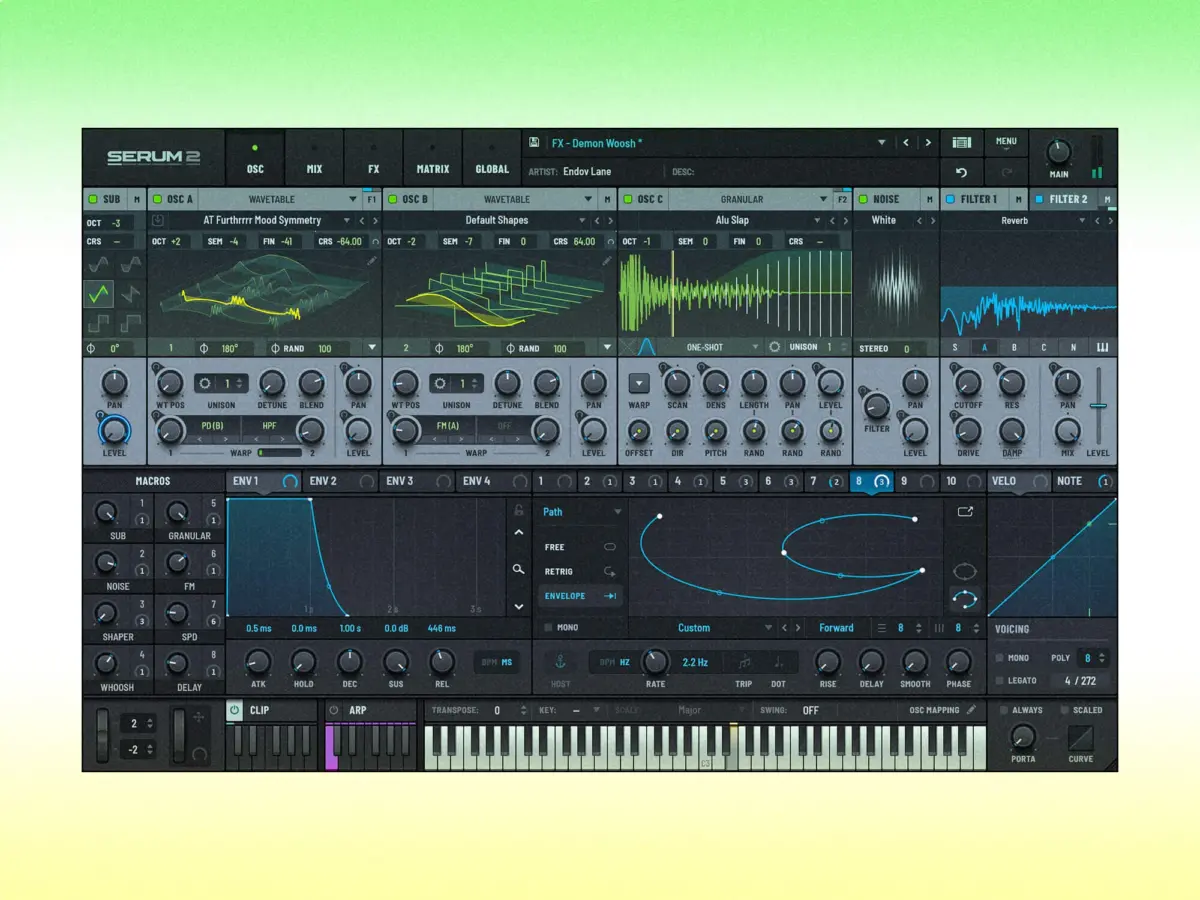
- Serum 2: Equips users with three primary wavetable oscillators, alongside a dedicated sub-oscillator and a noise oscillator capable of loading texture layers or transient samples. Crucially, Serum 2 introduces four revolutionary oscillator types: a multisample engine for organic acoustic layers, a dedicated looping/slicing sample oscillator, a flexible granular engine, and a spectral oscillator for real-time resynthesis. Furthermore, Serum 2 ships with a massive library of 288 native wavetables and features two Warp engines housing 32 distinct warp, filter, and distortion algorithms.
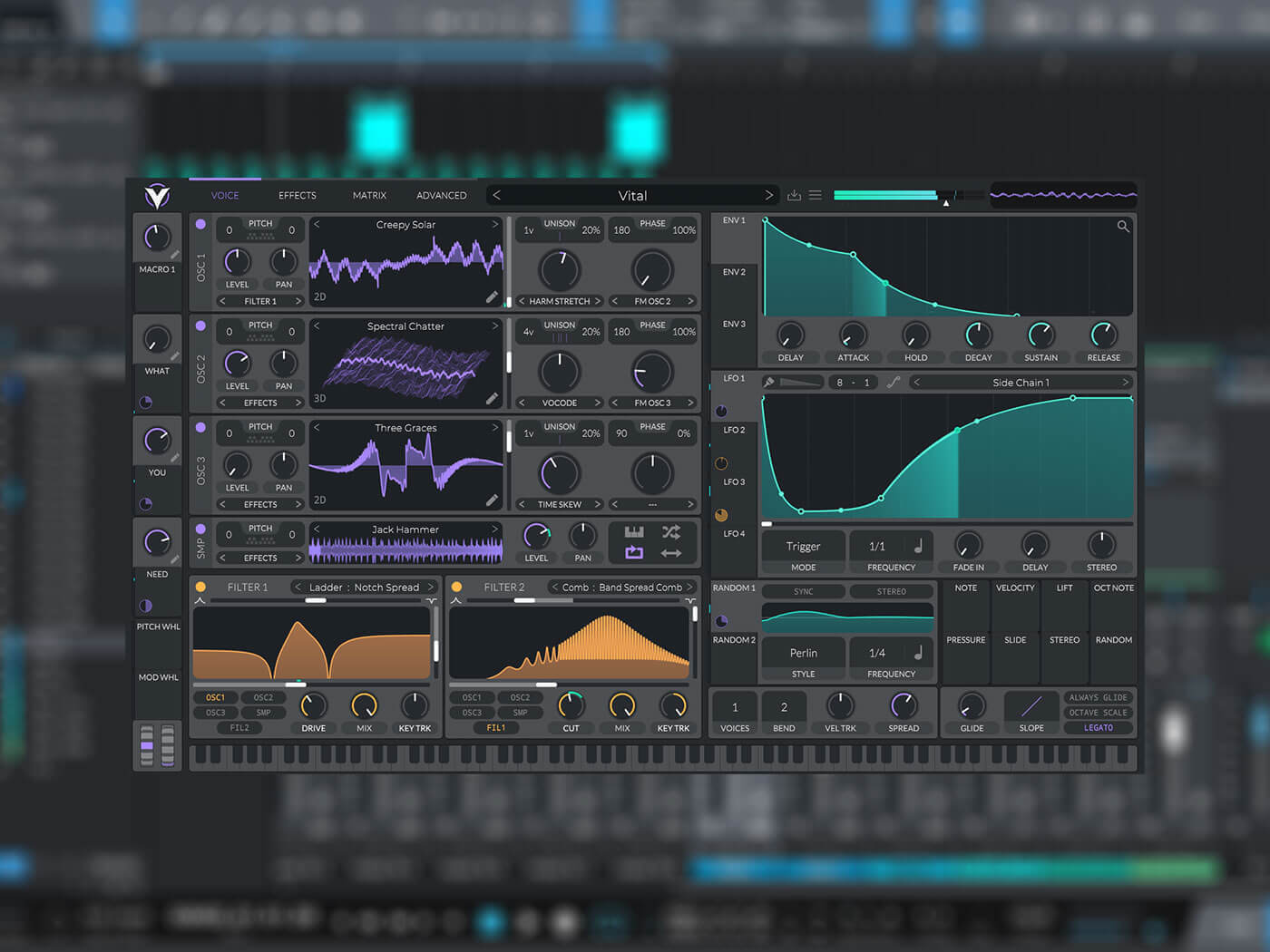
- Vital: Matches Serum with three wavetable oscillators and a versatile sample oscillator (though lacking a separate, dedicated sub). Vital utilizes 15 spectral morph modes and six wave morph modes alongside frequency modulation (FM) and ring modulation. However, its stock library is far leaner, providing just 25 wavetables in the free version (though expandable via third-party content).
The Verdict: While both synths produce crisp, artifact-free audio when utilizing high-quality oversampling, Serum 2’s inclusion of multisample, granular, and spectral engines elevates it into a true hybrid workstation. Vital remains remarkably potent for pure wavetable design, but Serum 2 handles multi-layered acoustic and electronic soundscaping with significantly less reliance on external plugins.
Filters and Signal Routing
Sound character is heavily defined by how a synth handles filtering, and both plugins offer dual-filter architectures with serial and parallel routing options.
- Serum 2: Elevates filter design to an art form. It includes an exhaustive array of filter modes—comb, phase, flange, formant, scream, ladder, and more. A standout feature is the custom XY-pad filter mode, which allows producers to draw in four variations of complex notches and morph between them fluidly—an essential tool for sculpting aggressive, evolving neuro-basslines.
- Vital: Offers 32 distinct filter options, each equipped with a morph slider to dynamically alter curve shapes. While Vital’s filters sound warm and responsive, critical listening reveals that Serum 2’s filters retain a microscopic edge in transient clarity and high-end air.
Effects Processing
Modern sound design often relies on internal processing to push patches from raw tone to mix-ready glory.
- Serum 2: Features 12 modular effects units, headlined by newly added convolution reverb and frequency shifter processors. Crucially, Serum 2 allows for multi-band signal splitting (processing low and high frequencies independently) and incorporates dual Bus effects, enabling hyper-targeted routing, such as applying delay exclusively to a single oscillator.
- Vital: Provides nine high-quality effects that can be reordered freely. Vital scores points for interface feedback, featuring delightful graphical visualizers within effects like compression and distortion. However, its routing is inherently more linear compared to Serum 2’s split-band capabilities.
Modulation Architecture
Modulation is where electronic music comes alive, and both synths provide near-infinite routing possibilities via drag-and-drop interfaces.
- Vital: Truly shines in this category. It offers up to six envelopes, eight LFOs with ultra-crisp vector graphics, two random generators, and a powerful modulation remapping tool. Standout workflow features include stereo LFO offsets (sending independent modulation signals to left and right channels for instant stereo width), real-time parameter previewing upon dragging a mod source, and oscillator scale-locking for in-key rhythmic arpeggios.
- Serum 2: Counters with an expanded LFO count, advanced random generators featuring XY path-tracing, and a robust modulation matrix with built-in curve remapping. While it lacks Vital’s stereo LFO offset natively, its modulation depth satisfies even the most demanding modular synthesis enthusiasts.
Supporting Context & Metrics: Market Dynamics and Accessibility
When evaluating software investments, financial metrics and community ecosystems play a decisive role.
| Feature / Metric | Serum 2 (Xfer Records) | Vital Free / Vital Pro (Vital Audio) |
|---|---|---|
| Price Point | $249 USD | Free / $80 USD (Pro Tier) |
| Development Team | Multi-developer enterprise | Independent (Matt Tytel) |
| Primary Oscillators | 3 Wavetable + Sub + Noise + Multisample/Granular/Spectral | 3 Wavetable + Sample Oscillator |
| Factory Wavetables | 288 | 25 (Free) / 150 (Pro) |
| Effects Rack | 12 Units (with multi-band splitting & bus effects) | 9 Units |
| Preset Ecosystem | Massive, industry-standard global library | Rapidly expanding, extensive community library |
The Developer Factor
An often-overlooked metric in software longevity is corporate backing versus independent maintenance. Xfer Records is a stable commercial entity with dedicated customer support, a robust website infrastructure, and guaranteed long-term compatibility updates across emerging operating systems and digital audio workstations (DAWs). Conversely, Vital is primarily driven by Matt Tytel. While its open-source underpinnings provide a fascinating safety net for the community, relying on a single developer introduces questions regarding long-term enterprise support—though its track record of stability thus far has been exemplary.
Official Statements and Industry Insights
The release of Serum 2 and its ongoing rivalry with Vital has sparked widespread commentary across the professional audio engineering community.

Industry veterans note that the psychological barrier of choice is a critical factor in modern music production. In a recent developer briefing, Xfer Records emphasized that Serum 2 was built not merely to chase trends, but to consolidate multiple production tools into a single, cohesive window. "Producers spend too much time bouncing between samplers, granular processors, and wavetable synths," noted a lead sound designer associated with the Serum 2 development cycle. "Our goal was to integrate those auxiliary disciplines directly into the Serum workflow without sacrificing the speed and clarity our users expect."
Conversely, proponents of Vital champion its accessibility and hyper-focused workflow. Independent electronic artists frequently highlight that Vital’s constraint-driven environment prevents "plugin fatigue." By offering intuitive visual feedback loops—such as pre-hearing modulation destinations—Vital encourages rapid experimentation without demanding a steep financial or cognitive investment.
Future Outlook: Which Synth Dominates Tomorrow’s Studio?
As we look toward the future of software synthesis, both Serum 2 and Vital occupy secure, albeit distinct, territories within the producer’s toolkit.
- The Case for Serum 2: If you require an uncompromising, all-in-one workstation that handles pristine wavetables, complex multi-sampling, granular texturing, and advanced spectral manipulation under one roof, Serum 2 justifies every dollar of its $249 price tag. It is an investment in professional longevity, universal preset compatibility, and bleeding-edge sound design capability.
- The Case for Vital: If you are an aspiring producer, operating on a strict budget, or simply prefer an interface optimized for rapid stereo modulation and lightning-fast sketching, Vital (in either its generous free tier or its $80 Pro incarnation) remains an absolute marvel of modern software engineering.
Ultimately, neither synth makes the other obsolete. Vital democratized the art of spectral wavetable synthesis, proving that world-class sound quality can be accessible to all. Serum 2 has responded by raising the ceiling, expanding the definition of what a software synthesizer can accomplish. For the modern producer, the choice is no longer about finding a functional tool, but rather selecting the specific creative partner that aligns with your workflow, budget, and sonic ambitions.