Executive Overview
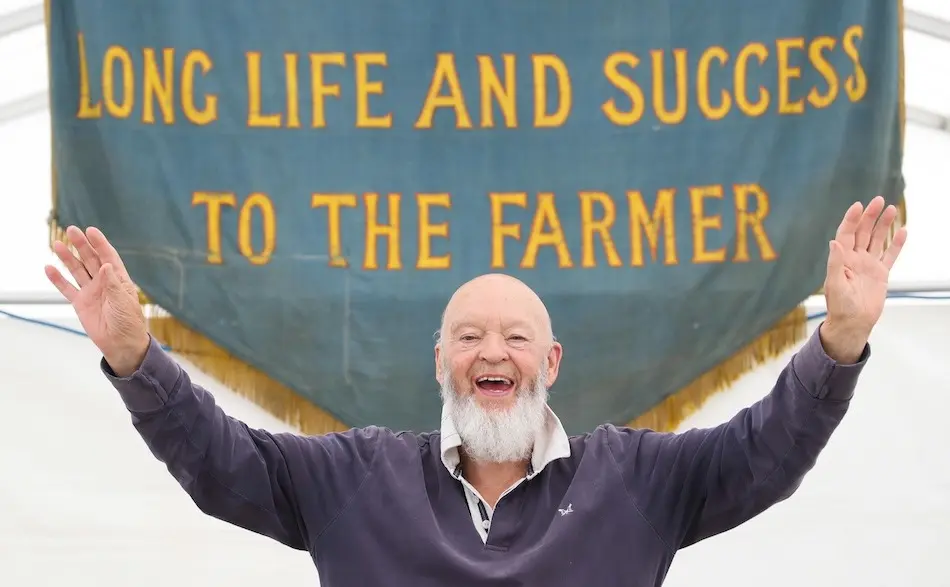
To generations of music lovers, cultural tourists, and bohemian pilgrims, Worthy Farm in Pilton, Somerset, is sacred ground. It is the birthplace and spiritual home of the Glastonbury Festival—an institution that has evolved from a modest 1970 dairy-farm gathering into the greatest performing arts festival on Earth. On October 17, 2025, the visionary behind this global phenomenon, Sir Michael Eavis, celebrated his milestone 90th birthday.
Sitting down for an exclusive interview at his Somerset home, captured through the lens of photographer Rik Mav, a remarkably spry and reflective Eavis surveyed more than five decades of historic cultural curation. Far from slowing down, the nonagenarian dairy farmer remains deeply integrated into the creative pipeline of the Festival, the daily operations of his working farm, and the enduring social fabric of his local community.
As the Festival navigates its scheduled fallow year, this comprehensive feature explores Eavis’s extraordinary journey. From early, grueling battles with local magistrates and law enforcement to the global expansion of the Worthy Farm cheddar brand, and his profound philanthropic footprint—including the construction of 52 social houses for Pilton residents—this is the story of a man who built a cultural empire entirely on his own terms.
Detailed Chronology: From 1970 to a Global Legacy
The Genesis: Pilton Pop, Folk and Blues Festival (1970)
The Glastonbury story began not with corporate backing or grandiose ambitions, but with a £1 ticket, free milk from the farm, and a profound love of music. Inspired by the 1970 Bath Festival of Blues and Progressive Music, a 35-year-old dairy farmer named Michael Eavis decided to host his own event. Some 1,500 people gathered to watch T. Rex—who stepped in as headliners after Kinks frontman Ray Davies dropped out—set against the backdrop of the Somerset countryside.
Those early years were fraught with existential threats. Eavis was locked in a perpetual state of friction with local authorities, the village establishment, village magistrates, and regional police forces who viewed the counter-cultural influx with profound suspicion and alarm.
"I think the main thing is that, in those days, I was always at war with the council and the village and the local magistrates and the police," Eavis reflected during his 90th birthday interview. "And it came good. Which is extraordinary, really. But the fight was really what made it work, there’s no doubt about that. It was certainly worth it!"
The early clashes forged a resilience that would define the Festival for decades. Despite warnings from the chairman of the magistrates—who bluntly cautioned Eavis, "If you do this again, you’ve had it"—the farmer pressed on.
Evolution and the Modern Era
Through the decades, Glastonbury survived muddy quagmires, financial near-misses, shifting political landscapes, and the rise of commercial mega-festivals to stand alone as an undisputed cultural titan. Eavis navigated the turbulent waters of the 1970s free-festival movement, the politicized 1980s (marked by strong alliances with the Campaign for Nuclear Disarmament), and the commercial explosion of the 1990s and 2000s without ever losing the counter-cultural soul of Worthy Farm.
Today, the Festival sells out in mere minutes, a testament to its ironclad reputation. When asked if a million tickets could be put on sale and still vanish instantly, Eavis laughed, conceding, "They probably would!"
Yet, for the founder, the magic lies not in corporate scale, but in the immediacy of the art. Reflecting on the most recent iteration of the Festival, Eavis noted that his personal highlight was witnessing Neil Young headline the Saturday night. "He was so good. He really loves performing here and he played such a great set," Eavis remarked, reiterating his standing philosophy: "I always think that the most recent one is the best one. I really do."
Supporting Context & Metrics: Beyond the Music
While the Pyramid Stage dominates global headlines every June, the true ecosystem of Sir Michael Eavis’s life and enterprise stretches far beyond a five-day weekend in early summer.
The Working Farm and the Global Cheddar Empire
Long before he was a legendary festival organizer, Eavis was—and remains—a West Country dairy farmer. The agricultural roots of Worthy Farm are not secondary to the Festival; they are its bedrock.
The farm’s daily output of high-quality milk is channeled directly to Wyke Farms, where it is transformed into authentic Worthy Farm Cheddar. What began as a local agricultural venture has blossomed into a national retail footprint. In a moment of characteristic humility and wonder, Eavis recalled discovering his farm’s cheese stocked on supermarket shelves hundreds of miles away.
"Actually, a couple of years ago, we went to Scotland on the train," Eavis shared. "When we got off in Glasgow, there was a Co-op shop just over the road. So I decided to pop across just to see if they had the cheese." Upon discovering the shelves fully stocked in Glasgow, he marveled, "It was all over the shelves! Isn’t that wonderful?"
Philanthropy and the Pilton Housing Project
Perhaps Eavis’s most enduring legacy away from the spotlight of the music industry is his deep commitment to social equity in his home village. Glastonbury Festival has historically funneled countless millions of pounds to charitable organizations, including Greenpeace, WaterAid, and Oxfam. However, the impact on Pilton itself is uniquely tangible.
Eavis spearheaded the construction of 52 social houses in Pilton, designed explicitly to ensure that local working-class families and young people are not priced out of their ancestral home by rural gentrification. Former England footballer and broadcaster Gary Lineker famously visited the development to open the homes, producing a widely shared documentary feature that broadcast the initiative to the nation.
Reflecting on the houses, Eavis expressed a deeply personal sense of fulfillment: "Gary Lineker came to open the houses, and he really saw the value of them. He did a lovely interview about them and it went everywhere. I think my mother would be proud of me for the houses too. They look lovely on a sunny day. I drive that way out of the village, you know, and I see the sun shining out on them and think, ‘How did all this happen?’"
Official Statements & Personal Reflections
In marking his 90th year, Eavis offered candid insights into his worldview, his faith, and his ongoing creative collaborations during the Festival’s scheduled fallow year.
Keeping the Creative Flame Alive
Even during a year without a festival, Eavis’s diary remains remarkably active. Rather than retreating into quiet retirement, he remains deeply connected to the artistic community that breathes life into Worthy Farm.
"We’re keeping busy," Eavis noted. "I’ve seen both Joe Rush and Arcadia in the last week, which gave me great pleasure as I still really enjoy working with such creative people."
The Moral Compass: Methodism and Politics
Glastonbury has never shied away from socio-political discourse, serving as a platform for environmental activists, political speakers, and global campaigners. When asked whether the Festival’s moral and political backbone stems from his Methodist upbringing, Eavis answered without hesitation: "I’m sure it is."
This unwavering moral framework has ensured that, despite its massive commercial success, the Festival retains a distinct conscience. "Oh absolutely," Eavis affirmed when asked about the enduring political angle of the event. "There will always be a political angle there. And I think people expect that."
Celebrating 90: "My Way"
True to form, Eavis’s celebration for his 90th birthday is rooted firmly in community and family. Eschewing grand celebrity galas or international excess, he planned a gathering in Pilton featuring local residents, family members, and close friends.
When pressed on the entertainment for the evening, Eavis revealed a charmingly modest performance plan: "The plan is to sing three songs with my band."
Asked whether Frank Sinatra’s iconic anthem My Way—an inescapable descriptor of his singular life path—would make the secret setlist, Eavis offered a knowing chuckle: "That’s a good guess!"
Confronted with the observation that he has undeniably lived life entirely on his own terms, the nonagenarian icon smiled: "Ha! Yeah, I think it would be fair to say that."
Future Outlook
As Sir Michael Eavis enters his tenth decade, the question of legacy naturally arises. Yet, the structures he has built—both physical and cultural—suggest that Worthy Farm will endure long into the future.
With daughter Emily Eavis playing a central role in guiding the Festival’s modern direction, the transition of stewardship is secure, bridging the counter-cultural rebellion of 1970 with the multi-generational modern audiences of the 21st century. The social housing in Pilton stands as a permanent monument to community responsibility, while the cheddar in Co-op stores across Britain serves as a daily reminder of the land from which it all sprang.
At 90 years old, Michael Eavis remains the beating heart of Somerset—a dairy farmer, a visionary rebel, a philanthropist, and the undisputed architect of the greatest show on Earth. As he looks out over the sunlit rooftops of the social houses he built for his neighbors, or listens to the plans for the next gathering at Worthy Farm, one thing is certain: he did it his way, and British cultural history will never be the same again.