For generations, fairy tales have served as the cultural bedrock of human imagination, whispering ancient warnings, casting spells of wonder, and navigating the treacherous waters of morality and human desire. But how do these deeply rooted narratives continue to maintain their hypnotic grip on the contemporary psyche? This central question animates The Art of Fairy Tales, a stunning visual exploration curated by Joanna Ebenstein. Rather than treating fairy tales as static relics of the past, the book investigates the ever-evolving lives these stories take on when filtered through the restless imaginations of visual artists across centuries.
Drawing upon Marina Warner’s classical invocation of enargeia—the ancient Greek concept of "shining vitality" that describes how a masterpiece seems almost to breathe and live—Ebenstein’s curated collection captures the vibrant essence of fairy-tale art across epochs. Eschewing a predictable, linear timeline, the book instead allows otherworldly figures from wildly divergent periods to converse directly on the page. William Nicholson’s luminous 1922 illustration of a delicate fairy emerging from a white poppy faces contemporary artist Mat Collishaw’s 1997 unsettling photographs of fairies tangled in technological debris.
By juxtaposing historical works with provocative modern reinterpretations, The Art of Fairy Tales reframes our understanding of folklore. It demonstrates that fairy tales are not fixed texts, but shape-shifting entities. From the Golden Age of Illustration to contemporary critiques of power and gender, this volume reveals how visual artists have continually reinvented the marvellous, proving that these ancient stories endure precisely because they invite endless metamorphosis.
Detailed Chronology: A Visual History of Enchantment
To understand how fairy tales have transformed across time, one must examine the historical milestones and artistic movements that have given them form. Ebenstein’s work highlights how specific eras have captured the zeitgeist of folklore through distinctive aesthetic lenses.
The Golden Age of Illustration (Circa 1880–1930)
The beating heart of Ebenstein’s collection anchors itself in the Golden Age of Illustration, an era when advances in printing technology allowed richly illustrated children’s books to flourish on an unprecedented scale. During this window, artists transformed fairy tales into immersive visual landscapes, blending meticulous craftsmanship with psychological depth.
The Viennese Masterpieces (1905): Austrian artists Heinrich Lefler and Joseph Urban produced sumptuous, highly stylized illustrations for a deluxe Viennese edition of Grimms’ Fairy Tales. Their work leaned into decorative arts and theatrical design, capturing the dark woods and royal courts of the Brothers Grimm with architectural precision and ornamental flair.
The Parisian Avant-Garde (1920s): François-Louis Schmied crafted breathtaking illustrations for the 1926 edition of Histoire de la Princesse Boudour—a French translation of a tale from The Arabian Nights. Published as an Art Deco masterpiece in an ultra-exclusive run of just 20 copies, Schmied’s work married modernist typography with luxurious woodblock printing, elevating children’s literature to high-end fine art.
Shadow and Silhouette Animation (1926): Moving off the printed page and onto the silver screen, German animator Lotte Reiniger revolutionized fairy-tale adaptation with The Adventures of Prince Achmed (1926). Inspired by One Thousand and One Nights, Reiniger used hand-cut silhouette figures manipulated frame by frame, creating the oldest surviving animated feature film. Her delicate, shadow-cast fantasies proved that fairy tales could breathe and move in cinematic space.
Ballet and the Folktale (1915): Russian painter Léon Bakst designed exuberant, sensory-overload posters and stage costumes for Igor Stravinsky’s The Firebird. Bakst’s vision translated traditional Russian folklore into a dizzying choreography of color and pattern, cementing the symbiotic relationship between fairy tales, music, and dramatic arts.
The Modern and Contemporary Metamorphosis
As the twentieth century bled into the twenty-first, the visual language of fairy tales shifted from romantic escapism to critical deconstruction. Artists began using the familiar tropes of folklore to interrogate modern anxieties, shifting technological landscapes, and socio-political shifts.
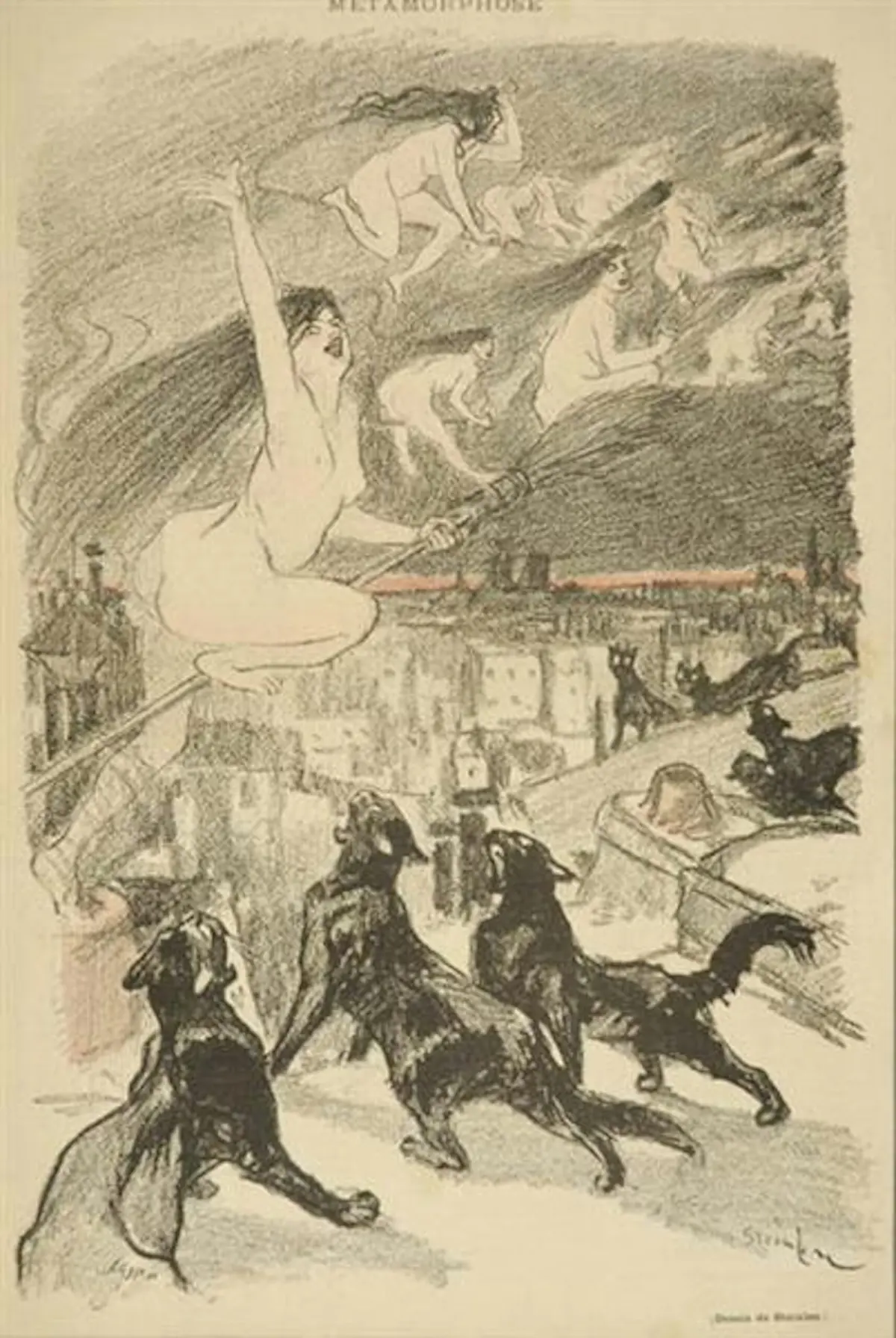
Fin-de-Siècle Symbolism (c. 1890): Théophile Alexandre Steinlen’s color lithograph, Metamorphosis – Black Cats Transforming Themselves into Witches, captured the fin-de-siècle fascination with the occult and female independence, showing exultant witches sweeping across Parisian rooftops.
Interwar and Mid-Century Shifts: Artists continued to re-examine the canonical tales, stripping away the sanitized Disney-fied veneer that would later dominate popular culture, and restoring the grit, ambiguity, and existential dread inherent in the original oral traditions.
Contemporary "Artivism" (Late 20th to 21st Century): Modern image-makers have weaponized fairy-tale iconography to address modern realities. Mat Collishaw’s 1997 digital and photographic works placed fairies directly into bleak, techno-dystopian debris, bridging the gap between ancient woodland spirits and electronic waste.
Supporting Context & Metrics: Witches, Dangerous Women, and the Art of Subversion
One of the most provocative intellectual threads running through The Art of Fairy Tales—and through modern folkloric studies at large—is the exploration of gender, power, and transgression.
The Scholarship of Subversion
In her chapter Witches and Dangerous Women, Ebenstein poses a fundamental question: What happens when women cross culturally prescribed boundaries and reclaim power for themselves? This inquiry builds upon a rich tradition of literary scholarship.
In her seminal 2006 text, Fairy Tales and the Art of Subversion, literary scholar Jack Zipes examined how fairy tales historically functioned as dual instruments. On one hand, they taught societal rules and compliance; on the other, they offered marginalized voices—particularly women—a clever, veiled vehicle to challenge those very rules.
This tension manifests vividly in visual art. Steinlen’s late-19th-century witches are not merely monstrous; they are liberated figures exulting in nocturnal freedom over the city of Paris. Similarly, contemporary artists have utilized fairy tales to interrogate systemic inequities, a phenomenon that has been termed "fairy-tale artivism."
Case Studies in Modern Reinterpretation
Ana Juan’s Caperucita Roja (2022): Spanish illustrator Ana Juan offered a startling visual retelling of Little Red Riding Hood. Her illustrations depict an eerie, red-capped girl lifting her skirts to reveal a monstrous black wolf made of shadow lurking beneath, its bared white teeth stark against the surrounding darkness. This imagery bypasses the sanitized adaptations designed for children to reclaim the dark, psychological undercurrents of the original oral tales.
Dina Goldstein’s Fallen Princesses (2007–2009): Israeli photographer Dina Goldstein upended the dominant iconography of Disney princesses. By placing classic heroines into gritty, real-world scenarios—such as Rapunzel undergoing chemotherapy or Snow White struggling with domestic mundanity—Goldstein’s photographic series directly questions idealized modern constructs of femininity, domesticity, and happiness.
These works validate what folklorist Cristina Bacchilega has long observed: fairy tales possess the unique capacity to "activate transformations in their characters and in us as creators–audiences–adapters."
Official Perspectives and Critical Insights
The enduring appeal of fairy-tale art lies in its ability to straddle the line between the hyper-familiar and the radically estranging. Critics, mythographers, and curators emphasize that the strength of Ebenstein’s book is its refusal to treat the genre as a museum piece.
Marina Warner, writing in her essay collection Forms of Enchantment (2018), emphasizes that the vitality of art relies on enargeia—making the unreal feel intensely, viscerally present. Ebenstein’s curation achieves precisely this by stripping away chronological barriers. When William Nicholson’s poetic, 1922 ethereal flora-fairy converses directly with Mat Collishaw’s 1997 techno-rubble sprites, the reader is jolted out of historical complacency.
"Wonder resides in that instant of recognition and estrangement," cultural critics note, "when a tale we think we know by heart appears before us with a face and form we have never seen before."
By refusing to impose a strict narrative timeline, Ebenstein allows the artwork to speak across decades. A viewer is invited to trace how a single motif—the witch, the fairy, the transformed beast—mutates in response to the historical traumas, technological revolutions, and artistic rebellions of its time. The result is a dynamic archive that honors the oral tradition’s core mechanic: stories live only as long as they are told differently by every new teller.
Future Outlook: The Ever-Mutating Marvellous
As we look toward the future of storytelling, the trajectory mapped out in The Art of Fairy Tales suggests that the realm of the marvellous will continue to expand in tandem with technological and cultural shifts.
The word "marvel" originates from the Latin mirari—to wonder at or to regard with astonishment. In an era dominated by hyper-saturation, digital screens, and artificial intelligence, the human impulse toward wonder has not faded; rather, it has sought refuge in radical new artistic mediums. Just as Lotte Reiniger pioneered silhouette animation in the 1920s and Mat Collishaw integrated photography with dark contemporary themes in the 1990s, the next generation of visual artists is poised to project fairy tales into virtual reality, immersive digital installations, and speculative bio-art.
Yet, despite these shifting mediums, the foundational architecture of the fairy tale remains unaltered. These narratives endure because their characters embrace continual metamorphosis, discovering yet another hidden room within an old, familiar house.
The Art of Fairy Tales serves as both a retrospective treasure trove and a manifesto for the future. It challenges creators and audiences alike to enter the long history of illustration with eyes wide open, proving that with every new act of seeing, old tales can become wondrous once more. As long as artists continue to find mirrors for their deepest fears and wildest aspirations within folklore, the spell of the fairy tale will remain unbroken.