On September 5, 2026, the London Irish Centre played host to a landmark event in contemporary classical music and modernist literature: the premiere of Here Comes Everybody: an overture to Finnegans Wake. Composed by Alastair White and performed by the renowned new-music ensemble Ensemble Exposé under the baton of Roger Redgate, the nearly hour-long work marks the official opening salvo of an astonishingly ambitious 13-year compositional project.
Conceived in tandem with producer and frequent collaborator Gemma Williams, this multi-decade undertaking aims to mirror the protracted gestation of James Joyce’s legendary 1939 masterwork. Just as Joyce spent seventeen years releasing fragments of Finnegans Wake to the public before final publication, White and Williams plan to release sequential iterations of their musical adaptation over thirteen years, culminating in 2039—the exact centenary of the novel’s complete publication.
The project is far more than a simple musical setting of a canonical text; it is a profound theoretical, structural, and artistic engagement with literary modernism. Rejecting the academic impulse to painstakingly decode every allusion within Joyce’s labyrinthine portmanteau prose, White champions a "surface-level" aesthetic. He argues that audiences should engage with Finnegans Wake much as they do with complex contemporary music—appreciating its sonic textures, rhythmic drives, and sonic architecture without demanding immediate hermeneutic mastery.
The premiere performance brought together a formidable lineage of musical complexity. Ensemble Exposé—founded in 1984 by Richard Barrett, Roger Redgate, and Michael Finnissy specifically to champion works deemed too difficult for mainstream ensembles—navigated White’s intricate contrapuntal web. Featuring virtuosic lines for flute, oboe, clarinet, percussion, violin, viola, and cello, alongside dramatic spoken-word performances by Cathal Murray, the overture established a bold, uncompromising blueprint for an artistic journey that will stretch well into the late 2030s.
Detailed Chronology
The Genesis: Conception and Irish Design Week (2025)
The seeds for this monumental 13-year undertaking were planted long before the London premiere. Following a prolific string of operatic collaborations—including WEAR (2018), ROBE (2019), WOAD (2020), and RUNE (2021)—Alastair White and Gemma Williams sought a new collaborative canvas. Williams, who is of Irish heritage, shared a deep mutual passion with White for the writings of James Joyce.
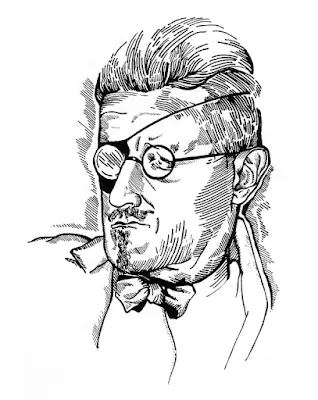
However, translating the titanic, multilingual, and structurally fluid universe of Finnegans Wake into a performance medium presented a seemingly insurmountable scale problem. Recognizing that the novel was too vast for a single operatic project, the duo elected to emulate Joyce’s own methodology. Just as Joyce parcelled out "work in progress" fragments over seventeen years (beginning in 1922, the same year Djuna Barnes famously sketched Joyce wearing an eyepatch), White and Williams decided to roll out their musical interpretation incrementally.
The project was officially announced to the public late last year during Irish Design Week, immediately drawing the attention of literary scholars, musicologists, and contemporary arts patrons. This preliminary introduction laid the groundwork for the development of Here Comes Everybody, serving as the conceptual springboard for the substantive musical score that would debut in London less than a year later.
The London Premiere: September 5, 2026
The culmination of months of rigorous preparation arrived on Saturday, September 5, 2026, at the London Irish Centre. The event was framed not merely as a concert, but as an overture—a formal threshold designed to launch a decade-plus artistic exploration.
The performance mobilized a powerhouse ensemble of contemporary music specialists:
- Conductor: Roger Redgate (under whom Alastair White formally studied at Goldsmiths, University of London)
- Flute: Rowland Sutherland
- Oboe: Christopher Redgate
- Clarinet: Heather Roche
- Percussion: Chris Brannick
- Violin: Caroline Balding
- Viola: Bridge Carey
- Cello: Clare O’Connell
- Reader: Cathal Murray
Running at nearly an hour in length, the overture defied conventional expectations of introductory curtain-raisers. Instead of a concise, thematic summary, White delivered a dense, uncompromising sonic landscape that mirrored the cyclical, recursive nature of Joyce’s famous opening sentence: "riverrun, past Eve and Adam’s, from swerve of shore to bend of bay, brings us by a commodius vicus of recirculation back to Howth Castle and Environs."
The Performance Arc
The structural trajectory of the overture unfolded in stark, theatrical phases:
- The Opening: The music commenced with an idiom that bore faint echoes of mid-century English pastoralism, which was abruptly shattered as the three strings erupted into violent, contrapuntal warfare. Violinist Caroline Balding’s line stood out as an isolated anchor of resistance against the surrounding instrumental turbulence.
- Wind Entry and Text Integration: The eventual integration of the wind instruments introduced a six-way texture of hyper-independent contrapuntal lines. This complex web quieted dramatically to make space for the first of two spoken-word interludes by Cathal Murray, who delivered vivid readings from Joyce’s text over sparse instrumental gestures and sustained string chords.
- The Climax and Resolution: A sudden resurgence of sharp, aggressive violence introduced the percussion section into the multi-layered texture. Long, expressionistic lines wound their way toward a thunderous climax dominated by crashing cymbals. The work ultimately receded, winding down to a solitary, hypnotic repeated tone that accompanied Murray’s final vocal reading from the novel.
Following the performance, an in-depth post-concert Q&A session featuring White, Williams, and the artistic team provided vital context regarding the philosophy underpinning the project.
Supporting Context & Metrics
The Legacy of Ensemble Exposé
To fully understand the weight of the London premiere, one must examine the institutional pedigree of Ensemble Exposé. Founded in 1984 by visionary composers Richard Barrett, Roger Redgate, and Michael Finnissy, the group came into existence out of sheer necessity. During the 1980s, mainstream musical establishments routinely rejected their scores as being too rhythmically complex, notationally dense, and physically demanding for standard ensembles to execute.
By assembling a collective of fearless virtuosos, Ensemble Exposé carved out a legendary status within the international contemporary music scene. Their involvement in White’s project is a crucial validation of its technical rigor. White’s background as a former student of Roger Redgate at Goldsmiths ensures a natural stylistic lineage, positioning Here Comes Everybody within a direct tradition of British New Complexity.

Structural and Theoretical Underpinnings
White’s approach to Finnegans Wake relies heavily on mathematical and architectural parallels, specifically drawing from fractal geometry. Much like the self-similar, infinitely recurring patterns found in fractals, Joyce’s text operates on scales micro and macro simultaneously. White translates this into musical form by creating textures where clarity and obscurity constantly trade places, driven by a calculated use of repetition.
Crucially, White explicitly rejects a naïve "mickey-mousing" approach—he does not attempt to create a literal, one-to-one sonic illustration of the plot events unfolding in the novel. In doing so, he aligns himself with Joyce’s own aesthetic doctrine. Instead, White extracts the intrinsic linguistic rhythms of Joyce’s polyglot prose and uses them as the foundational pulse and rhythmic architecture of his musical score.
Furthermore, White views Joyce’s handling of narrative structure as a historical solution to a modern compositional crisis. Contemporary composers have long wrestled with a false dichotomy: whether to write teleological, developmental music inherited from the classical and romantic traditions, or to abandon linear progression entirely for static, disjointed blocks of sound. By treating Finnegans Wake as a non-linear, multi-directional surface, White found a structural template that has profoundly influenced his wider catalogue—including his work with the Slovenian organization Institut Abeceda and pieces like Fields of Vision.
Official Statements & Insights
During the post-concert Q&A session at the London Irish Centre, Gemma Williams and Alastair White offered deep insights into the motivations driving their 13-year commitment.
Discussing the origins of the project, Williams noted:
"Having collaborated on several operas—WEAR (2018), ROBE (2019), WOAD (2020), and RUNE (2021)—we knew we wanted to continue creating operatic and large-scale vocal works. Combined with a desire to anchor a major project in Ireland, and our shared obsession with James Joyce, Finnegans Wake naturally emerged as the ultimate frontier. However, its sheer scale demanded a fragment-based methodology that mirrors Joyce’s own historical process."
White elaborated on his unconventional choice to write an operatic overture for a work that defies traditional operatic structures:
"None of my earlier operas used an overture due to practical running-time constraints, so writing one for Finnegans Wake was an entirely new novelty. Yet, the operatic overture is a fascinating form because it exists adjacent to the story. It turned out to be the absolute perfect way to begin tackling Finnegans Wake, especially considering that the novel itself famously starts in media res—right in the middle of a broken sentence."
Addressing the broader academic and cultural reception of modernist literature, White delivered a sharp critique of traditional hermeneutics:
"Commentators continually err by trying to dig deep down into the work as if unearthing an archaeological artifact. We should be treating it as a surface. People listen to and thoroughly enjoy music without needing to be musically literate; a similar analogy must be applied to Finnegans Wake. We can take profound pleasure in the sheer sonic and linguistic surface without feeling any academic obligation to decode every single historical and literary allusion."
Future Outlook
With the successful premiere of Here Comes Everybody, Alastair White and Gemma Williams have formally set the wheels in motion for one of the most intellectually rigorous and enduringly ambitious artistic timelines of the 21st century.
The roadmap for the next thirteen years is daunting. Rather than retreating into traditional composition, the duo has committed to a rolling episodic release schedule, staging subsequent fragments, chamber works, and operatic installations that will slowly accumulate into a monumental composite portrait of Joyce’s literary mountain.
As the project marches toward its definitive conclusion in 2039—marking one hundred years since the 1939 publication of the complete Finnegans Wake—it promises to continuously challenge audiences, performers, and musicologists alike. By refusing to flatten Joyce’s linguistic galaxy into digestible commercial tropes, White and Williams are forging a rare bridge between high modernist literature and radical contemporary composition. The riverrun has begun anew, and the artistic world will be listening closely to where its currents lead over the next thirteen years.