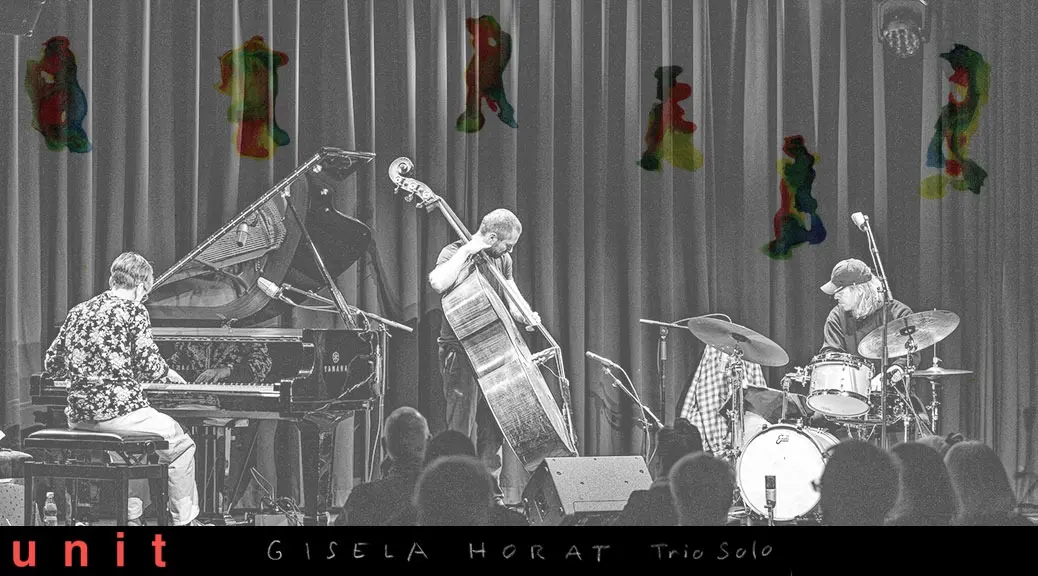
Swiss contemporary jazz is undergoing a quiet renaissance, spearheaded by artists who refuse to neatly categorize their craft within traditional idioms. At the vanguard of this movement is pianist and composer Gisela Horat, whose expansive double-album release, Trio Solo, serves as a masterclass in modern improvisation, textural exploration, and structural deconstruction. Released via the venerable Swiss non-profit label Willisau—an institution dedicated to new music and jazz since 1983—this 2LP set bridges the gap between Horat’s formidable trio work and her deeply intimate solo piano performances.
Spanning 19 distinct pieces recorded across four intensive days at Gabriel Recording in Stalden, Obwalden, Trio Solo is a towering achievement. It consolidates the pianist’s seventh trio recording and her fourth solo outing into a unified, immersive artistic statement. At the heart of this project lies "Leben" (Life), a composition that has served as Horat’s creative compass for nearly a quarter of a century. Reimagined here three times—once with her long-standing rhythm section and twice as solo piano vignettes, with the final iteration dramatically retitled "Leben!"—the piece encapsulates her artistic philosophy: an ongoing investigation into how much structural material can be stripped away while leaving fertile ground for spontaneous creation.
Rich with classical inflections, avant-garde interior piano preparations, and moments of unalloyed darkness, Trio Solo is not merely a collection of songs; it is a psychological landscape. This review-analysis explores the trajectory of Horat’s career, the acoustic architecture of the album, and a rigorous, side-by-side breakdown of the music that defines this landmark release.
Detailed Chronology
The Evolution of an Unconventional Artist (1969–2015)
Born in 1969, Gisela Horat’s formative years were spent amidst the rugged topography of a small mountain village in the Swiss canton of Uri. Her initial artistic training followed a traditional European path, grounded heavily in classical piano lessons. However, her intellectual curiosity extended far beyond the conservatory.
Before committing entirely to music, Horat pursued a rigorous scientific trajectory at ETH Zurich, ultimately earning a degree in nutritional science with a focus on biology. Yet, the gravitational pull of creative expression proved irresistible. Leaving the sciences behind, she immersed herself in music, building her jazz foundations through private instruction with notable Swiss pianists, intensive ear-training courses, rhythm workshops, and theory classes. Demonstrating a multidisciplinary approach early on, she also expanded her instrumental vocabulary to include the saxophone and conga.
For years, Horat operated as an independent force in the Swiss music scene, self-releasing her trio and solo records. A major structural shift occurred in 2009 with the official formation of the Gisela Horat Trio. After years of personnel adjustments, the lineup solidified in 2015 with the addition of bassist Simon Iten and drummer Samuel Büttiker. This rhythm section provided the telepathic synergy required for Horat’s complex, shifting metric frameworks.
From Independent Releases to Institutional Recognition (2015–Present)
As a trio, Horat, Iten, and Büttiker forged a telepathic unity, touring and releasing independent projects that gradually caught the attention of European critics. The watershed moment for institutional recognition arrived with the release of Live in Leipzig via Unit Records, which expanded her audience beyond domestic borders.
Building upon this momentum, Horat aligned with the Willisau label for Trio Solo, her second release with the imprint. Willisau’s long-standing tradition of championing uncompromising, avant-garde Swiss jazz made it the ideal home for a double-album project of this magnitude. Recorded across split sessions in November 2024 and October 2025, Trio Solo captures Horat at the absolute zenith of her powers, balancing the dynamic collective energy of a well-oiled piano trio with the naked, unshielded vulnerability of solo piano performance.
Supporting Context & Metrics
The Acoustic Architecture: Gabriel Recording and the Bösendorfer Imperial
The physical and sonic reality of Trio Solo is inseparable from its recording environment. Captured over four days at Gabriel Recording in Stalden, within the Obwalden municipality of Sarnen, the engineering of the album demands immediate attention. The piano resonates with such striking physical presence that listeners may feel as though the instrument occupies the very room with them.
The mechanical specifics of the recording are crucial to understanding its unique timbre. While the first disc showcases Horat within the trio format, the second disc is a masterclass in solo performance executed on a Bösendorfer Imperial grand piano. The Imperial is a legendary instrument distinguished by its nine extra keys at the bass end, extending the keyboard down to a sub-audible low F.
These additional strings are not merely ornamental; they resonate sympathetically whenever other notes on the piano are struck, generating a natural, room-shaking reverberation. For an artist like Horat, who approaches the piano as an entire acoustic ecosystem rather than a simple keyboard, the Bösendorfer Imperial is the ultimate collaborator.

Inside the Piano: Extended Techniques and Prepared Soundscapes
Horat does not restrict her artistry to the keys. Across Trio Solo, she frequently utilizes extended techniques, transforming the grand piano into a percussion ensemble. By laying felt, cymbals, ping-pong balls, and seashells directly across the strings, she invites chance into her compositions.
This approach evokes comparisons to avant-garde pioneers—such as Keith Tippett tossing car keys onto piano strings—yet Horat’s execution remains entirely her own. Every scrape, dampening effect, and percussive thud serves an emotional and structural purpose, bridging the gap between classical composition and abrasive free improvisation.
Official Statements & Artistic Philosophy
At the core of Gisela Horat’s artistic ethos is the composition "Leben." First recorded in 2002 as a duo performance with violinist Maria Geiger, and later revisited by her trio on the album erzählen, the piece has accompanied the pianist for the majority of a quarter of a century.
When discussing her ongoing relationship with "Leben," Horat frames it not as a finished artifact, but as a perpetual existential inquiry. Across its three iterations on Trio Solo—one with the band and two solo, culminating in the exclamation-marked "Leben!"—only a solitary chord and a fundamental rhythm consistently survive.
"The piece has become a question she keeps asking herself," notes critic Steve Williams in his initial assessment of the work: how much can she remove and still have something to improvise on?
This minimalist reductionism defines Horat’s approach to the keyboard. Rather than filling every sonic void with notes, she treats silence, resonance, and negative space as active musical components. By continually stripping away melodic ornaments, she forces herself, her trio, and her listeners into a state of heightened listening.
The Four-Sided Journey: A Track-by-Track Breakdown
With 19 pieces distributed evenly across four vinyl sides, Trio Solo rewards a structured listening experience. The tracklist can be effectively parsed into three distinct conceptual pillars: Stand-outs, Improvisations, and Foreboding/Dark Ambient Explorations.
1. The Stand-Outs: Melodic Clarity and Classical Inflexions
- "Leben" (Trio Version – Side A): Opening the record with a stunning delivery from the leader, this version establishes the thematic thread of the album, grounding the listener in familiar rhythmic motifs before the avant-garde experiments take hold.
- "Blick in die Welt" (A Look at the World – Side B): Opening Side B with a calming, undulating melody, this track demonstrates the joyous synergy of the piano trio format. It showcases how Horat, Iten, and Büttiker bounce off one another with effortless grace.
- "Einfach müde" (Simply Tired – Side C/Disc 1 Closer): A poignant conclusion to the first disc, capturing the trio operating in complete, meditative unison. Classical inflexions ripple through Horat’s phrasing, highlighting her conservatory foundations.
- "Mutter" (Mother – Side C / Solo Disc): A standout solo piece that utilizes the Bösendorfer Imperial’s extended lower registers to generate a rich, brooding timbre and dense texture.
- "Abschied" (Farewell – Side D Closer): A majestic, resolute conclusion to the entire 2LP set, offering emotional closure after the record’s darker psychological descents.
2. The Improvised Frontiers: Textural Deconstruction
- "Verloren" (Lost – Side A): The trio’s first venture into unadulterated free improvisation. With seashells resting on the piano strings, the acoustic landscape fractures into jagged, unpredictable sonorities.
- "Der kleine Gnom" (The Little Gnome) & "Im Stress" (Under Stress – Side B): Operating as a continuous diptych, these pieces build frenetic energy, with "Im Stress" sounding like a direct psychological continuation of the former.
- "Innere Unruhe" (Inner Unrest) & "Zerstreutheit" (Distraction – Side C): These two pieces represent the only completely unscripted moments on the album, originating without any pre-composed starting points. Horat navigates the piano’s interior, producing abrasive yet purposeful scrapes.
- "Spielerei" (Tinkering – Side D): Opening the final side with direct finger-to-string manipulation, emphasizing tactile immediacy over traditional keyboard technique.
3. Into the Darkness: Foreboding and Psychological Depth
A significant portion of Trio Solo plunges into unsettling, sepulchral territory, guided by evocative, grim titles:
- "Ein Schicksalsschlag" (A Blow of Fate) & "Angst" (Fear): Side A closes with Simon Iten bowing his double bass while dramatic piano stabs slice through the mix. The sinister atmosphere evokes the tension of a psychological thriller.
- "An meine Schwester denken" (Thinking of My Sister) & Solo "Angst" (Side C Closer): An ominous pairing that highlights grief and existential dread.
- "Dem Tode nahe" (Close to Death), "Leben!" (Life!), & "Vergessen" (Forgetting – Side D): Read sequentially, Side D’s titles sketch a brief, tragic human arc—tinkering, the approach of death, life, forgetting, farewell. "Dem Tode nahe" is profoundly sepulchral, leading directly into the explosive gloom of "Leben!" and the cymbal-like string preparations of "Vergessen."
Future Outlook
Trio Solo is scheduled for official release on September 25, positioning itself as one of the most intellectually rigorous and sonically arresting European jazz releases of the decade. For Gisela Horat, this monumental 2LP set represents a crucial milestone: a moment where decades of classical training, scientific inquiry, and avant-garde exploration coalesce into a single, unified artistic statement.
As Horat continues to interrogate her foundational composition "Leben"—asking how much can be stripped away while preserving the essence of improvisation—it is abundantly clear that this third recorded iteration will not be her last. Trio Solo challenges listeners to embrace silence, confront the dark corners of the human psyche, and witness a master pianist stretching her wings across an expansive, uncompromising canvas.