Executive Overview
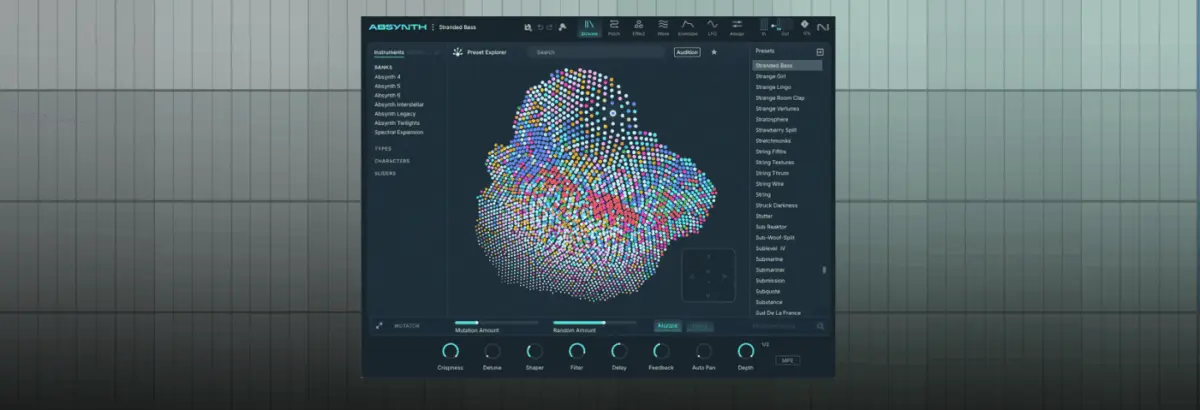
Native Instruments’ legendary synthesizer, Absynth, has long enjoyed a reputation as a powerful tool for film scoring, ambient soundscapes, and cavernous cinematic textures. Historically celebrated for its multi-stage envelopes, intricate modulation routing, and expansive sound-design potential, Absynth has traditionally been pigeonholed as a specialist instrument for evolving pads and drone-heavy atmospheres.
However, with the arrival of Absynth 6—unveiled as a standout centerpiece within Komplete 26—Native Instruments has profoundly modernized the instrument’s architecture. The newly revived software features an overhauled Granular Engine, advanced multi-stage envelopes capable of tight rhythmic control, Moog-inspired ladder filter suites, and spatial processing tools like the Aetherizer.

Rather than focusing purely on its ambient heritage, this tutorial-style technical overview investigates a startling premise: taking a single, unassuming one-shot sample of a Peking Opera gong and—step by step—shaping it into a relentless, high-energy, performance-ready techno riff. Through deep modulation, custom envelope transformations, and multi-layered granular synthesis, Absynth 6 proves it is far more than an ambient soundscape generator. It is a fierce, highly adaptable groovebox capable of commanding the dancefloor at 129 BPM.
Detailed Chronology: Building the Techno Riff Step-by-Step
Transforming an organic, metallic one-shot into a driving, acid-tinged techno sequence requires methodical sound design. Here is the complete chronological blueprint utilizing Absynth 6 inside your DAW.

Phase 1: The Initial Seed and Granular Translation
The process begins with simplicity. Load Absynth 6 into your DAW at a steady techno tempo of 129 BPM and program a foundational MIDI clip. When loading a New Preset, the instrument defaults to a basic, static sine wave playing your rhythm.
- Navigate to the Patch tab.
- Replace the default oscillator with Absynth 6’s upgraded Granular Engine.
- Select the Peking Opera Gong sample as your singular audio source.
While the raw sample brings a unique metallic timbre, it sounds distant from club-ready production standards on its own.

Phase 2: Unleashing Granular Density
To introduce weight and grit, transpose the sound down by 12 semitones (one full octave). Next, switch over to the Grain tab and shrink the grain size down to 3ms.
This step exposes the sheer power of Absynth 6’s overhauled Granular Engine. The maximum density parameter has been scaled up to a massive 32. Dropping this density parameter back down to 4 instantly strips away the complexity, leaving a thin, lifeless texture. At 32, however, the overlapping grains fuse into a dense, aggressive foundation.

Phase 3: Envelopes as the Secret Weapon
Absynth’s legendary status has always hinged on its advanced envelope system.
- Click Osc A Amp, open the Transform menu, and select Expand to Rhythm, engaging BPM Sync.
- Click New Envelope and target Osc A Main Pitch.
- Engage the LFO button and pull the first envelope breakpoint all the way down.
Remarkably, without adding traditional filters or distortion yet, the interaction between the level-pumping amplitude envelope and the pitch-modulating LFO instantly generates the bouncing cadence of an acid bassline.

Phase 4: Fine-Tuning Modulation and Spikes
To refine the movement:
- Access the LFO page and deselect channels B and C from the LFO’s pitch assignment, ensuring it strictly governs the primary layer.
- Raise the Pitch slider to 25, the Time to 1.6919, and the Phase to 32.063.
This precise adjustment introduces unstable pitch modulation alongside sharp, aggressive transients, cementing the sequence’s status as a bona fide acid line.

Phase 5: Sculpting with Moog-Style Ladder Filters
To tame and contour the raw frequencies, deploy Absynth 6’s newly integrated Moog-modeled Ladder filter suite:
- Ladder Band-Pass (BP): Set to 542.92 to isolate and accentuate the boxy, aggressive acid mid-range.
- Ladder Low-Pass (LP): Set to 500.56, with the resonance cranked up to 43.875.
This dual-filter configuration introduces organic warmth and self-oscillating squelch, elevating the patch to peak-time acid techno standards.

Phase 6: Introducing Layer Two for Breakbeat Groove
To build rhythmic complexity, bring in a second layer:
- Load a Sample Engine in Channel 2, utilizing the same Peking Opera Gong sample, transposed down a full 24 semitones (two octaves).
- Mute Channel A temporarily to monitor your work.
- Select Osc B Amp, apply Expand to Rhythm, and switch the Mode to Retrigger.
Phase 7: Syncopation and Envelope Re-triggering
- Pull the beat length/timing down to 0.250 to establish a fast, syncopated, delay-like pulse.
- Grab the lower of the two pink envelope circles and drag it left toward the start of the second envelope spike.
This instructs Absynth to rhythmically retrigger the envelope until the second pair of MIDI notes triggers, smoothly transitioning into the main envelope trajectory. The result is an undeniable, swinging groove.

Phase 8: Spatial Depth via the Aetherizer
Absynth 6 introduces the lush Aetherizer effect. Instead of feeding it the Master signal, pull the slider down and feed it exclusively from Channel B.
- Set Feedback to 75.
- Set the Wet signal to 0.562 (assignable to a Macro for live sweeping).
Because this effect bypasses Channel A, you can cleanly blend your original aggressive layer back into the mix without washing out its transients.

Phase 9: Layer Three and the Overhauled Loop Section
On Channel C, load a third Sample Engine using the Peking Opera Gong. Open Absynth 6’s freshly overhauled Loop section, setting a loop start point of 5600 and an end point of 12644.
This preserves the core riff while injecting filthy, syncopated micro-repeats. Reintroducing Channels A and B creates a massive, multi-tiered sonic wall.

Phase 10: Performance Macro Mapping
Finally, map key parameters—such as individual channel volumes and the Aetherizer Wet amount—to hardware or software Macros. This final step transforms Absynth 6 from a static VST into a fierce, live-jamming techno groovebox.
Supporting Context & Metrics: The Evolution of Absynth
To understand the weight of Absynth 6’s inclusion in Komplete 26, it helps to contextualize the instrument’s journey within electronic music production history:

- The Ambient Legacy: Released originally by Native Instruments (and famously designed by Brian Clevinger), Absynth carved out a niche in the early 2000s as a premier software synthesizer for sound designers working on films, video games, and downtempo electronica.
- Granular Breakthroughs: The jump to Absynth 6 addresses historical limitations by increasing granular density ceilings to 32 grains, allowing producers to turn sparse one-shots into dense, harmonically rich noise floors suitable for modern industrial and techno genres.
- Filter Emulation Accuracy: The addition of Moog-styled Ladder filter models bridges the gap between digital wavetable/granular synthesis and classic analog subtractive synthesis, making acid and driving techno lines far more authentic to program natively within the plugin.
Official Statements and Industry Perspective
Sound designers and product developers have long championed the philosophy that constraints breed creativity. By taking a non-traditional sound source—a cultural percussion instrument like the Peking Opera gong—and forcing it through the aggressive routing capabilities of Absynth 6, producers challenge traditional genre boundaries.
Industry reactions to Komplete 26 highlight Absynth 6’s resurrection as a masterclass in software longevity:

"Absynth was never meant to sit quietly in the background of ambient tracks," notes lead product documentation from Native Instruments. "Its deep modulation matrix and envelope architecture mean that any audio source—whether a sine wave or a metallic gong—can be weaponized into rhythmic, shifting sequences if pushed hard enough."
Future Outlook: The Modular Future of Software Synths
As electronic music production trends continue to favor hybrid workflows, cross-genre sound design, and live-improvisational capabilities, software instruments must evolve beyond static preset players. Absynth 6’s successful pivot from ambient texture machine to techno groovebox signals a broader shift in virtual instrument design.

Producers no longer look for plugins that do one thing well; they demand flexible architectures where granular engines, multi-stage modulation envelopes, and analog-modelled filters coexist under one hood. With Absynth 6 anchoring Komplete 26, the boundaries separating cinematic sound design, modular experimentation, and peak-time techno production have never been more porous.
Absynth is available now within Komplete 26. For more information, visit the official Native Instruments website.