Executive Overview
In the contemporary landscape of borderless art, few composers occupy as singular a space as pianist and sonic architect Lucy Khanyan. Born in Yerevan and navigating a creative existence bridged between the United States and Armenia, Khanyan has steadily built a reputation as an uncompromising voice in modern improvised music. Her distinct compositional language—forged largely outside the traditional academic conservatory system—weaves together the rich microtonal tapestries of Armenian folk traditions, the intellectual rigor of avant-garde jazz, the atmospheric color palettes of impressionism, and the tactile grit of experimental electronics. Over the past decade, her discography—marked by defining releases such as Vision, PERSPektiV, Äbsentia, and her radical, imaginative re-imaginings of the works of Komitas—has proven her to be an artist driven by a singular mandate: to take inherited cultural wealth and actively reshape, rather than merely preserve, it.
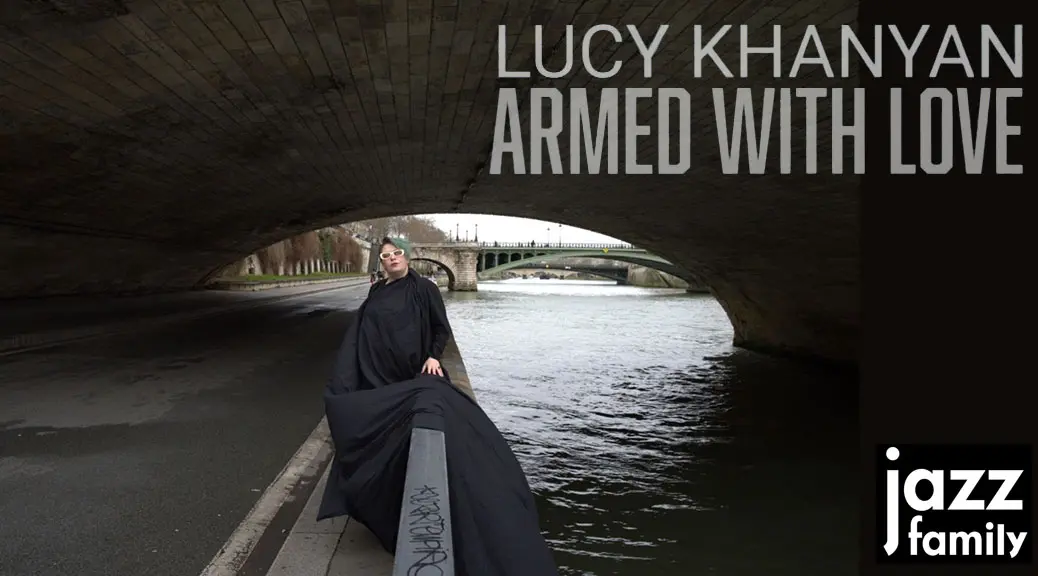
Her latest offering, Armed with Love, recorded in the heart of Paris and released via Jazz Family, represents her most intimate and globally minded project to date. Teaming up with French double bassist Gabriel Pierre and Brazilian drummer and percussionist Isaias Alves, Khanyan has formed a genuinely transnational trio whose symbiotic dynamic anchors the album’s emotional core. The resulting music defies tidy genre classification. It is rooted in earth-bound folk sensibilities yet refuses to be constrained by conventional folk-jazz formulas.
However, as with any ambitious work of avant-garde exploration, Armed with Love is not without its friction points. While the album boasts moments of breathtaking beauty, sophisticated harmonic interplay, and profound emotional resonance, it also stumbles in its structural daring, specifically concerning a jarring stylistic detour on the track "Mind" featuring Emcee Agora. This comprehensive review examines the creation, sonic architecture, structural triumphs, and occasional miscalculations of Armed with Love, offering a definitive look at an artist deeply immersed in the ongoing process of musical "becoming."
Detailed Chronology and Artistic Evolution
To fully understand the weight of Armed with Love, one must trace the winding trajectory of Khanyan’s artistic evolution. Coming of age in Yerevan, Khanyan was surrounded by a musical culture steeped in ancient liturgical chants, modal folk iterations, and the towering cultural legacy of composer and ethnomusicologist Komitas. Yet, rather than remaining a passive inheritor of this tradition, she developed a restless curiosity that pushed her toward the margins of genre.
Opting largely for a self-taught path after foundational musical studies, Khanyan spent her formative years absorbing the structural freedoms of avant-garde jazz and the harmonic colors of European classical impressionism. This unusual stylistic synthesis birthed her early albums. Vision and PERSPektiV established her reputation as a pianist with an acute sense of space and a fearless approach to dissonance. By the time she released Äbsentia and her tribute project focused on Komitas, Khanyan had crystallized her core artistic philosophy: music as an ongoing state of "becoming and unfolding."
The genesis of Armed with Love began to take shape during Khanyan’s transitional periods between her Armenian roots and her Western explorations. Seeking a sonic environment that could mirror this transnational identity, she convened in Paris—a historic hub for expatriate artists and cross-cultural musical experimentation. It was here that she integrated the distinct musical backgrounds of Gabriel Pierre and Isaias Alves into her writing process.
Unlike past projects that leaned heavily on dense arrangements or electronic augmentation, Armed with Love strips away the excess, prioritizing acoustic resonance and real-time improvisational dialogue. The recording sessions in the French capital captured an ensemble discovering its collective voice on the fly. The resulting record is structured as a continuous emotional narrative, chronicling Khanyan’s ongoing dialogue with her heritage, her adopted environments, and the universal language of modern jazz improvisation.
Supporting Context & Sonic Architecture
The sonic architecture of Armed with Love rests entirely on the interplay between three distinct musical personalities. Gabriel Pierre brings a distinctly European contrabass lyricism—grounded yet agile, capable of holding down a deep harmonic foundation while singing in the upper registers. Isaias Alves introduces a rhythmic fluidity forged in Brazilian percussion traditions, steering clear of standard jazz-drumming tropes in favor of textural subtleties, polyrhythmic accents, and resonant space.
The album opens with "Order in Kaos," a title that serves as an accurate manifesto for the entire recording. From the downbeat, the track establishes a volatile yet balanced ecosystem where rigid structural frameworks and complete improvisational freedom constantly rub against one another. Khanyan’s piano work here avoids predictable resolutions, moving effortlessly between cascading, impressionistic chord clusters and stark, angular melodies.
This sense of conversational urgency continues on "Heart Rip." Rather than functioning as a traditional rhythm section that merely marks time behind a soloist, Pierre and Alves treat every measure as a responsive dialogue. When Khanyan shifts a phrase or alters a dynamic, the bass and drums respond instantaneously. This creates a rare intimacy where the listener can hear the musicians listening to one another in real time—arguably the record’s greatest aesthetic triumph.
As the album progresses into its longer-form pieces, such as the six-minute centerpiece "Rebirth," the trio is granted the necessary space to breathe. Here, tempo and tension slacken, allowing the acoustic properties of the instruments to dominate the soundstage. Tracks like "Bridge" and "It Happened Anyway" further underscore Khanyan’s growing maturity as a composer who understands the power of restraint. She creates emotionally suggestive landscapes without spelling everything out for the listener, relying instead on lingering harmonic ambiguities and subtle dynamic shifts.
The Stylistic Fracture: A Critical Assessment of "Mind"
Despite the high caliber of musicianship displayed throughout the first half of the album, Armed with Love hits a severe compositional speed bump with the track "Mind." Featuring contributions from Emcee Agora on rap and spoken word, the track introduces an overt jazz-hip-hop fusion element that feels entirely disconnected from the sonic universe built in the preceding minutes.
Experimentation is, without question, a foundational pillar of Khanyan’s artistic identity. Her career has been defined by a refusal to stay within comfortable boundaries, and there is no ideological restriction against incorporating hip-hop elements into a contemporary jazz framework. Artists such as Robert Glasper, Kamasi Washington, and countless European jazz innovators have successfully bridged this gap.
However, execution is paramount, and on Mind, the experiment simply collapses. The track abruptly shatters the meditative, folk-infused atmosphere that the trio had so carefully cultivated. Instead of feeling like a natural, organic extension of the piano trio’s improvisational dialogue, the hip-hop insertion feels like an idea violently imported from an entirely different record.

From a sequencing standpoint, it is a puzzling decision. The track disrupts the album’s carefully developing momentum, breaking the spell of intimacy and leaving the listener jarred. In an era where listeners curate their own playlists, "Mind" acts as a glaring roadblock. For the discerning listener, it is the kind of track that prompts you to reach for the remote or the turntable arm to hit the skip button.
It is a rare miscalculation in an otherwise cohesive body of work, proving that even the most adventurous artists can occasionally misjudge how far a stylistic pivot can stretch before snapping the listener’s engagement.
Official Statements and Artistic Philosophy
To understand Lucy Khanyan’s motivations behind Armed with Love, one must examine her stated philosophy regarding tradition, identity, and the creative process. In interviews surrounding the album’s rollout through Jazz Family, Khanyan has frequently returned to the concepts of "becoming" and "unfolding."
"Music is never a finished monument; it is a living organism that breathes through the environment in which it is played and the people who create it," Khanyan notes. "When you take Armenian folk traditions, you are not handling museum artifacts. You are handling living pulses. My goal has never been to preserve them in glass cases, but to let them collide with my present reality—whether that reality is living in the United States, recording in Paris, or listening to avant-garde electronics."
This philosophy explains the friction present in her music. By forcing ancient modal structures into conversation with contemporary jazz harmony and international rhythm sections, Khanyan deliberately courts tension.
Gabriel Pierre echoed this sentiment in production notes reflecting on the Paris sessions:
"Working with Lucy requires a willingness to abandon preconceived notions of accompaniment. We aren’t here to back up a pianist; we are here to construct a shared room where every wall is shifting. The music demands total vulnerability."
Isaias Alves added regarding the cross-cultural dynamic of the trio:
"My background in Brazilian percussion gave me a different way to look at pulse. When you combine that with Armenian folk asymmetry and French jazz sophistication, you get something that cannot be rehearsed in a traditional sense—it has to be discovered in the moment."
Future Outlook and Live Performances
As Armed with Love makes its way into the hands of international critics and contemporary jazz enthusiasts, Lucy Khanyan stands at a critical juncture in her career. The album, despite its isolated sequencing misstep, firmly establishes her as one of the most intellectually curious and technically accomplished composer-pianists working at the intersection of European jazz and world folk traditions.
The true test of this material, however, has always resided in the live arena, where the improvisational dialogue between Khanyan, Pierre, and Alves can be pushed to its absolute limits without the pressure of studio sequencing. Fans and critics will have an immediate opportunity to witness this dynamic firsthand when Lucy Khanyan takes the stage live at the Jass Club in Paris, France, on September 2nd.
Looking forward, Khanyan’s trajectory suggests an artist who will continue to court controversy, test boundaries, and refuse artistic complacency. If she can harness the fearless experimentation that occasionally derailed Mind and channel it back into the organic, telepathic interplay that defines tracks like "Order in Kaos" and "Rebirth," her next musical chapter promises to be nothing short of transcendent.
Armed with Love may contain structural scars, but they are the scars of an artist actively building a new language—one note, one collision, and one transformation at a time.