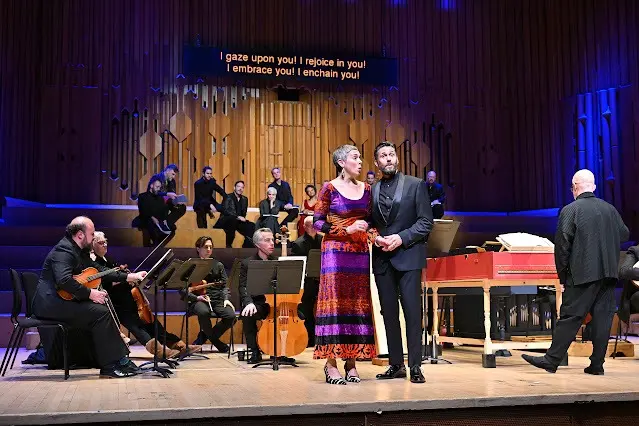
On November 17, 2026, London’s Barbican Hall played host to what many classical music critics are already hailing as one of the definitive operatic highlights of the year. Conductor Laurence Cummings, leading the internationally acclaimed Academy of Ancient Music (AAM), delivered a riveting, near-complete performance of Claudio Monteverdi’s 1642 masterpiece, L’incoronazione di Poppea (The Coronation of Poppea). Fresh from a critically acclaimed staging in Venice just the weekend prior, the ensemble presented a meticulously researched, highly ambitious, and dramatically charged interpretation of the Venetian baroque landmark.
Monteverdi’s final opera is an anomaly in the classical canon—a searing psychological drama where traditional moral boundaries dissolve, and the "bad characters" emerge victorious. The Barbican production capitalized on this moral ambiguity, offering a gripping, three-hour semi-staged experience. Driven by a stellar cast featuring Anna Dennis as Poppea, Ed Lyon as Nerone, Katie Bray as Ottavia, and Christopher Lowrey as Ottone, Cummings’ production bypassed superfluous theatrical gimmicks in favor of razor-sharp character studies, musical fidelity, and an irresistible theatrical momentum. By restoring nearly all of Monteverdi’s expansive score—including divine interventions, comic interludes, and the grand coronation scene—the performance bridged the gap between 17th-century Venetian performance practice and modern audience expectations.
Detailed Chronology & Performance Analysis
Act I: Establishing Ambition and Intrigue
The evening opened with the prologue—a philosophical debate among divine personifications representing Virtue (La Virtù), Fortune (La Fortuna), and Love (Amore). Katie Bray, stepping into the role of La Virtù with a sober and telling vocal account, set an intense tone before pivoting seamlessly into her portrayal of the spurned Empress Ottavia.
Following the prologue, the audience was immediately immersed in the shifting allegiances of Rome. Christopher Lowrey’s Ottone, discovered lingering outside Poppea’s home, was imbued with an unexpected psychological depth. Rather than playing the ditherer as a mere comic fool, Lowrey elicited genuine sympathy from the house, grounding the character’s hesitation in palpable human suffering.
Anna Dennis’s Poppea quickly established herself as a formidable dramatic force. Eschewing the typical skittish or overly fragile portrayals often assigned to the role, Dennis brought poise, sensual allure, and ironclad vocal command to her scheming. Her interactions with Ed Lyon’s Nerone crackled with electric chemistry. Lyon, stepping into a role historically written for a soprano castrato (and frequently taken by a mezzo-soprano in modern revivals), sang with sharp focus and virility. While lacking the upfront aural sensuality of a lower female register, Lyon utilized his tenor to project a dangerous, volatile, and deeply compelling emperor. His sudden, terrifying outbursts of temper underscored a Nero driven by absolute, unchecked power.
Act II: Philosophical Gravity and Comic Counterpoint
As the tragedy deepened, the production’s structural integrity was tested by Monteverdi’s intricate mosaic of high tragedy and earthy comedy. Nahuel Di Pierro brought a dignified, warm-toned gravitas to the philosopher Seneca, meeting his forced suicide order with sobering nobility.
To counterbalance the heavy philosophical and political machinations, Cummings maintained a swift, unbroken pacing between scenes. The comic relief provided by the servants and lesser nobility acted as a brilliant structural foil. Rory Carver (Valletto) and Danni O’Neill (Damigella) delivered a carefree, vivid scene that highlighted youthful vitality against the oppressive shadows of the imperial court.
Meanwhile, mezzo-soprano Fiona Kimm—bringing nearly half a century of stage experience to the role of the nurse, Nutrice—displayed impeccable comic timing, particularly in her dry, knowing interactions with Katie Bray’s increasingly desperate Ottavia. Stuart Jackson’s Arnalta offered another masterclass in baroque performance style. Balancing heroic upper-register tone with deep tenderness during Act II’s famous lullaby, Jackson brought a multi-dimensional warmth to the role of the devoted servant.
Act III: The Ascent of Poppea
The final act surged toward its morally ambiguous climax. Katie Bray delivered a searing, razor-sharp performance as Ottavia faces exile, spitting out Busenello’s libretto with tragic intensity. Her confrontation with Lowrey’s Ottone—who psychs himself up to commit murder under imperial duress—was a masterclass in dramatic tension.
The opera culminated not in a grand, triumphant full-ensemble finale, but in the notoriously intimate, profoundly ravishing duet between the newly crowned empress and her emperor, “Pur ti miro.” Stripped down to a skeletal continuo accompaniment consisting of harpsichord, theorboes, and harp, Dennis and Lyon leaned into the music’s expressive dissonances. The silence in Barbican Hall was absolute; the performance closed on a breathtakingly quiet, chilling note of triumph for historical villainy.
Supporting Context & Metrics
The Textual Labyrinth of Poppea
The survival of L’incoronazione di Poppea is nothing short of a musicological miracle. Monteverdi composed during an era when opera scores were treated as functional theatrical working tools rather than immutable works of art. Operas were routinely discarded, heavily altered, or fitted with new librettos to suit local tastes.
Our current understanding of Monteverdi’s late theatrical output leaps across decades:
1607:L’Orfeo (Mantua) – Written for lavish court forces for a ducal wedding.
1640:Il ritorno d’Ulisse in patria (Venice) – Composed for commercial theatre with minimal instrumental forces.
1642/43:L’incoronazione di Poppea (Venice) – Premiered at the Teatro Santi Giovanni e Paolo, seating roughly 900 patrons.
Because no single authoritative score exists—musicologists must navigate conflicting early Venetian manuscripts, a heavily altered 1651 Neapolitan revival score, and Giovanni Francesco Busenello’s printed 1656 libretto—modern directors face immense editorial choices. Furthermore, musicological analysis indicates that the aging Monteverdi likely enlisted his composition pupils to assist with the orchestration.
Production Statistics & Instrumentation
Total Named Roles: 21, supplemented by the Coro dei Famigliari (Seneca’s followers), Consuls and Tribunes, and the Coro d’Amori.
Orchestral Footprint: A lean, historically informed period instrument ensemble comprising:
String section: 7 players
Theorbos: 2
Harps: 1
Continuo Group: Reiko Ichise (viola da gamba), William Carter and Kristiina Watt (theorbos), Joy Smith (harp), Ashok Gupta (harpsichord/organ), and Laurence Cummings (harpsichord direction).
Duration: Approximately 3 hours, including a single interval.
Official Statements & Cast Insights
In interviews surrounding the production run, conductor Laurence Cummings emphasized the necessity of honoring the fluid, speech-driven nature of Venetian early baroque opera over modern operatic grandiosity.
"Monteverdi’s writing is essentially a sung play," noted editorial reviews of Cummings’ rehearsal philosophy. "The pacing must reflect the dialogue-heavy texture of the Teatro Santi Giovanni e Paolo. If you slow it down to match 19th-century romantic standards, the dramatic architecture collapses. Our goal was to let the recitative breathe while preserving the theatrical momentum that hooked audiences in 1642."
Casting choices also drew significant commentary from baroque performance practitioners:
Ed Lyon (Nerone): Addressed the dramatic logic of casting a tenor over a mezzo-soprano, focusing on the volatile psychological dimensions of Nero’s authority.
Fiona Kimm (Nutrice): Representing a 50-year career spanning multiple generations of historical performance practice, Kimm provided institutional memory and seasoned theatrical weight to the ensemble.
The Continuous Group: Lauded universally for their active, responsive continuo realization, which kept the dramatic recitatives feeling improvised, spontaneous, and emotionally urgent.
Future Outlook
The success of Laurence Cummings and the Academy of Ancient Music’s L’incoronazione di Poppea signals a robust, ongoing appetite for rigorous, historically informed stagings of early 17th-century masterworks in major European concert halls. By demonstrating that Monteverdi can command a major modern venue like the Barbican without relying on heavy stage machinery or anachronistic concept-regie, the production has set a new benchmark for baroque opera performance.
As classical programming increasingly seeks to balance accessibility with musicological integrity, this production offers a blueprint for future revivals: respect the open-ended nature of early scores, cast singing actors with acute verbal clarity, and trust that Monteverdi’s genius for human psychology requires no modernization to grip a contemporary audience from beginning to end.