
Executive Overview
The image of the touring musician has undergone a profound psychological and cultural shift over the past two decades. Historically, the rock-and-roll circuit revolved around the mythology of excess: late nights, cramped passenger vans, smoke-filled backstage rooms, and an unspoken industry culture that actively discouraged parenthood. For decades, choosing to have children meant stepping away from the stage, or resigning oneself to the fragmented, chaotic existence of an absentee parent.
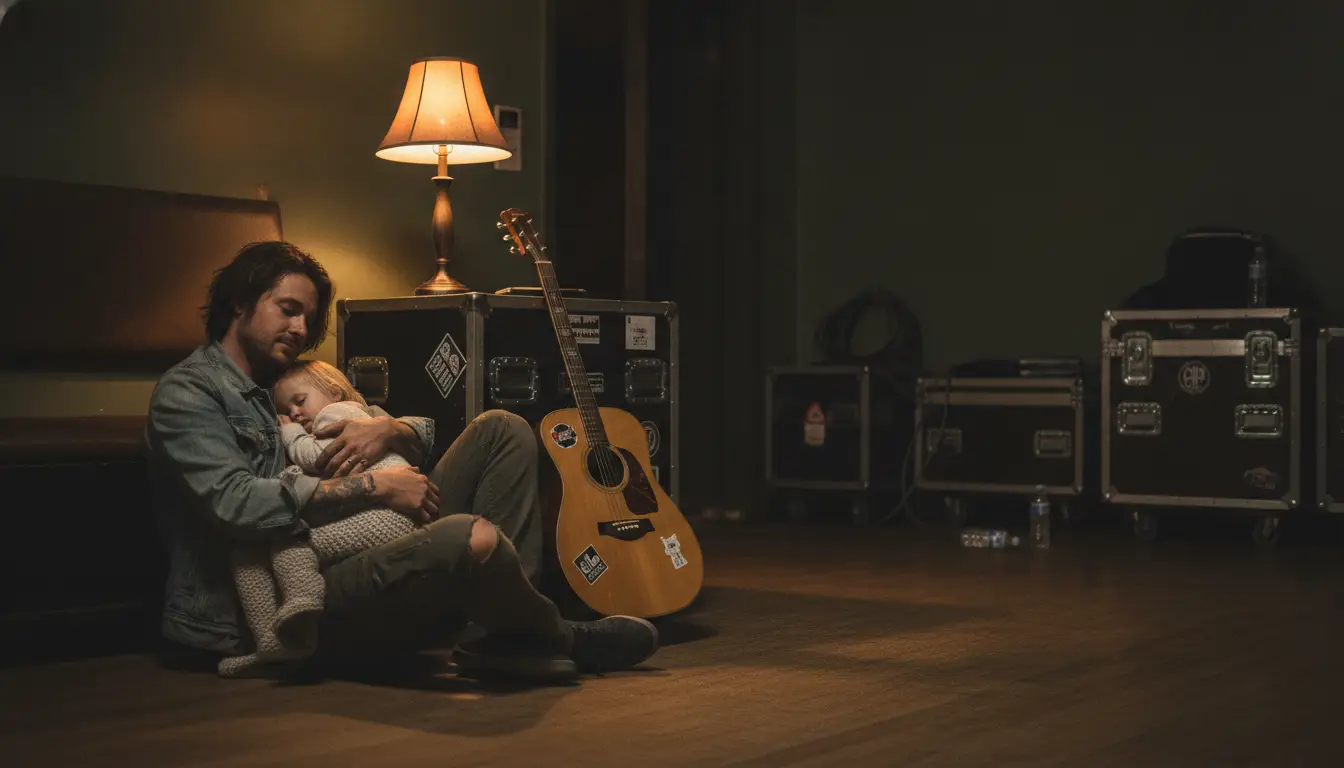
Today, that paradigm is fracturing. A growing cohort of independent and major-label artists are rejecting the binary choice between a sustainable career in music and a cohesive family life. They are taking their partners, children, and occasionally travel nannies on the road with them. While this lifestyle has opened up crucial industry conversations about what sustainable touring looks like in the twenty-first century, it has also introduced immense logistical hurdles. Chief among them is a challenge familiar to every parent, yet exponentially magnified by a life in motion: how to help a toddler sleep in an ever-changing rotation of hotel rooms, backstage dressing rooms, and tour bus bunks.
To solve this, a growing number of musician-parents are looking outside the traditional music industry for answers, finding unexpected utility in early childhood education philosophies—specifically, the Montessori method of sleep. By adapting minimalist, low-to-the-ground sleep environments designed for freedom of movement and developmental autonomy, these traveling families are establishing portable islands of routine. This deep-dive investigation explores the intersection of life on the road, modern parenting, and the quiet revolution transforming the touring economy.
Detailed Chronology: The Evolution of the Touring Family
To understand how modern musicians navigate life on the road with toddlers, it is necessary to trace how the industry’s attitude toward parenthood has evolved since the early 2000s.
Phase One: The Era of Isolation (Early 2000s)
At the turn of the millennium, domestic touring was dominated by a young, unencumbered demographic. Booking agents and labels structured routing with relentless intensity—playing thirty shows in thirty-five cities across six weeks was considered standard operating procedure. During this era, musicians who started families typically bifurcated their lives: the artist toured for months on end while their partner remained at home with the children. The psychological toll of this separation was rarely discussed openly, viewed merely as the price of admission for artistic survival.
Phase Two: The Structural Pushback (2010–2015)
As the streaming economy began to depress recorded music revenues, touring shifted from a promotional tool to the primary source of income for mid-level and independent acts. Musicians could no longer afford to stay off the road for prolonged stretches, nor could they easily sustain two households on declining revenues. Bands began to push back against the grueling, wide-open scheduling of the past.
Prominent acts began negotiating hard limits on routing lengths. For instance, indie rock stalwarts The National famously established an internal pact a decade ago to cap tours at strict two-to-three-week blocks, ensuring that parents in the band could return home before family structures completely frayed. Similar scheduling modifications were adopted by artists like Sharon Van Etten and independent folk acts who realized that survival on the road required structural boundaries rather than sheer endurance.
Phase Three: Bringing the Family Along (2015–Present)
As bands shortened their legs on the road, a logical next step emerged: bringing the children along for shorter regional runs or family-friendly festival circuits. Publications like Rolling Stone and Slate began documenting the rise of the "touring family"—acts like David Wax Museum and Truckstop Honeymoon, who integrated their children directly into their professional lives.
However, integrating children into a transient lifestyle exposed a gaping vulnerability in standard touring logistics. While adults can adapt to shifting time zones, unfamiliar beds, and erratic schedules on sheer willpower, small children—particularly toddlers undergoing critical developmental and sleep-training phases—cannot. The resulting sleep deprivation quickly became the ultimate threat to the viability of family touring, forcing artists to innovate beyond traditional gear and travel cribs.
Supporting Context & Metrics: The Logistics and Realities of Road Parenting
The mechanics of touring with children involve complex financial and psychological calculations. Far from being a glamorous perk, traveling with family requires rigorous planning, deep financial investment, and creative problem-solving.
The Financial Architecture of Touring with Kids
For mid-level touring acts, the economics are precarious. While legacy stadium acts can easily absorb the cost of multi-room hotel suites, private transport, and dedicated childcare staff, independent artists operate on razor-thin margins.
- Childcare Costs: According to industry reports highlighted by touring advocacy groups, professional road nannies typically command daily rates ranging from $300 to $500 per day, in addition to covered travel, lodging, and per diems. For a two-week tour leg, this single expense can entirely wipe out a band’s net profit.
- Routing Constraints: Because children require predictable environments, tour routing can no longer be optimized purely for ticket sales or geographical efficiency. Artists must factor in rest days, hospital proximity, playground access, and manageable daily driving distances.
- The "Sleep Control" Deficit: When families spend upwards of six months a year moving between disparate cities, a child’s external environment is in a state of perpetual flux. Hotel cribs vary wildly in safety standards and physical comfort. Tour bus bunks are notoriously narrow, dark, and difficult to secure for a toddler who has recently learned to climb. Airbnbs offer inconsistent furniture setups. Consequently, controlling the child’s immediate sleep environment has become the single most vital variable for touring parents.
The Rise of Montessori Sleep Systems on the Road
To combat the psychological disruption of sleeping in unfamiliar spaces, many musician-parents drawn to child-led parenting philosophies have turned to Montessori-influenced sleep setups.
The core of this system is the floor bed—a simple mattress placed directly on or very close to the floor, stripped of the high rails or enclosed wooden slats that define standard cribs. Rooted in the educational philosophy of Dr. Maria Montessori, an early 20th-century Italian physician and educator, the approach emphasizes freedom of movement, independence, and an environment curated to a child’s physical proportions.
For touring families, the appeal is multifaceted:
- Portability of Concept: While a heavy wooden bed frame cannot travel in a van, the principle of the floor bed adapts easily. A thin, high-density travel mattress can be laid directly on a hotel room floor against a wall, instantly replicating the familiar home setup.
- Elimination of Fall Risks: In unfamiliar hotel rooms or elevated temporary beds, toddlers face significant fall hazards. A floor bed neutralizes this risk entirely.
- Psychological Continuity: Placing a child behind the bars of an unfamiliar hotel pack-and-play often triggers anxiety and resistance. A floor bed offers a familiar spatial dynamic that travels effortlessly from city to city.
Official Statements and Industry Insights
The intersection of parenting and professional musicianship has generated candid discourse across the music community. Artists are increasingly transparent about the structural realities of balancing career ambitions with domestic responsibilities.
Suz Slezak of the indie-folk duo David Wax Museum, who has spent years touring alongside her husband, bandmate, and their two children, spoke candidly to Rolling Stone about the economic friction of life on the road with dependents:
"The math of touring with children is brutal when you aren’t pulling in major-label guarantees. You rely heavily on community, host stays, and consistency in the small things. When everything else around you—the venue, the city, the bed, the schedule—is changing every single night, the bedtime routine becomes your anchor."
Similarly, Aaron Dessner of The National has frequently discussed how fatherhood fundamentally restructured how his band approaches the road:
"A decade ago, we realized that if we wanted to stay sane and keep our families intact, we had to draw hard lines. We implemented a strict rule: tours cap out at two or three weeks max. Beyond that, the psychological cost at home becomes too high. You can’t write or perform at your best if you’re constantly carrying the anxiety of missing your children’s lives."
Child development specialists and pediatric sleep consultants note that the Montessori approach aligns naturally with the demands of transient lifestyles. Dr. Elena Vance, a developmental psychologist specializing in early childhood environmental adaptation, explains:

"Children under the age of three rely heavily on spatial predictability to self-regulate. When a child wakes up in the middle of the night in a dark, unfamiliar tour bus bunk or hotel room, the panic response is triggered by confinement and disorientation. A floor bed system gives the child autonomy—they can navigate their immediate space, touch familiar comfort objects, and settle themselves without crying out for an adult to rescue them from behind bars. For families on the move, that psychological security is invaluable."
What the Montessori Sleep Approach Involves in Practice
For families attempting to implement this system—whether at home or adapted for the road—the floor bed is merely the centerpiece of a holistic environmental strategy.
1. Total Room Preparation ("Baby-Proofing")
Because a floor bed allows a child to exit their sleeping area independently, the entire bedroom or hotel space must be rigorously prepared before the child is left unsupervised.
- Electrical outlets must be capped.
- Heavy furniture, televisions, and floor lamps must be securely anchored to walls to prevent tipping.
- Clutter and loose cords must be entirely removed from the floor-level zone.
2. Developmental Alignment
Experts generally recommend introducing Montessori-style floor setups between four and eighteen months of age, contingent upon the child’s gross motor development. During the six-to-eighteen-month window, infants rapidly refine motor skills such as crawling, pulling themselves up to stand, and walking. Confining a developing toddler to a restrictive crib during extended travel periods can frustrate their natural physical impulses. A floor bed preserves their freedom to move, stretch, and reposition themselves naturally.
3. Material Safety and Indoor Air Quality
For parents spending weeks at a time living out of enclosed tour buses or densely carpeted hotel rooms, environmental toxins are a genuine concern. Consequently, musician-parents gravitating toward child-led furniture often prioritize rigorous safety certifications:
- GREENGUARD Gold Certification: Administered by UL Solutions, this standard certifies that products have been rigorously tested for low chemical emissions, including volatile organic compounds (VOCs) and formaldehyde.
- Natural Finishes: Solid hardwood frames treated with organic beeswax or natural plant oils rather than synthetic polyurethane lacquers are heavily favored to maintain pristine indoor air quality in confined mobile spaces.
Future Outlook: A Quieter, More Sustainable Industry Shift
Despite the innovative adaptations being made by individual artists, structural challenges across the broader music industry remain formidable.
Streaming royalties continue to generate historically low payouts for the vast majority of working musicians. Inflationary pressures have severely squeezed tour guarantees for mid-level and independent acts, meaning that the cost of hotels, fuel, gear rental, and travel logistics consumes an ever-larger share of box-office revenue. Furthermore, institutional childcare support—such as subsidized family dressing rooms, on-site festival nurseries, or touring child-care stipends—remains virtually nonexistent outside of top-tier pop and legacy rock tours.
Yet, the true transformation is cultural rather than institutional. The era of the silent sacrifice—where musicians felt compelled to hide their families or sacrifice their domestic lives to maintain an authentic "road warrior" image—is rapidly fading.
By adopting practical, portable solutions borrowed from early childhood education, such as Montessori sleep systems, and by speaking openly about the gritty logistics of parenting on tour, today’s artists are charting a new path forward. They are proving that a life in music does not require the forfeiture of family life, and that the modern tour bus can, with enough intention, become a home on wheels.