Executive Overview
For over four decades, the sonic architecture underpinning the world’s most demanding live music events has quietly relied on the engineering prowess of L-Acoustics. Whether echoing across the sun-baked expanses of major global music festivals or integrated into the acoustic treatment of boundary-pushing cultural hubs—such as London’s newly inaugurated Apple Music Hall—L-Acoustics systems represent the gold standard in high-performance sound reinforcement. More than half of the world’s largest music festivals depend on their hardware. However, the company’s impact is equally profound in the digital domain, where its pioneering simulation software has redefined how audio engineers approach complex acoustic environments.
At its annual Media Software Summit, L-Acoustics announced a major milestone in its software ecosystem with the release of SoundVision version 2026.4, alongside significant upgrades to its cloud-based collaboration platform, SoundVision Connect. Designed to address the modern demands of large-scale concert production, the 2026.4 update introduces deep optimization for Apple Silicon processors and advanced support for the company’s flagship L1 line array systems. Concurrently, the platform expansion includes the debut of SoundVision Connect Plus, a high-capacity tier engineered for enterprise-scale collaboration.
In a bold move to lower the barrier to entry across the live sound industry, L-Acoustics has announced that both the standard software and the premium Connect Plus tier will be completely free of charge for the next 12 months. This strategic initiative aims to democratize access to cutting-edge acoustic modeling tools, transforming how solo audio engineers, major production houses, and global touring teams design, share, and execute world-class sound systems.
Detailed Chronology: From Educated Guesswork to Precision Modeling
To understand the magnitude of the SoundVision 2026.4 release, it is essential to examine the historical evolution of acoustic design in live performance environments. For decades prior to the mid-2000s, designing sound reinforcement for massive arenas, outdoor amphitheaters, and sprawling festival grounds was an exercise in empirical intuition.
The Pre-SoundVision Era
Before the digital revolution transformed live production workflows, audio system design relied heavily on accumulated institutional knowledge. Engineers accumulated data over years of repeatedly working with similar speaker configurations in familiar venues.
"The design process mostly required accumulated knowledge gathered over repeatedly working with similar systems in various venues over the course of years," explains Scott Sugden, Director of Product Management and Innovation at L-Acoustics. "There was a lot of educated guesswork, and sometimes that produced an acceptable result; sometimes it was less acceptable."
This trial-and-error methodology carried significant operational risks. In high-stakes environments where audio schedules are compressed down to mere minutes, misjudging coverage zones, splay angles, or acoustic throw could result in uneven sound pressure levels (SPL), phase cancellation, and poor audience coverage—issues that were notoriously difficult to rectify once crowds arrived.
The 2004 Paradigm Shift
Recognizing the industry’s need for predictability, L-Acoustics released the original iteration of SoundVision in 2004. As the world’s first 3D sound design and acoustic simulation program built specifically for line array systems, SoundVision fundamentally altered the pre-production workflow.
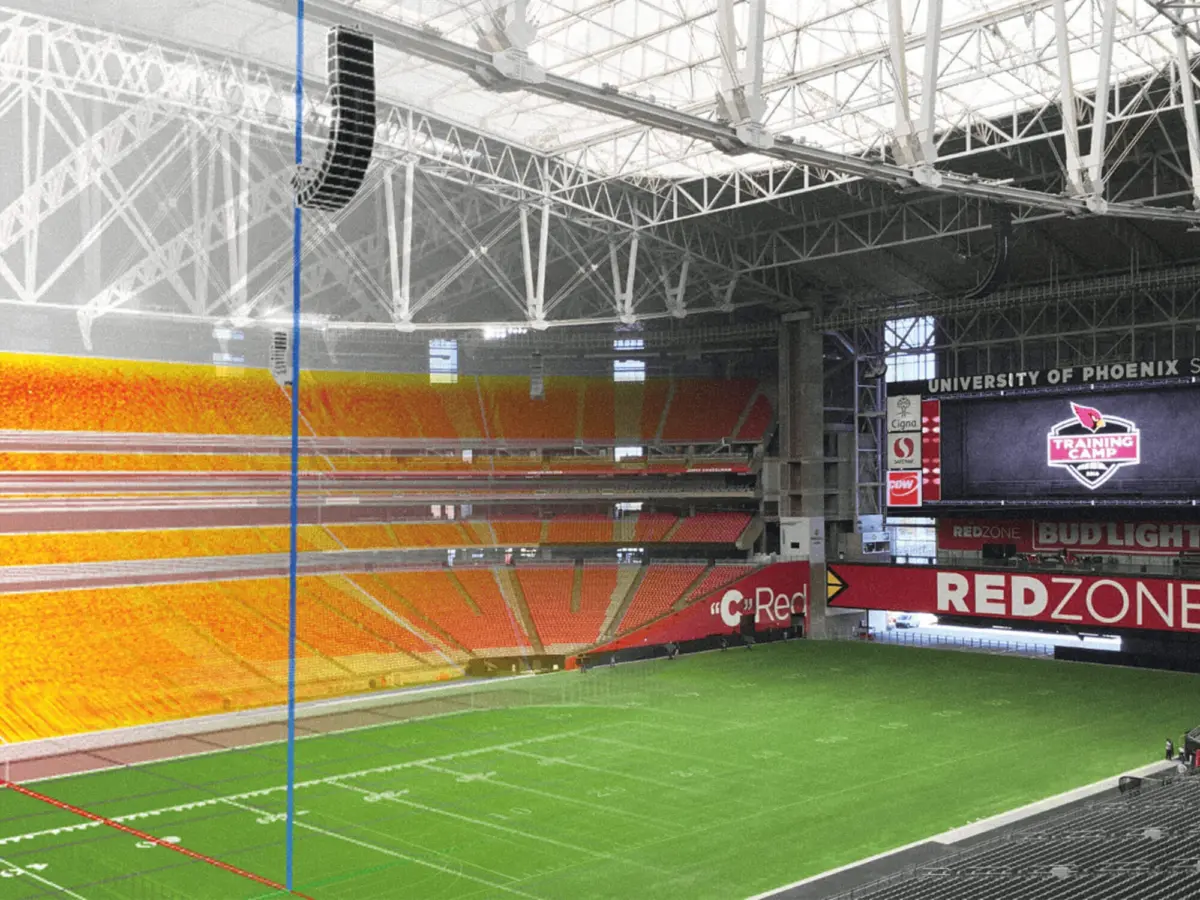
By enabling engineers to construct accurate three-dimensional digital models of any venue—incorporating seating tiers, architectural obstacles, and spatial boundaries—SoundVision allowed users to calculate coverage patterns and map SPL distribution across an entire space with mathematical precision.
The software eliminated the traditional guesswork, allowing engineers to visualize direct sound, identify reflection zones, and optimize array geometries long before loading equipment into a truck.
The Coachella Case Study
The true efficacy of SoundVision under extreme pressure is best illustrated by large-scale festival deployments. Scott Sugden spent over a decade designing and managing the complex audio deployments at the Coachella Valley Music and Arts Festival in Indio, California. The operational realities of such massive undertakings leave virtually zero margin for error.
"[At Coachella] every year, for over a decade, the number of seconds I was allowed to hear the sound system before the first band was generally between zero and 60," Sugden reveals.
The logistical constraints of the world’s largest music festivals mean there is virtually no time for on-site system validation, tuning, or calibration before the headlining artist’s first sound check. Every calibration variable must be accounted for in pre-production.
"Meaning everything had to be done in pre-production," Sugden emphasizes. "SoundVision allowed me to do that." By relying on meticulous acoustic modeling before ever setting foot in the Colorado Desert, deployment teams could fly massive line arrays with absolute confidence that the audio performance would match digital predictions down to the decibel.
Supporting Context & Metrics: The Evolution of Version 2026.4 and Connect
The newly unveiled SoundVision 2026.4 and SoundVision Connect ecosystem represent a major leap forward, addressing both local processing power and remote workflow fragmentation.
Hardware Optimization and Processing Power
Modern audio modeling requires heavy computational rendering, particularly when calculating complex FIR (Finite Impulse Response) filters, direct-to-reverberant ratios, and mechanical load safety limits simultaneously. Version 2026.4 brings substantial performance enhancements tailored specifically for Apple’s silicon-based Macs (M-series processors). This optimization results in drastically reduced rendering times, smoother 3D viewport navigation, and heightened responsiveness when handling multi-zone stadium models.
Furthermore, the update introduces expanded, native support for projects utilizing L-Acoustics’ flagship L1 line array systems. As high-density, high-output enclosures become standard for major international tours, the software ensures that engineers can accurately predict the mechanical and acoustic interactions of these advanced cabinets within complex rigging topologies.

Solving Workflow Fragmentation with SoundVision Connect
While local processing power handles the heavy lifting of acoustic physics, modern production teams are rarely centralized in a single office. Touring acts, system integrators, and rental houses frequently operate across multiple time zones, leading to notoriously messy collaboration pipelines.
David Reid, L-Acoustics Product Marketing Manager for Software, highlights the traditional friction points of collaborative audio design:
"The process of collaboration was typically very fragmented before. There are long email threads with attachments, PDFs, and screenshots, which makes it very difficult to keep track of the current version of a design. This is what we tried to tackle with SoundVision Connect."
First introduced in 2025 as a cloud-based collaboration hub, SoundVision Connect bridged the gap between desktop design and team coordination. The new iteration builds extensively upon that foundation by introducing robust, professional-grade collaboration features:
- Contextual Model Commenting: Team members can drop targeted, location-specific pins and comments directly onto the 3D model, eliminating ambiguity regarding acoustic trouble spots or rigging adjustments.
- Automated Component Inventorying: The platform instantly generates comprehensive parts lists, ensuring that every bracket, cable, amplifier, and enclosure required for a design is cataloged and accounted for.
- Version Control and A-B Testing: Users can generate, archive, and cross-compare multiple iterations of a sound design within the same project space, allowing for instantaneous A-B performance testing of different array configurations or coverage strategies.
- Centralized Cloud Archiving: All project files, revision histories, and administrative updates are stored securely in the cloud, guaranteeing that the entire team is consistently working from the master file.
Official Statements and Tiered Architecture
To accommodate the diverse scales of modern audio businesses—ranging from independent solo contractors to massive multinational audio-visual conglomerates—L-Acoustics is introducing a structured, tiered subscription model anchored by SoundVision Connect Plus.
Scaling for the Industry: Connect vs. Connect Plus
During the Media Software Summit, David Reid detailed the strategic thinking behind the multi-tier structure, emphasizing accessibility and scalability.
"What we’re trying to do is make SoundVision Connect more scalable to the needs of various businesses," Reid points out. "If you’re an individual sole trader, maybe SoundVision Connect is a good entry point for you. You can store up to three projects, three versions per project, and there can be three project owners. But with SoundVision Connect Plus, all of that expands."
To better understand how the standard and Plus tiers scale to meet commercial demands, consider the following operational limits:
| Feature / Metric | SoundVision Connect (Standard Tier) | SoundVision Connect Plus |
|---|---|---|
| Cloud-Based Projects | Up to 3 active projects | Up to 1,000 active projects |
| Design Versions per Project | Standard versioning limits | Up to 8 distinct versions for A-B testing |
| Simultaneous Project Owners | 3 collaborators | Up to 10 co-owners working concurrently |
| Primary Target Audience | Independent engineers, boutique firms | Large rental houses, global touring companies, enterprise integrators |
The 12-Month Free Access Initiative
In a move that has sent positive shockwaves through the professional audio community, L-Acoustics has confirmed that the standard version of SoundVision and SoundVision Connect will remain permanently free.
More remarkably, the high-capacity SoundVision Connect Plus tier will be completely free of charge for the next 12 months. At the time of writing, the company has not yet announced the definitive pricing structure that will take effect once the introductory promotional window closes.
By removing financial barriers for an entire year, L-Acoustics is actively encouraging global adoption of cloud-integrated workflows, allowing production teams of all sizes to stress-test the Plus tier within real-world commercial environments without immediate budgetary constraints.
Future Outlook: The Intersection of Cloud Architecture and Immersive Audio
The release of SoundVision 2026.4 and SoundVision Connect Plus points toward a clear trajectory for the future of live event production. As live concerts increasingly incorporate complex immersive audio configurations—such as spatial audio routing, object-based mixing, and multi-channel surround arrays deployed in acoustically challenging arenas—the need for hyper-accurate predictive modeling becomes non-negotiable.
The Shift Toward Real-Time Cloud Synchronization
As cloud infrastructure deepens its integration into professional audio workflows, the line between pre-production modeling and live venue execution continues to blur. Future iterations of acoustic software are expected to bridge offline simulation tools with real-time telemetry from touring amplifiers and DSP processors. By tying cloud-based design repositories directly to on-site hardware performance metrics, engineers will soon be able to monitor environmental deviations (such as temperature and humidity shifts altering sound propagation in real time) and push optimized corrections directly through platforms like SoundVision Connect.
Democratizing Elite Production Standards
Historically, access to proprietary high-end simulation suites was restricted by prohibitive capital expenditure requirements, often favoring large-scale operations over independent contractors. By providing universal, free access to industry-grade simulation software—and temporarily offering enterprise-level cloud collaboration features at zero cost—L-Acoustics is setting a new standard for industry accessibility.
As independent designers, regional production companies, and global touring engineers adopt SoundVision Connect Plus over the coming year, the collective standard of live event audio will inevitably rise. The days of relying solely on on-site guesswork are long gone; in their place stands an era defined by precision physics, seamless cloud collaboration, and uncompromised sonic fidelity delivered to every seat in the house.
SoundVision and SoundVision Connect are available for immediate download via the official L-Acoustics platform. The SoundVision Connect Plus tier is accessible free of charge for a limited 12-month promotional period.