Executive Overview
As the golden haze of a quintessential English summer morning settled over the rolling topography of Worthy Farm on Sunday, June 29, 2025, the curtain rose on the final, breathless act of the world’s most iconic greenfield music and performing arts festival. Glastonbury 2025 has reached its crescendo. For four days, an ephemeral city of roughly 210,000 revellers, artists, activists, and traders has pulsed with creative energy, transforming the dairy farm in Pilton, Somerset, into the beating cultural heart of the United Kingdom.
Sunday at Glastonbury is historically a study in contrasts: a bittersweet symphony of jubilation and exhaustion, monumental musical legacies and frantic campsite pack-downs. The overarching mood on June 29 is defined by a collective determination to extract every last drop of magic from the final hours, even as thermometers steadily climb toward another sun-baked afternoon. Festival organizers, emergency services, and Worthy Farm stewards have mobilized an intricate logistical apparatus to manage the final-day surge. With monumental performances slated from veteran icons like Rod Stewart in the coveted Legend slot, indie-rock royalty The Maccabees closing out The Park, and late-night electronic spectacles stretching deep into Monday morning, safety, crowd dynamics, and environmental stewardship have taken center stage.
This comprehensive retrospective and live-rolling report examines the intricate choreography required to safely shepherd hundreds of thousands of attendees through the final day of Glastonbury 2025. From crowd-flow optimization and heat management to the socio-cultural impact of the festival’s closing moments, we analyze how Worthy Farm navigates its grand finale.
Detailed Chronology: The Final Day Unfolds
Morning: The Exodus and the Heat
The morning of June 29 began not with silence, but with the rustle of nylon, the rattling of trolley wheels, and the low hum of diesel engines as early departures commenced the ritual packing-down of campsites. True to the meteorological forecasts that have favored the festival throughout the weekend, Sunday broke bright, clear, and unremittingly warm.
Festival organizers issued early morning advisories emphasizing the critical need for heat safety. With ultraviolet indices running high and shade at a premium across the open fields, medical teams ramped up hydration campaigns. Campers breaking down tents were explicitly reminded of the festival’s core ethos: "Love the Farm, Leave No Trace." Environmental teams deployed across the site to distribute recycling bags, urging attendees to dismantle their gear and take their tents home rather than contributing to the post-festival landfill imagery that has plagued contemporary festival culture in past decades.
Afternoon: The Pilgrimage to the Pyramid
As the sun climbed to its zenith, the demographic gravity of Worthy Farm shifted decisively away from the outer ring campsites and toward the major arena stages. The Pyramid Stage, Other Stage, West Holts, and The Park faced comfortable yet formidable crowds.
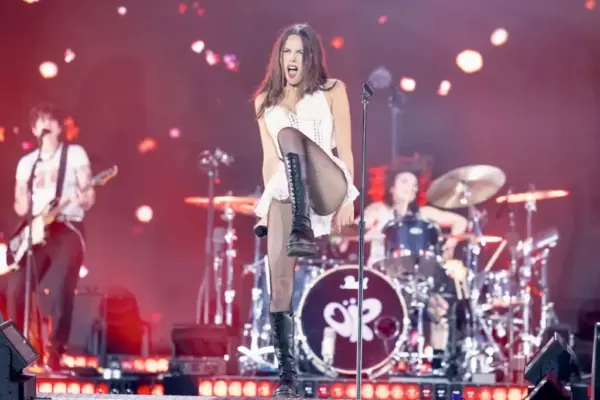
The undisputed emotional anchor of the afternoon came at 5:45 PM, when British musical royalty Sir Rod Stewart took to the Pyramid Stage for the legendary Sunday afternoon tea-time slot. The field was packed to capacity hours in advance, a multi-generational sea of fans stretching far beyond the sound towers, eager to witness a masterclass in pop-rock showmanship. Stewart’s set delivered a parade of timeless anthems, cementing the tradition of the Sunday afternoon legend slot as one of the defining cultural rituals of the British summer.
Simultaneously, alternative beats and eclectic sounds drew substantial numbers to West Holts and the Park Stage, setting the tempo for an evening that promised seamless transitions from classic rock to contemporary indie revivalism.
Evening and Night: The Closing Crescendo
As dusk draped the Somerset landscape in shades of amber and violet, the festival’s temporal velocity accelerated. The headline draw for the indie faithful materialized at 10:15 PM at The Park Stage, where the newly reunited Maccabees performed a triumphant closing set. For an audience that had mourned the band’s 2017 hiatus, the performance served as a poignant, high-energy punctuation mark to the weekend.
However, the closure of the main stages did not signal the end of Glastonbury 2025; rather, it catalyzed the migration toward the sprawling labyrinth of the late-night entertainment zones. At 12:30 AM, bass music virtuoso Sub Focus prepared to ignite the jaw-dropping architectural marvel of the IICON stage, while eclectic electronic performance artist Marc Rebillet was slated to take over the Shangri-La Stage at 2:00 AM, promising an improvisational, high-octane masterclass that would push the festival well into the small hours of Monday morning.
Supporting Context & Metrics: Logistics, Crowd Dynamics, and Infrastructure
Managing a population the size of a medium-sized city within a working agricultural framework requires military-grade logistical planning. On the final day of Glastonbury 2025, the primary operational challenge shifted from ingress and intra-festival movement to crowd attenuation, choke-point management, and the eventual mass egress.
Crowd Flow and Tactical Diversions
With tens of thousands of people moving simultaneously toward high-profile bottleneck areas, the festival’s crowd management teams implemented dynamic routing strategies. Throughout Sunday evening, stewards actively managed crowd densities, utilizing temporary diversions to guide festival-goers away from saturated thoroughfares and toward clearer transit corridors.
Key metrics and operational protocols for June 29 included:
- "One In, One Out" Protocols: Tented venues, particularly within Shangri-La, Block9, and the Common, operated under strict capacity limits. Stewards enforced dynamic holding pens to prevent overcrowding hazards.
- Alternative Route Architecture: Festival communications heavily promoted the use of secondary pathways. Data from previous years indicates that the physically shortest route between stages during peak hours is frequently the slowest due to friction and pedestrian congestion. Attendees were encouraged to utilize perimeter routes, such as the Dragon’s Tail, the elevated ridge above The Park, or the expansive plateau above the Tipi field and Green Fields.
- Decompression Zones: For those overwhelmed by the sensory intensity of the central arenas, designated quiet zones provided psychological and physical respite.
Environmental Metrics and the "Love the Farm" Campaign
The logistical tail of Glastonbury extends far beyond the music. Organizing body Glastonbury Festivals Ltd., in partnership with Greenpeace, WaterAid, and Festival Republic, coordinated a massive post-event cleanup operation. On Sunday, June 29, messaging underscored personal accountability:
- Tent Recovery: Past festivals saw upwards of 10% of tents abandoned. Volunteers mobilized early Sunday to encourage recycling, while permanent infrastructure improvements—such as mandatory deposit schemes for reusable cups—drastically reduced single-use plastic waste across the 1,000-acre site.
- Campsite Sweeps: Waste sorting facilities scaled up operations immediately following the final notes at Worthy Farm, preparing to process hundreds of tonnes of organic and inorganic material in the weeks following the gates closing.
Official Statements and Operational Guidance
To ensure the safety and well-being of every participant on the final day, the Glastonbury Festival press and safety office issued comprehensive operational advisories.
"Hello and welcome to the final day of Glastonbury 2025! We hope you have a wonderful day," stated the official morning festival dispatch. "It’s likely to be another warm one—so please do check out our heat advice. And if you’re packing up your camp today, please love the farm and leave no trace."
Addressing the anticipated bottlenecks around the core musical hubs, the operational command team issued explicit behavioral guidelines for evening transit:
"There are likely to be comfortably busy crowds at the Pyramid, Other, West Holts and the Park Stages—with Rod Stewart’s Pyramid set (5.45pm) and Maccabees’ Park performance (10.15pm) set to attract big audiences. Other potentially busy shows today include Sub Focus at IICON (12.30am) and Marc Rebillet at Shangri-La Stage (2am).
The late-night areas will also be popular again this evening. We will be diverting crowds at times to help you find clear space to enjoy yourselves. We expect that there will be one in, one out queues on some of our tented venues, and on occasion it may be necessary to divert you around some areas when they are at capacity. Please listen to stewards and be patient with them."
Recognizing the psychological toll of mass gatherings during the final hours, festival organizers issued empathetic guidance regarding egress physics:
"When leaving our bigger arenas and venues, please remember there are lots of you. If you take your time the crowds will thin out and you’ll get out more easily. And when heading to stages remember, we have a lot of alternative routes to places, the shortest route will often not be the quickest.
As always, if you do come across a busier crowd and you’d prefer some space, your best bet is to turn around and head for somewhere a bit quieter (Dragon’s Tail, the hill above The Park or the space above the Tipi field and the Green Fields, for example)."
Future Outlook: The Legacy of Glastonbury 2025 and Beyond
As the final reverberations of Glastonbury 2025 fade across the Vale of Avalon, attention inevitably turns toward the horizon. Glastonbury operates on a cyclical farming model, incorporating a designated "fallow year" periodically to allow the land, local wildlife, and the dairy farm infrastructure to recover from the immense footprint of the event. While official announcements regarding a future fallow year are meticulously weighed against agricultural assessments by the Eavis family, the structural resilience demonstrated during the 2025 edition underscores the enduring viability of the festival model.
Socio-Cultural Impact
Glastonbury 2025 has once again proven its unmatched ability to capture the zeitgeist of contemporary global culture while maintaining a deeply rooted connection to British countercultural traditions. From powerful political discourse embedded in performances across the Left Field and Green Fields to the unifying euphoria of the Pyramid Stage, the festival has reinforced its status as an indispensable sociological barometer.
Infrastructure Evolution
Looking forward, the operational successes—and friction points—observed on Sunday, June 29, will serve as valuable data points for future planning. The refinement of crowd-flow algorithms, the expansion of green energy integration across sound systems, and the ongoing crusade against single-use plastics will continue to evolve. Worthy Farm remains a living laboratory for sustainable large-scale event management.
As the sun sets on Glastonbury 2025, casting long shadows over the Pyramid Stage and illuminating the glowing art installations of the late-night districts, the collective memory of this weekend is already being forged. For the 210,000 souls traversing the pathways tonight, the journey home may be long and weary, but the spirit of Worthy Farm—resilient, communal, and profoundly celebratory—will endure long after the tents are struck and the fields return to the quiet stewardship of nature.