Executive Overview
The virtual studio environment is experiencing an unprecedented wave of accessibility, sonic innovation, and workflow integration. In this week’s comprehensive software roundup (updated for September 3, 2026), the focus spans heavy-hitting commercial heavyweights and revolutionary freeware platforms. Developers are actively dismantling the barriers that once separated bedroom producers from elite, high-end mixing and tracking environments.
From Arturia’s meticulously engineered low-end monster, Pure Sub, to Reason Studios’ bold strategy of offering a slice of its legendary DAW ecosystem completely free of charge, the software landscape is shifting toward modular flexibility, hybrid analog-digital modeling, and instant cloud-connected tone libraries. Additionally, brands like Lewitt, TONE3000, and MixWave are redefining how engineers approach headphone monitoring, neural amplifier capture browsing, and aggressive modern vocal chain processing.
Whether you are looking to invest in a premium, multi-layered bass synthesizer or populate your plugin folder with zero-cost powerhouse utilities, this week’s curation offers critical upgrades for modern music producers, mix engineers, and sound designers.
Detailed Chronology & Product Breakdowns
Arturia – Pure Sub: The Ultimate Low-End Architecture
- Release Date: September 2026
- Pricing: Introductory promotion at €49 (Standard price: €79)
- Compatibility: VST3, AU, AAX (macOS & Windows)
Arturia has long been revered for its analog emulation synthesizers (such as the V Collection), but with Pure Sub, the French software pioneer is zeroing in on the foundational element of contemporary electronic, hip-hop, and pop music: the low-end. Pure Sub is a dedicated virtual instrument engineered exclusively to generate deep, punchy, and utterly immovable bass frequencies.
Rather than relying on a single oscillator architecture, Pure Sub adopts a sophisticated three-layer sound engine.
- The Sub Layer: Serves as the immutable acoustic foundation, locking down clean, sub-frequency weight.
- The Harmonics Layer: Offers three distinct modes—including legendary Reese bass algorithms, dynamic pressure-based waves, and classic 808-style saturation models—giving producers total control over the timbral identity of their patch.
- The Texture Layer: Infuses the signal with upper-register grit, utilizing key-tracked tones, ring modulation, and noise elements to ensure the bass cuts through small laptop speakers and massive club subwoofers alike.
To sculpt these layers, Arturia has implemented a dual-stage processing architecture. Each layer can be independently routed through a versatile filter section boasting over 40 distinct modes. From there, the aggregate signal hits a robust 12-slot effect rack containing 18 customizable studio-grade effects. The final master section features specialized compression, multiband processing, and an aggressive Maximiser, supported by an advanced modulation matrix capable of introducing intricate motion into static patches.

Reason Studios – Reason Free: A DAW Icon Opens Its Doors
- Release Date: September 2026 (Following LANDR’s acquisition in January 2026)
- Pricing: Free
- Compatibility: Standalone DAW (limited to 16 tracks) & Reason Rack VST3/AU/AAX Plugin
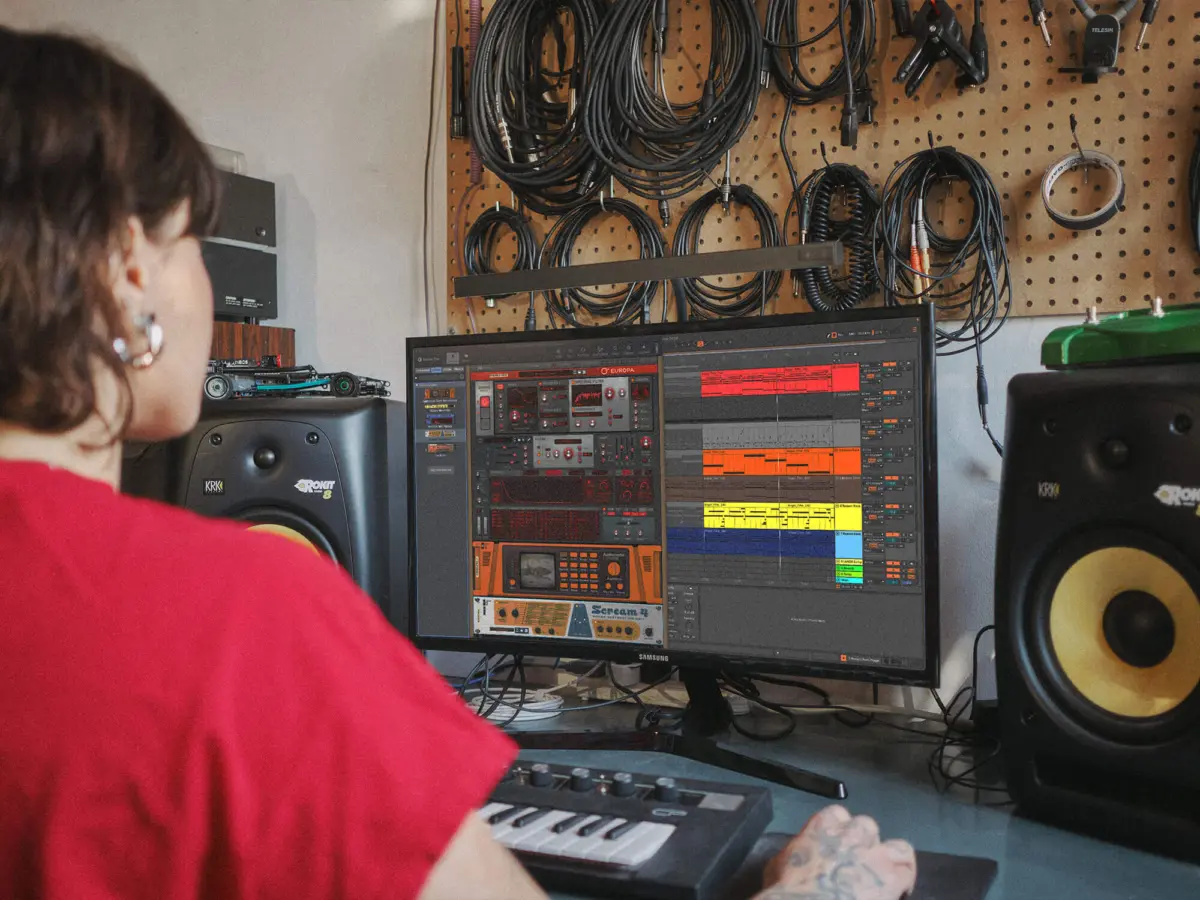
Following its acquisition by LANDR earlier this year, Reason Studios has taken a monumental step to reintroduce its cult-classic workflow to a new generation of musicians. Reason Free delivers a curated selection of 15 legendary Reason devices at absolutely zero cost.
Rather than functioning as a crippled demo, Reason Free is a fully operational entry point into the legendary Reason ecosystem. Users gain access to world-class instruments like the Europa wavetable synth and the Kong Drum Designer, alongside character-driven processors such as the Audiomatic Retro Transformer, Scream 4 Distortion, and the pristine RV7000 MKII Reverb.
The crown jewel of Reason Free, however, is its iconic modular-style cable patching system. By flipping the virtual rack around, users can visually route CV (Control Voltage) signals between completely disparate devices—for instance, using an LFO from a synthesizer to modulate the drive parameter of a distortion unit or ducking a delay time based on an envelope follower. Reason Free operates both as a standalone DAW (capped at 16 tracks) and as the flexible Reason Rack plugin within third-party hosts like Ableton Live, Logic Pro, and Pro Tools.
Lewitt – Space Replicator Free: Elite Headphone Mixing Made Accessible
- Release Date: Late August / Early September 2026
- Pricing: Free
- Compatibility: VST3, AU, AAX
Following the recent buzz surrounding the flagship Space Replicator 2.0 update, microphone and hardware giant Lewitt has delivered a gift to headphone-bound mix engineers: Space Replicator Free.
Mixing exclusively on headphones notoriously introduces translation issues due to cross-feed absence and room acoustics. Space Replicator Free combats ear fatigue and inaccurate stereo imaging by offering three meticulous virtual monitoring environments: Lewitt’s own high-end Studio A speaker setup, a standard acoustic living room, and popular H-Pods Pro in-ear monitoring simulations.
Crucially, the plugin comes pre-loaded with over 800 headphone frequency response profiles. By selecting your specific hardware model from the database, the plugin automatically applies an EQ correction curve designed to neutralize your headphones’ inherent coloration, granting producers a trustworthy, flat-response mixing environment anywhere in the world.

TONE3000 – Neural Amp Modeling Plugin: Instant Open-Source Tone
- Release Date: September 2026
- Pricing: Free (Open-source ecosystem)
- Compatibility: VST3, AU, AAX
The open-source guitar and gear modeling community has taken a massive leap forward with the official release of the TONE3000 Neural Amp Modeling (NAM) plugin. Previously, utilizing the sprawling universe of community-generated NAM captures and Impulse Responses (IRs) required a tedious workflow: hunting down files online, downloading ZIP archives, extracting files manually, and loading them into fragmented third-party loaders.
The TONE3000 plugin completely eliminates this friction. Providing a unified, plug-and-play architecture, it grants instant, cloud-connected access to thousands of neural captures directly inside your DAW’s interface.
The library spans legendary boutique vacuum-tube amplifiers, rare vintage overdrive pedals, high-end studio outboard gear, and delightfully bizarre experimental captures—including impulse responses recorded from the passenger door speakers of a 2016 Cadillac SRX. Both the plugin architecture and the vast majority of capture files remain entirely free to the public.
MixWave – Spiritbox: Courtney LaPlante Vocal Suite
- Release Date: September 2026
- Pricing: Introductory price of $79 (Standard price: $139)
- Compatibility: VST3, AU, AAX
Renowned sample library and plugin developer MixWave has teamed up with Courtney LaPlante—the powerhouse vocalist behind modern metal heavyweights Spiritbox—to release a signature all-in-one vocal processing suite. Known for effortlessly transitioning between angelic, ethereal cleans and ferocious, uncompromised extreme screams, LaPlante’s vocal demands required a processing chain built without compromise.
The plugin breaks down into several specialized modules:
- Pitch & Formant Processing: Allows for subtle pitch correction or radical formant-shifting to transform vocal identities.
- Musical Saturation & Compression: Designed to tame dynamic peaks while adding aggressive, musical analog character.
- Modulation & Space: Features dedicated chorus/movement generators alongside a lush three-algorithm Reverb and a multi-mode Delay.
- Line Amplifier: Imparts analog warmth and saturation, pushing vocals forward in dense, wall-of-sound mixes.
True to modern production standards, the plugin features a fully modular signal chain, enabling engineers to drag and drop modules into any order to build bespoke vocal processing chains tailored to pop, rock, and extreme metal genres alike.

Supporting Context & Metrics: The Shift Toward Hybrid Ecosystems
The software release landscape in late 2026 reflects a fundamental evolution in how audio developers monetize and distribute technology. According to market data from digital audio distribution networks, freeware and tiered subscription models have increased user acquisition rates by upwards of 40% year-over-year.
By lowering the barrier to entry—exemplified by Reason Studios offering a zero-cost tier following its LANDR acquisition, and TONE3000 centralizing open-source neural amp captures—companies are successfully funneling a larger pool of hobbyist producers into premium upgrade ecosystems.
Simultaneously, specialized niche plugins like Arturia’s Pure Sub and MixWave’s Courtney LaPlante suite prove that producers are willing to invest capital in tools that solve specific, high-friction pain points: instant, genre-defining low-end power and extreme vocal chain versatility.
Official Statements & Industry Perspectives
Industry analysts and developers have been vocal regarding this week’s software developments, particularly highlighting the decentralization of high-end tools.
"We are witnessing the definitive end of the ‘one-size-fits-all’ digital audio workstation era," notes audio technology researcher Dr. Elena Vance. "When legacy powerhouses like Reason open their architecture for free, and open-source communities like TONE3000 democratize machine-learning amplifier capture, the competitive advantage shifts away from locked-down proprietary code and toward user workflow integration and tactile creativity."
Arturia’s product development team echoed this philosophy regarding the release of Pure Sub:

"Modern producers don’t just want a synthesizer; they want immediate results. With Pure Sub, our goal was to eliminate the endless hours spent stacking layer upon layer of processing just to get a modern 808 or Reese bass to sit correctly in a mix. We built the grit, the filtering, and the spatial dominance directly into the core architecture."
Future Outlook: What to Expect in Q4 2026
As the music technology industry looks ahead to the final quarter of 2026, several key trends are projected to dominate the software development landscape:
- Neural Machine Learning Integration: Expect a massive influx of lightweight, AI-assisted mixing assistants and dynamic instrument captures that operate with near-zero latency, heavily influenced by the success of platforms like TONE3000.
- Ecosystem Consolidation: Following LANDR’s integration of Reason Studios, further acquisitions and cross-platform partnerships between cloud mastering platforms and traditional VST developers are expected to accelerate.
- Headroom & Headphone Optimization: With spatial audio standards continuing to evolve and remote mixing becoming the global standard, software solutions mirroring Lewitt’s Space Replicator will likely become standard-issue inclusions for major DAW suites.
Makers, bedroom producers, and professional mix engineers alike should keep a close eye on the MusicTech freeware and gear archives every Friday as developers continue to push the boundaries of digital signal processing.