Executive Overview
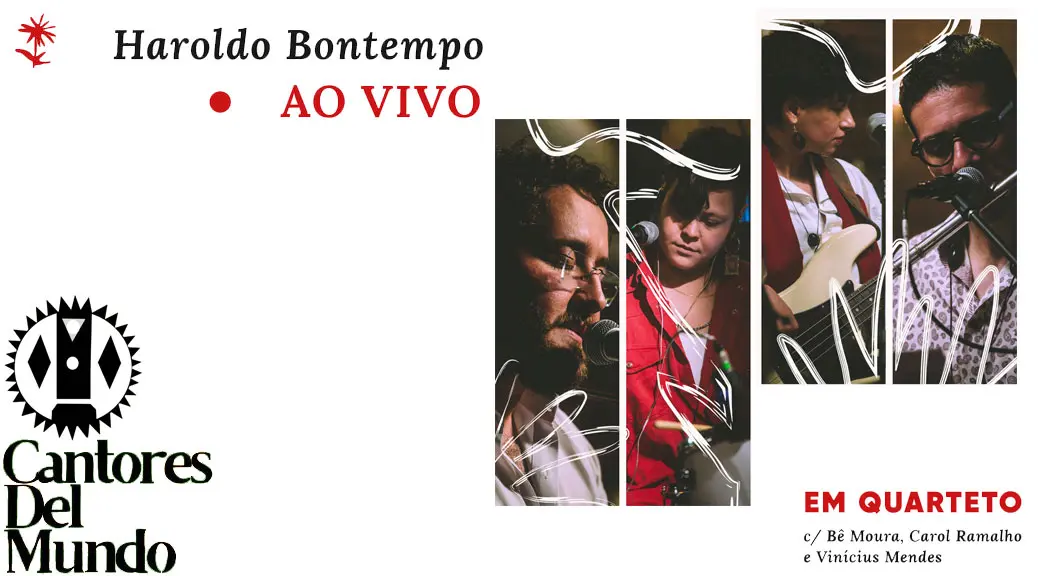
In an era saturated with digital production and algorithmic perfection, the true pulse of contemporary Brazilian popular music often beats loudest within the unvarnished confines of a live studio session. Enter singer-songwriter, multi-instrumentalist, and composer Haroldo Bontempo. With his latest release, Ao Vivo em Quarteto, recorded live in the intimate acoustics of Galeria Resistor in Belo Horizonte, Brazil, Bontempo has achieved something rare: a definitive re-contextualization of his own catalogue. Rather than offering a standard "greatest hits" compilation or a conventional live album, Bontempo and his tight-knit ensemble have breathed vibrant, spontaneous new life into songs that have defined his rapidly expanding solo career.
Comprising twelve meticulously curated tracks, the album acts as a bridge connecting Bontempo’s foundational acoustic minimalism with the expansive, jazz-infused warmth of a fully realized quartet. Over the course of the project, listener-favorites from earlier releases—including his 2020 debut Músicas para Travessia, Voz e Violão, and the eclectic Indie Hippie Retrô Brasileiro—are stripped of their original studio constraints and allowed to breathe, stretch, and evolve.
Backed by a formidable rhythm and brass section consisting of drummer Bã Moura, bassist Carol Ramalho, and woodwind virtuoso Vinícius Mendes, Bontempo anchors his compositions on acoustic guitar and vocals while allowing his collaborators the freedom to steer the music into uncharted territories. The resulting soundscape effortlessly balances the timeless sophistication of bossa nova and samba with subtle veins of 1960s soul, acoustic folk, and free-flowing psychedelia.
For longtime followers of Bontempo’s journey, Ao Vivo em Quarteto offers a thrilling, high-definition look at how his songs translate in real time. For uninitiated listeners, it serves as the ultimate gateway drug—a masterclass in arrangement, performance, and modern Brazilian songwriting.
Detailed Chronology: From Mineiros da Lua to Solo Mastery
To fully appreciate the scope and sonic maturity of Ao Vivo em Quarteto, one must trace the evolutionary trajectory of Haroldo Bontempo’s musical life. Music has been a constant presence since his early youth, a background that nurtured his innate understanding of harmony, rhythm, and ensemble dynamics long before he stepped out into the spotlight as a solo artist.
The Formative Years and Ensemble Beginnings
Bontempo’s early reputation was forged in the trenches of the underground and independent Brazilian music scenes. As a respected collaborator and instrumentalist, he cut his teeth playing within various regional outfits, most notably the celebrated alternative group Mineiros da Lua. During this period, Bontempo honed his craft not merely as a frontman, but as a team player—an invaluable asset within an ensemble who understood how to elevate the collective sound without ego. This foundational collaborative spirit deeply influenced his later approach to arrangement, teaching him to leave sonic space for fellow musicians to contribute their own distinct voices.
The 2020 Solo Breakthrough: Músicas para Travessia
Despite his extensive experience as a sideman and band member, Bontempo’s formal solo career did not officially launch until 2020. The release of his debut full-length project, Músicas para Travessia, marked a definitive turning point. Armed with a six-string acoustic guitar, his own expressive vocals, and a collection of keyboards, Bontempo laid down the foundational architecture of his solo soundscapes.
Rooted deeply in the rich heritage of bossa nova and traditional samba, Músicas para Travessia introduced audiences to an artist capable of marrying classic Brazilian melodic sensibilities with introspective, contemporary lyricism. Tracks from this era, such as the tender and evocative "Virgem" (initially recorded as a stripped-down two-hander featuring Arthur Melo on bongos), established Bontempo as a vital new voice in modern Brazilian songwriting.
Expanding the Palette: Folk, Psychedelia, and Indie Sensibilities
Not content to rest on the laurels of traditional bossa nova formulas, Bontempo used the subsequent years to systematically expand his sonic palette. A steady slew of standalone singles and follow-up EPs showcased an artist in perpetual motion.
Listeners began to notice subtle twinges of psychedelic experimentation weaving their way into his acoustic tapestries. Elements of acoustic folk began to assert themselves in appropriate doses, bridging the gap between tropicalia, regional Brazilian folk traditions, and contemporary indie-pop sensibilities. Projects like Voz e Violão and Indie Hippie Retrô Brasileiro further diversified his discography, providing contrasting interpretations of his growing catalogue and proving that Bontempo’s songwriting could comfortably bend across multiple genres without losing its emotional core.
Supporting Context & Metrics: The Galeria Resistor Sessions and the Quarteto Dynamic
The catalyst for Ao Vivo em Quarteto lies in both geography and chemistry. Recorded live at Galeria Resistor—a cultural hub and recording space nestled in the creative heart of Belo Horizonte—the album captures the raw, unfiltered energy of musicians playing in the same room, reacting to each other’s micro-expressions, breathing the same air, and feeding off the intimate energy of a live performance environment.
The Ensemble: A Masterclass in Chemistry
While Bontempo is a thoroughly capable multi-instrumentalist in his own right, Ao Vivo em Quarteto deliberately shifts the burden of heavy lifting away from solo multi-tracking and places it squarely on the shoulders of a stellar four-piece lineup. Having forged their collaborative bond since 2024, the quartet operates with telepathic precision.
- Haroldo Bontempo: Anchoring the project on acoustic guitar and lead vocals, Bontempo acts as the compass of the ensemble. His rhythm guitar work is both percussive and harmonically rich, providing a sturdy framework for the improvisational flights of his bandmates.
- Bã Moura (Drums): Moura’s drumming eschews heavy-handed bombast in favor of textural nuance. Utilizing brushes, rim-clicks, and subtle cymbal work, Moura understands the dynamic requirements of bossa nova and jazz, driving the tempo forward with an effortless, feather-light touch.
- Carol Ramalho (Bass): Ramalho provides the deep, resonant floor of the quartet. Her melodic basslines walk the fine line between traditional samba syncopation and walking jazz bass, anchoring the harmony while conversing fluidly with Bontempo’s vocal lines.
- Vinícius Mendes (Flute & Saxophone): Mendes is nothing short of a revelation across the twelve tracks. Switching effortlessly between the breathy, pastoral warmth of the flute and the smoky, expressive wail of the saxophone, Mendes introduces a sophisticated harmonic vocabulary that elevates the arrangements into jazz-club territory.
Re-Contextualizing the Catalogue: Key Track Breakdowns
The true brilliance of Ao Vivo em Quarteto is revealed when examining how familiar compositions undergo radical sonic transformations under the stewardship of the quartet.

1. "Manhãs no Cais"
Few songs in Bontempo’s catalogue illustrate his stylistic versatility quite like "Manhãs no Cais." Having previously appeared in stark, solitary confinement on the acoustic Voz e Violão project, and later receiving a lush, sweeping ballad treatment on Indie Hippie Retrô Brasileiro, the track presented a unique curatorial challenge.
Instead of repeating past formulas, the Galeria Resistor session births a decidedly jazzier interpretation. The rhythm section locks into a hypnotic, swinging groove while Vinícius Mendes weaves intricate woodwind counter-melodies around Bontempo’s vocal delivery. The result is a sophisticated, breezy masterclass that feels at once urban and deeply pastoral.
2. "Até Que Eu Gosto de Você"
Another standout moment on the album, "Até Que Eu Gosto de Você," benefits immensely from a star-making, scene-stealing performance by Vinícius Mendes on the flute. Here, the arrangement taps directly into the golden era of 1960s Brazilian soul and cinematic jazz-funk. The interplay between Bontempo’s conversational vocal style and Mendes’s soaring, blues-tinged flute runs infuses the composition with an irresistible, danceable swagger that proves this quartet is capable of turning introspection into pure euphoria.
3. "Virgem"
Originally introduced to the world on Bontempo’s 2020 debut, Músicas para Travessia, as a sparse, intimate duet anchored purely by Bontempo’s guitar and Arthur Melo’s delicate bongo work, "Virgem" receives the royal treatment on Ao Vivo em Quarteto. Freed from its initial minimalist constraints, the track is afforded the luxury of an expanded line-up and a considerably more enriched, multi-dimensional sound. Bã Moura’s subtle percussion and Carol Ramalho’s warm bassline provide a rhythmic bed that allows Bontempo to deliver one of his most impassioned vocal performances to date.
Official Statements and Artistic Vision
Speaking on the conceptual framework behind Ao Vivo em Quarteto, Bontempo has frequently emphasized the importance of community and spontaneity in his creative process. While studio wizardry allows for infinite control, it often sacrifices the electric unpredictability of human interaction.
"When you play alone, you are having a conversation with yourself," Bontempo has noted in reflections surrounding his live sessions. "When you bring a quartet into a room like Galeria Resistor, you are suddenly opening up a roundtable discussion. Everyone is listening, everyone is reacting, and the song transforms into something far greater than what I could have written on my own bedroom floor."
The decision to record live in Belo Horizonte was also a deliberate nod to the city’s rich musical heritage. Belo Horizonte—and the broader Minas Gerais state—has long held a legendary status in Brazilian music history, famously birthing the Clube da Esquina movement in the 1970s, which seamlessly blended bossa nova, jazz, rock, and regional folk music. Bontempo’s work with his quartet proudly carries this torch, proving that the Minas Gerais tradition of sophisticated harmonic exploration and poetic lyricism remains vibrantly alive in the 21st century.
Furthermore, collaborators like Vinícius Mendes have highlighted the organic nature of the arrangements. Rather than spending weeks rehearsing rigid charts, the quartet relied on mutual trust, deep listening, and a shared vocabulary built over months of touring and playing together since 2024. This organic approach ensures that every single track on Ao Vivo em Quarteto pulses with genuine emotional urgency rather than clinical perfection.
Future Outlook: The Next Chapter for Haroldo Bontempo
As Ao Vivo em Quarteto makes its way into the ears of critics, jazz aficionados, and contemporary Brazilian music enthusiasts worldwide, it marks the closure of one distinct chapter and the exhilarating opening of another for Haroldo Bontempo.
By successfully re-contextualizing his past catalogue, Bontempo has proven that his songwriting possesses a rare, timeless elasticity. The songs from Músicas para Travessia, Voz e Violão, and his various independent EPs were never rigid artifacts; they were living, breathing compositions waiting for the right ensemble to unlock their ultimate potential.
What Lies Ahead?
Industry insiders and fans are already speculating on what comes next for the Belo Horizonte native. Having mastered the art of the intimate acoustic solo record, the expanded live quartet format, and the stylistic cross-pollination of indie-folk and psychedelia, Bontempo is uniquely positioned to take his sound onto international stages.
The critical acclaim surrounding Ao Vivo em Quarteto signals a growing global appetite for authentic, genre-defying Brazilian music that respects historical traditions while aggressively pushing contemporary boundaries. Whether he chooses to return to the studio to pen an entirely new suite of ensemble-based compositions or continues to take his current quartet on an extensive touring circuit, one thing is abundantly clear: Haroldo Bontempo is no longer just a promising newcomer or a valued sideman. He is a pillar of modern Brazilian songcraft, an artist whose singular voice continues to soar higher with every passing traversal.
For new listeners discovering his music through the rich, sun-drenched acoustics of Galeria Resistor, Ao Vivo em Quarteto is not merely an introduction—it is an invitation into a vast, exquisite musical world waiting to be explored, savored, and celebrated.