On August 19, 2026, the prestigious BBC Proms welcomed Glyndebourne Opera to the grand stage of the Royal Albert Hall for a triumphant, stripped-down concert staging of Richard Strauss’s masterwork, Ariadne auf Naxos. Conductor Robin Ticciati led the London Philharmonic Orchestra (LPO) through a luminous, sharply responsive reading of the score, while a stellar international cast brought acute dramatic focus and vocal majesty to a venue notoriously challenging for operatic performance.
Adapting Laurent Pelly’s acclaimed new Glyndebourne production—restaged for the Proms by Paul Higgins—this presentation bypassed the cumbersome sets often associated with the work in favor of a minimalist framework. Relying solely on symbolic doorways and platform staging, the production pivoted entirely on high musical values, textual clarity, and intense psychological nuance.
Led by Samantha Hankey as the frantic Composer, Rachel Willis-Sörensen as a soaring Ariadne, David Butt Philip as an indefatigable Bacchus, and Alina Wunderlin as a scintillating Zerbinetta, the ensemble proved that economy of design can often amplify theatrical impact. Rather than getting lost in the cavernous expanse of London’s Victorian amphitheater, Strauss’s delicate meta-theatrical comedy and soaring emotional architecture thrived, offering audiences a masterclass in operatic reduction.
Detailed Chronology & Production Breakdown
The Prologue: Backstage Mayhem and Artistic Integrity
The evening commenced with the chaotic, high-stakes environment of the opera’s Prologue. Pelly’s contemporary costume design and Higgins’s nimble direction ensured that even in the vastness of the Royal Albert Hall, the frantic backstage hierarchy was instantly legible.
.jpg)
At the center of this whirlwind was Samantha Hankey, whose portrayal of the Composer was nothing short of definitive. Donning an uninspiring, workaday suit offset by fierce, expressive makeup and contorted body language, Hankey injected the role with palpable anxiety and razor-sharp intensity. Vocally, Hankey was peerless; whenever the character contemplated the transcendent beauty of music, Hankey’s phrasing soared, elevating the artistic philosophy at the heart of Strauss and Hugo von Hofmannsthal’s libretto.
Providing a brilliant counterweight to the Composer’s angst was Michael Kraus’s austere, paternal Music Master, alongside Ru Charlesworth’s brilliantly nimble Dancing Master. Charlesworth elevated a secondary role through deft footwork, exceptional musicality, and magnetic stage presence. Meanwhile, William Relton delivered an acerbic, perfectly calibrated Majordomo, anchoring the Prologue’s central meditation on the sanctity and compromise of artistic creation.
The Opera Proper: Myth, Mischief, and Metatheater
As the narrative transitioned to the desert island of Naxos, the minimalist staging required actors to adapt quickly—most notably Rachel Willis-Sörensen’s Ariadne, who spent portions of the early scene lying on the floor. Without heavy set pieces to distract, the psychological gravity of the piece intensified.
Willis-Sörensen approached the title role with profound sobriety and gravitas. Fully cognizant of the madcap commedia dell’arte troupe capering around her, her Ariadne built a slow, deliberate emotional arc toward the arrival of Bacchus. When she launched into “Es gibt ein Reich,” her voice unfurled with a richly generous, beautifully lined core. Yet, for all her capacity to fill the cavernous hall, she retained an intimate, hauntingly hushed vocal restraint that commanded absolute silence from the audience.
.jpg)
David Butt Philip’s Bacchus stood as a vocal tour de force. Rarely has the notoriously punishing tenor role been sung with such effortless power and lyricism. Wearing a tight athletic vest beneath an open robe, Butt Philip offered a masterclass in breath support, with visible abdominal control demonstrating the sheer physical mechanics required to generate his radiant, untired high notes.
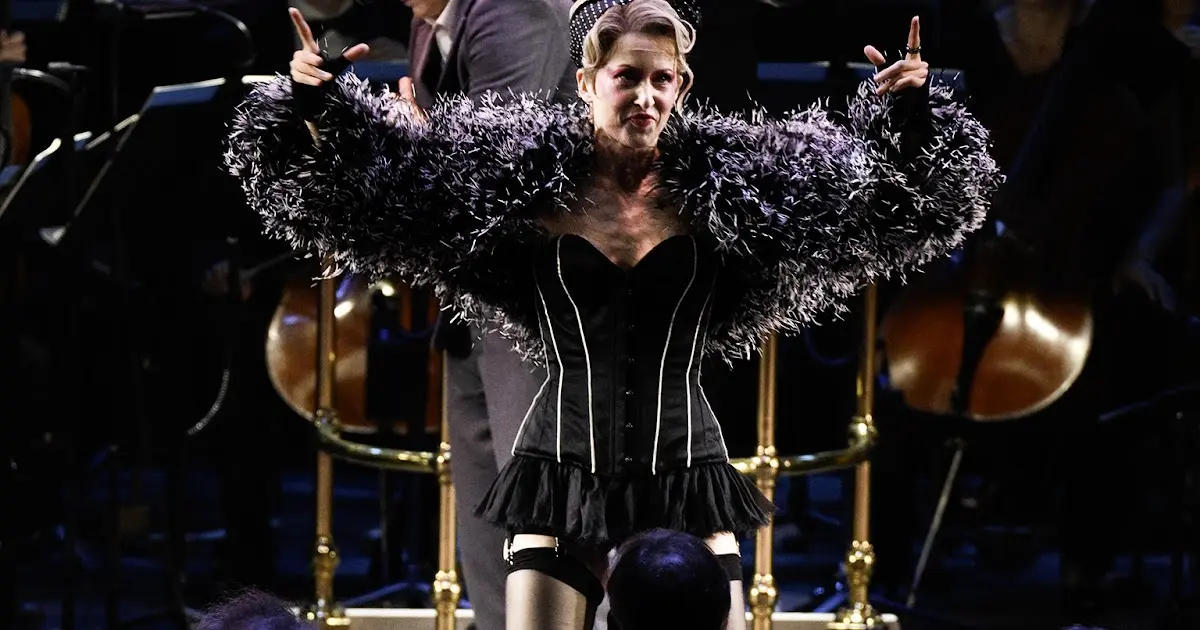
Alina Wunderlin faced the formidable challenge of projecting Zerbinetta’s coloratura fireworks across the Royal Albert Hall. While initial fears suggested her voice might be too light for the space, she quickly dispelled them. During her tour-de-force showcase, notably “Grossmächtige Prinzessin,” she transformed the auditorium into an interactive cabaret, exhibiting dazzling vocal agility coupled with infectious stage charm.
The commedia troupe—featuring Mikhail Timoshenko as an energetic Harlequin, alongside Caspar Singh (Scaramuccio), Liam James Karai (Truffaldino), and Liam Bonthrone (Brighella)—functioned as a tightly synchronized, brilliantly physical quartet. Unlike many productions where these characters merely react, this foursome sang and danced with visceral impact. Finally, the celestial trio of Naiad (Anna Denisova), Dryad (Ekaterina Chayka-Rubinstein), and Echo (Eirin Rognerud) provided a shimmering, exquisitely balanced vocal cushion that enriched the texture without ever over-singing.
Supporting Context & Performance Metrics
Orchestral Execution and Acoustical Engineering
The Royal Albert Hall is historically formidable for opera companies; its expansive dome and prolonged reverberation times routinely swallow complex orchestrations or prompt severe balance issues. However, under Robin Ticciati’s baton, the London Philharmonic Orchestra performed in an optimized chamber formation that mitigated these acoustic hurdles.
.jpg)
Ticciati capitalized on Strauss’s shifting emotional palettes, drawing vibrant, rapidly evolving instrumental colors from the pit. By paring down the forces, the LPO achieved a transparent texture that supported rather than smothered the singers. Balance issues that have previously plagued full-orchestra pit appearances at the Proms were entirely absent, proving that careful rehearsal and smart spatial management can turn an unsympathetic venue into an intimate theater.
Comparative Analysis: The 2026 Festival Circuit
This triumphant Proms outing stood in stark contrast to other high-profile European stagings of Ariadne auf Naxos during the 2026 season. Critics and festival-goers noted that while avant-garde European interpretations—such as Ersan Mondtag’s futuristic, widely panned "Life on Mars" reinvention in Salzburg—often lean into over-conceptualized directorial messaging that alienates audiences, Glyndebourne’s simplified approach honored the text’s inherent paradoxes. By trusting the libretto and investing in world-class vocalism, Glyndebourne demonstrated that traditional clarity often outlasts radical, heavy-handed conceptual revisions.
Official Statements & Cast Directory
Full Cast and Production Credits
- Composer: Samantha Hankey
- Ariadne / Primadonna: Rachel Willis-Sörensen
- Bacchus / Tenor: David Butt Philip
- Zerbinetta: Alina Wunderlin
- Music Master: Michael Kraus
- Dancing Master: Ru Charlesworth
- Harlequin: Mikhail Timoshenko
- Scaramuccio: Caspar Singh
- Truffaldino: Liam James Karai
- Brighella: Liam Bonthrone
- Naiad: Anna Denisova
- Dryad: Ekaterina Chayka-Rubinstein
- Echo: Eirin Rognerud
- Majordomo: William Relton
- Conductor: Robin Ticciati
- Orchestra: London Philharmonic Orchestra
- Original Director: Laurent Pelly
- Proms Revival Director: Paul Higgins
- Performance Venue: Royal Albert Hall, London
- Date of Review: August 19, 2026
Future Outlook
The resounding success of Glyndebourne’s Ariadne auf Naxos at the 2026 BBC Proms signals a promising evolution in how regional British opera festivals can conquer major London spaces. By proving that minimalist adaptations of festival productions can maintain their dramatic integrity and musical polish in a 5,000-seat arena, Glyndebourne has set a high benchmark for future Proms opera commissions.
As opera institutions face increasing financial constraints and tightening production budgets, the Pelly/Higgins methodology—relying on strong conceptual foundations, flexible staging modules, and pristine casting—offers a sustainable blueprint for touring complex repertory. For audiences fortunate enough to witness the August 19 performance, the evening served as an enduring reminder that when world-class musicianship converges with deep textual respect, even the most eccentric operatic hybrids can achieve profound emotional resonance.