Executive Overview
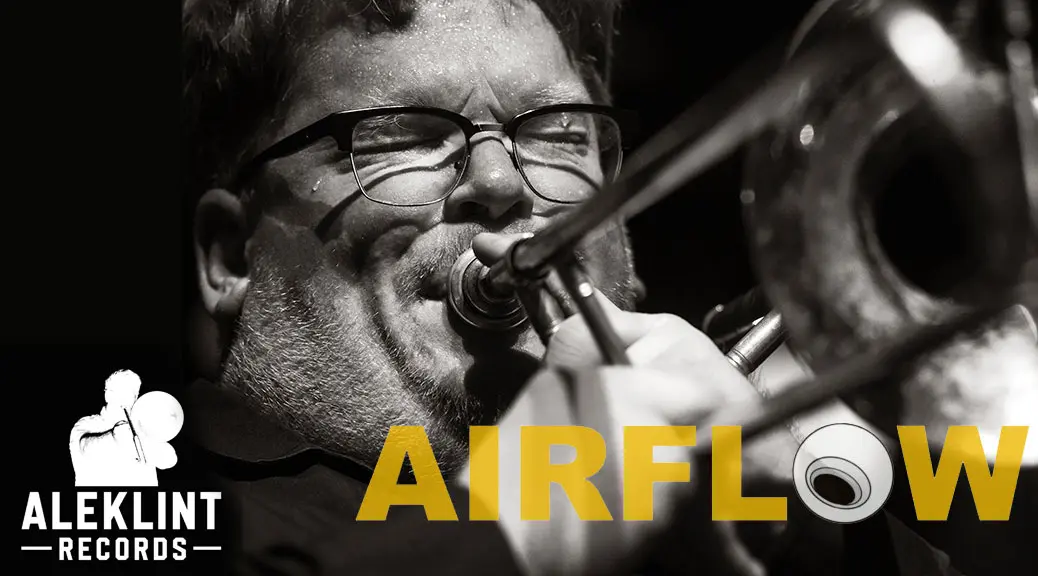
For a quarter of a century, Swedish trombonist Mats Åleklint has operated as one of the most reliable and versatile sonic engines in contemporary avant-garde and improvised music. Whether driving the thunderous low-end pulses of the Fire! Orchestra, navigating the intricate harmonic geometries of Angles, holding down the bottom in the Johan Lindström Septet, or contributing to the colossal ensemble forces of Paal Nilssen-Love’s Large Unit and the Norrbotten Big Band, Åleklint has spent his career as someone else’s trombone. His discography is vast, studded with high-profile collaborations alongside heavyweights like Dave Holland and Carla Bley, yet until recently, his presence as a primary bandleader was preserved on a single quartet record released via Moserobie.
That dynamic shifts irrevocably with the release of Airflow.
Issued on his newly minted, eponymous imprint—Åleklint Records—Airflow is a striking act of self-determination. Recorded, mixed, and mastered entirely by Åleklint himself, the album features a singular, uncompromising dialogue between the trombonist and veteran organist Sten Sandell. Captured over the course of a single day in March at the historic Uppenbarelsekyrkan in Saltsjöbaden, Sweden, the album consists of six free improvisations distributed evenly across two sides of vinyl: three pieces per side, utterly unmediated by producers, engineers, or external arbiters.
The resulting music is not background listening. It is a grueling, magnificent, and intellectually rigorous interrogation of breath, metal, stone, and resonance. By pairing the infinitely variable, lung-powered brass tube of the trombone with the monolithic, wind-driven architecture of a 1988 Walter Thür pipe organ, Åleklint and Sandell have bypassed the commercial safety nets of modern jazz and improvised music. Instead, they have erected a monument to risk, carving out a territory where acoustic physics meet spiritual acoustics. This review-chronicle examines the genesis of Airflow, the acoustic and historical weight of its recording environment, the deep mechanical kinship between its two instruments, and the uncompromising artistic vision that birthed Aleklint Records’ inaugural release.
Detailed Chronology: A Day at Uppenbarelsekyrkan
To understand Airflow, one must understand the environment that gave it shape. The organ is famously the one instrument that cannot travel to a session; it is inextricably bound to the physical architecture of its housing. For Airflow, Åleklint and Sandell travelled to Saltsjöbaden’s Uppenbarelsekyrkan (The Church of Revelation), a masterwork of National Romantic architecture designed by Ferdinand Boberg and constructed between 1910 and 1913. Financed by industrialist Knut and Alice Wallenberg—whose remains lie entombed directly beneath the sanctuary—the church was conceived by Archbishop Nathan Söderblom with a singular overarching theological and artistic programme: revelation, the moment at which the hidden is abruptly disclosed.
Boberg answered this brief with brutalist-leaning early modernist solidity. The structure is built from hard, unforgiving surfaces: a frame and facade of red Helsingborg brick, cold granite blocks, and gleaming marble at the altar, culminating in a long nave that channels the eye and sound eastward into an octagonal chancel. Perched on a small gallery on the south side of the tower body—directly above the Wallenberg crypt—sits the church’s pipe organ. Built in 1988 by Walter Thür of Torshälla, the instrument features thirty-two stops, incorporating salvaged pipework from the church’s older organ. Its case is adorned with vibrant paintings by local artist Gunvor Westelius.
On a cold day in March, Åleklint and Sandell sequestered themselves within this sonic cavern. With no safety net of pre-arranged melodies, predetermined chord progressions, or post-production sweetening, they tracked six improvisations in a single continuous sweep of creative energy.
Side A: The Battle of Breath and Bellows
Side A opens with “Fanfare,” a title that immediately invokes traditional calls to attention, though what follows subverts every military or ceremonial expectation. Åleklint’s trombone enters almost with a screech, cutting razor-sharp lines against a warm, foundational organ cushion laid down by Sandell. Soon, the trombonist adopts the posture of a horn player calling for reinforcements across a hostile battlefield. The two instruments bellow, spar, and answer one another in a rolling dialogue of microtonal friction, punctuated late in the piece by the snapping shut of a mute that chokes the horn’s projection just enough to sharpen its edge. The track is saturated with the rolled, percussive buzz of flutter-tongue techniques, establishing from the outset that neither player is interested in polite harmonic consensus.
The second track, “State of Mind,” tackles the fundamental structural asymmetry of the pairing. Sandell holds a continuous, unyielding drone, yet continuously shifts its internal parameters, stepping the pitch upward from one fixed point to the next with mechanical precision. Åleklint responds by swooping in and out on his slide, micro-tonally mapping the ambiguous, untempered spaces between those fixed points—sonic territory that no single pipe in the building’s architecture was ever built to reach.
Side A concludes with “All Aboard,” a piece characterized by mechanical agitation. A rapid fluttering sound—presumably the rhythm of Sandell’s foot working the organ’s swell shutters, or perhaps the tremulant stirring the church’s internal wind supply—drives the rhythm underneath. Following a sequence of mounting dramatic tension, the trombone introduces a surprisingly welcoming, lyrical pattern roughly three-quarters of the way through the piece. Yet, this olive branch is offered against the unyielding backdrop of Sandell’s omnipresent drone, which refuses to relent, softening nothing and forgiving less.
Side B: Mechanical Deconstruction and Final Alloy
Side B opens with “Broken Machine,” immediately establishing a shift in texture. High frequencies pierce the air, accompanied by an wheezing, pneumatic rasp that evokes a wheezing accordion or a decaying circus organ. The muted horn returns, with Åleklint’s hand physically cupped over the bell to shape, catch, and distort the escaping air. Unlike the sustained, cathedral-filling tones of the first side, the organ here introduces keyed, percussive strikes, setting up a frantic, angular call-and-response with the trombone that feels dangerously close to structural collapse.
“Meeting Points” follows, arriving with a thin, bright, and brittle temperament. The high mutation stops of the organ speak against the plucked, percussive attack inherent to the instrument’s mechanical tracker action, mimicking the harplike timbre of a distant harpsichord. This fragile beauty plays out over a desolate sonic landscape, haunted by a low, rasping groan from the organ pipes that would not feel out of place in a classic black-and-white horror film.

The album culminates with “Alloy,” a track where the title performs literal, material labor. The music pits brass (the copper-zinc alloy of the trombone) against tin and lead (the traditional pipe metal of the organ)—the physical elements from which both instruments draw their existence. The piece is a harrowing distillation of industrial sound: screeching metal, unidentified percussive clatters, heavy, lung-crushing organ rasps, and a final, decaying drone that seals the album’s fate. As the final vibrations die away in the cold brick of Uppenbarelsekyrkan, it is clear there are no musical survivors left to pass a comforting melody on to the next generation.
Supporting Context & Metrics: The Physics of Kinship
To fully appreciate the radical nature of Airflow, one must examine the acoustic engineering that underpins the collaboration. Despite their disparate physical appearances—one a sprawling, monumental permanent installation of wood, leather, and metal pipes; the other a portable, hand-held brass tube manipulated by a single pair of lungs—the trombone and the pipe organ are near-absolute biological and physical relatives.
The Organological Connection
- The Reed Principle: A significant subset of an organ’s thirty-two stops are classified as reeds. These operate on the exact same aerodynamic principle as a brass instrument: a beating metal tongue oscillates rapidly at one end of a resonating tube, mirroring the way a player’s flesh-and-blood lips vibrate against a metal mouthpiece.
- The Basun Connection: Within Sandell’s Saltsjöbaden disposition lies a stop known as the Basun (Trombone) 16-foot, planted firmly in the pedal division. This means Åleklint literally walked into a sacred building containing a mechanical, stationary trombone that had been waiting for him since the church’s organ was installed in 1988—an acoustic artifact cut to a fixed length, programmed by its builders never to bend a note.
- The Variable vs. Fixed Spectrum: Åleklint’s trombone represents the antithesis of the organ pipe. It is the sole horn in general orchestral use built around a continuously variable air column, with no pitch permanently fixed in the metal until the player’s arm locks it into place. Conversely, the organ draws its wind from a steady, motorized electric blower that will force air through its flues until a technician cuts the power. Every drone Sandell sustains is infinite until switched off; every drone Åleklint holds carries its own biological expiration date, bound entirely by the limits of human lung capacity.
Official Statements & Critical Perspectives
Writing about unvarnished, radical free improvisation has historically posed a formidable challenge to music journalism. Without the familiar waypoints of pre-composed structure, structured meter, and recurring melodies, critics are forced to abandon standard vernacular in favor of phenomenological reporting.
Reflecting on the sessions, the artistic philosophy behind the record centers on absolute creative autonomy. By bypassing traditional record labels, distribution networks, and studio intermediaries, Åleklint and Sandell sought an unadulterated transfer of energy from the performer to the medium.
In a joint artistic statement implied by the record’s uncompromising delivery, the duo noted that the language of Airflow is intentionally unfamiliar. It requires no translation because it demands direct visceral engagement. The music rejects the commodified comfort of resolved chord changes, substituting an architectural confrontation between human breath and mechanical wind.
As critic Steve Williams notes in his liner assessments of the project, the psychological arc of the album mirrors a tactical military deployment:
"The horn that opens ‘Fanfare’ is calling for reinforcements. By the close of ‘Alloy’ what the record needs is the other kind of order, the one an officer gives when the ground is worth keeping: stand firm, hold the position."
Future Outlook: The Blueprint for Aleklint Records
The release of Airflow marks far more than a curious side project for two veterans of European improvised music; it establishes a bold operational blueprint for the future of independent avant-garde publishing.
In launching Aleklint Records with a recording as uncompromising, abrasive, and commercially hazardous as Airflow, Mats Åleklint has made a definitive ideological statement. In an era where streaming platforms and algorithmic curation incentivize frictionless, background-friendly ambient and neo-classical sounds, Åleklint Records has planted its flag on the most difficult, jagged terrain imaginable.
The album serves as a challenge to the broader contemporary jazz and improvised music community. It demonstrates that veteran artists, after decades of serving as side-men and structural components in larger creative machines, can reclaim the means of production, engineering, and distribution to capture uncompromising sonic art on their own terms.
Whether subsequent releases on the imprint will maintain the austere, ascetic purity of Airflow remains to be seen. However, by staking the label’s inaugural catalog number on a day-long dialogue between a human lung and a 1988 Walter Thür pipe organ inside the cold, historical brick of Uppenbarelsekyrkan, Aleklint Records has issued an order to the contemporary music world that cannot be ignored: Stand firm, hold the position, and let the air flow.