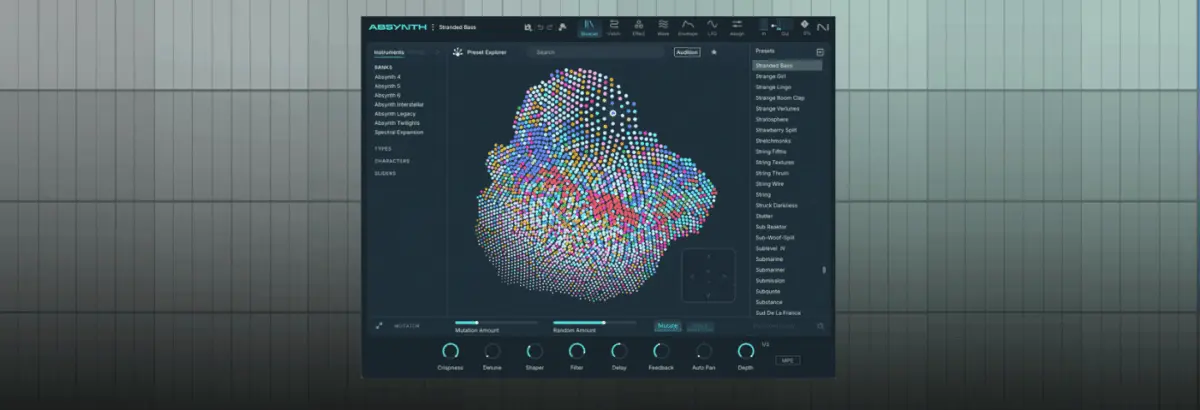
Native Instruments’ legendary synthesizer, Absynth, has long held a near-mythical status within electronic music production circles. Renowned for its complex, multi-stage envelopes, deep modulation matrix, and formidable capabilities in long-form sound design, Absynth has historically been pigeonholed as a tool reserved for cinematic film scoring, sweeping ambient pads, and otherworldly, evolving textures. However, the release of Absynth 6—available as part of the massive Komplete 26 bundle—fundamentally redefines the instrument’s boundaries. With overhauled granular architecture, a completely revamped loop engine, Moog-inspired ladder filter models, and the lush spatial wizardry of the Aetherizer effect, Absynth 6 proves to be remarkably adept at generating raw, hard-hitting, performance-ready techno elements.
In this deep-dive tutorial and technical breakdown, we explore how electronic music producers can leverage the power of Absynth 6 to transform a single, unassuming audio file—specifically, a traditional Peking Opera Gong one-shot sample—into a filthy, multi-layered, evolving acid techno sequence. By manipulating multi-stage envelopes beyond simple amplitude control, utilizing dense granular engines, and implementing intricate rhythmic retriggering, this guide demonstrates how a sprawling ambient texture can be sculpted into a tightly focused, high-energy groove that forms the heartbeat of a modern club track.
To understand the transformative power of Absynth 6, we must follow a precise architectural workflow. Operating at a steady club tempo of 129 BPM, our objective is to build a complex, evolving, and rhythmically aggressive techno patch from absolute scratch using only one audio sample.
Step 1: Initializing the Patch and Deploying the Granular Engine
The journey begins inside your digital audio workstation (DAW) of choice. First, instantiate Absynth 6 on an instrument track and program a foundational MIDI sequence—a driving, syncopated pattern designed to push a four-on-the-floor arrangement.
Load a New Preset in Absynth 6, press play, and you will initially hear a standard, unassuming sine wave tracking your MIDI performance.
Navigate to the Patch tab within the instrument’s interface.
Replace the default oscillator with Absynth’s newly overhauled Granular Engine.
Import your source audio: select the Peking Opera Gong one-shot as your raw audio material.
At this stage, the raw sample carries traditional acoustic characteristics, but when married to a pulsing beat, it immediately establishes an organic foundation for rhythmic manipulation.
Step 2: Pitch Transposition and Density Unleashed
A pristine acoustic gong sample is a far cry from the raw, distorted aesthetics of warehouse techno. To inject grit and weight into the patch, we must manipulate its frequency domain and playback parameters:
Detune the sound downward by 12 semitones (a full octave), instantly shifting the harmonic profile into a darker, heavier register.
Switch over to the Grain tab and shrink the grain size down to 3ms.
Observe the profound impact of Absynth 6’s upgraded granular architecture. The instrument’s maximum density has been dramatically increased to a staggering 32. To appreciate the sheer engineering leap of version 6, drop the density parameter down to 4; the sound instantly loses its aggressive edge, becoming thin and limp. The maxed-out density setting, conversely, introduces a thick, saturated wall of granular texture.
Step 3: Sculpting Movement via Amplitude and Pitch Envelopes
Absynth has always derived its secret sauce from its legendary multi-stage envelope system. We will now harness this system to generate rhythmic propulsion and melodic motion:
Click on Osc A Amp, open the Transform menu, and select Expand to Rhythm.
Engage BPM Sync to lock the envelope movements tightly to your DAW’s master clock.
Create a New Envelope and assign it to Osc A Main Pitch.
Activate the LFO button and drag the first envelope breakpoint all the way down.
Remarkably, through this simple routing manoeuvre, the envelope begins pumping the amplitude level while the LFO modulates the pitch, instantly morphing the static sample into a bouncing, functional acid bassline.
Step 4: Fine-Tuning the Envelope and Modulation Parameters
To refine the acid character of our sequence, we must isolate our modulation targets and dial in specific numerical offsets:
Navigate to the LFO page and deselect channels B and C from the LFO’s pitch assignment matrix, ensuring that the modulation affects only our primary layer.
Raise the Pitch slider to 25, the Time parameter to 1.6919, and the Phase to 32.063.
These precise adjustments introduce a wobbly, unstable pitch modulation peppered with sharp, aggressive transient spikes, firmly locking the patch into a filthy, authentic acid aesthetic.
Step 5: Applying Moog-Style Ladder Filtering
No acid techno line is complete without distinctive, resonant filtering. Absynth 6 introduces a powerhouse suite of filter models inspired by classic analog ladder topologies:
Insert a Ladder BP (Band-Pass) filter first, setting the cutoff to 542.92 Hz. This effectively isolates and accentuates the boxy, nasal mid-range frequencies characteristic of classic acid synths.
Follow this with a Ladder LP (Low-Pass) filter set to 500.56 Hz.
Crank the resonance parameter up to 43.875 on the low-pass filter. The result is a screaming, self-oscillating, ultra-filthy acid line that cuts effortlessly through a dense mix.
Step 6: Introducing Layer Two and Retrigger Modes
A truly professional techno patch rarely relies on a single oscillator. To add depth and complexity, we will introduce a secondary layer:
Load a Sample Engine into Channel 2, load the same Peking Opera Gong sample, and transpose it down an intimidating 24 semitones (two full octaves).
Temporarily lower the volume of Channel A so you can audition and shape Layer 2 in isolation.
Access the envelope section, select Osc B Amp, apply the Expand to Rhythm function once more, and switch the envelope Mode to Retrigger.
Step 7: Fast Retriggering and Groovy Syncopation
To achieve a complex, delay-like rhythmic interplay:
Pull the beat length/timing parameter down to 0.250 to generate a rapid, highly syncopated pulse.
Locate the lower of the two pink envelope circles and drag it to the left, aligning it with the onset of the second envelope spike.
By doing this, we instruct Absynth to rhythmically retrigger the envelope rapidly until the second MIDI note triggers, at which point retriggering ceases and the remainder of the envelope plays out. This imparts an undeniable, organic human groove to the sequence.
Step 8: Spatial Depth via the Aetherizer Effect
Absynth 6 features an upgraded spatial processing tool known as the Aetherizer, capable of generating impossibly lush, granular-infused reverb and delay textures:
Route the effect away from the Master signal by pulling its input slider all the way down, isolating its input source exclusively to our secondary layer (Channel B).
Crank the Feedback parameter to 75 and set the Wet signal blend to approximately 0.562. (Pro-tip: Assign this parameter to a macro control to enable real-time dramatic sweeps during live performances).
Because this effect is isolated to Channel B, it leaves our primary acid line on Channel A untouched. You can now blend Channel A back into the mix.
Step 9: The Third Layer and Advanced Looping
To crown our patch with maximum sonic complexity, we add a third and final layer:
On Channel C, insert another Sample Engine loaded with our ubiquitous Peking Opera Gong sample. Lower the volumes of Channels A and B temporarily to audition it against a tech-house/techno drum loop.
Open Absynth 6’s newly overhauled Loop section. Set a loop start point of 5600 and an endpoint of 12644.
The engine continues to track the main riff, but now infuses it with wildly syncopated, granular micro-repeats. Bring the volumes of all three layers back up to achieve a monolithic wall of sound.
Step 10: Final Balancing and Live Groovebox Integration
With all three layers active, you are left with a massive palette of sounds that function brilliantly both independently and in various combinations.
Assign macro controls to key parameters such as individual channel levels and the Aetherizer wet/dry mix.
These assignments effectively convert Absynth 6 from a static studio plugin into a fierce, highly interactive live-jamming techno groovebox capable of endless variations on the fly.
Supporting Context & Metrics: The Evolution of Absynth
To fully appreciate the significance of Absynth 6 within the modern production landscape, it is helpful to examine its historical trajectory. Originally developed by Brian Clevinger and later acquired by Native Instruments, Absynth became a staple of early-2000s electronic music production. Its semi-modular architecture, combining granular, sample-playback, wave-folding, and FM synthesis oscillators across multiple channels, offered a playground for sound designers who found standard subtractive analog emulations limiting.
However, as the software instrument market shifted toward streamlined, CPU-efficient, user-friendly soft synths, Absynth languished without significant updates, eventually being phased out of contemporary Native Instruments bundles. Its return in Komplete 26 as Absynth 6 represents a major engineering triumph. Key performance metrics and architectural upgrades in version 6 include:
Expanded Granular Engine: Maximum density increased from historical limits (typically 4 to 8) up to a massive 32, allowing for ultra-dense, noise-like textural pads and aggressive industrial transients.
Analog Filter Emulations: The inclusion of licensed Moog-style ladder filter topology bridges the gap between digital wavetable manipulation and warm, self-resinating analog filth.
Enhanced Envelope Resolution: Multi-stage breakpoint envelopes with advanced retrigger and rhythmic expansion modes, offering step-sequencer-level modulation without sacrificing continuous curve flexibility.
Next-Generation Aetherizer: Upgraded algorithms that reduce CPU overhead while dramatically increasing the clarity and spatial depth of granular reverb tails.
Official Statements and Industry Reception
The surprise revival of Absynth within the Komplete 26 ecosystem has sent ripples through the electronic music production community. Native Instruments’ product development team emphasized that bringing back Absynth was a direct response to years of passionate lobbying from loyal power-users and avant-garde sound designers.
"Absynth was never just a synth; it was a universe of sonic potential that defied traditional categorization," noted a senior Native Instruments product manager during the Komplete 26 launch event. "With version 6, we didn’t want to modernize it into a sterile, generic virtual analog. Instead, we doubled down on what made it legendary—its deep modulation architecture, its unpredictable granular engines, and its capacity for chaos—while equipping it with the modern routing and filter options that today’s underground electronic producers demand."
Early adopters and underground techno producers have embraced the instrument’s unexpected utility in heavy club genres. While traditionally associated with ambient soundscapes and cinematic drones, producers are discovering that Absynth 6’s multi-channel envelope manipulation makes it an elite weapon for generating rolling basslines, evolving industrial percussion, and razor-sharp synthesized stabs.
Future Outlook
The resurgence of Absynth 6 signals a broader industry trend: the reclamation of complex, deep-dive software synthesis in an era dominated by instant-gratification preset browsers and AI-driven sample generators. As electronic music subgenres continue to cross-pollinate—merging the aggressive textures of industrial and noise with the rigid, hypnotic pulse of modern techno—producers are increasingly searching for tools that yield unique, signature sound palettes rather than homogenized factory presets.
By proving that a single traditional percussion sample can be systematically dismantled, modulated, filtered, and reconstructed into an uncompromising club weapon, Absynth 6 reasserts its position as one of the most powerful and imaginative sound design platforms ever coded. Whether scoring high-concept cyberpunk films or driving peak-time warehouse sound systems, Absynth 6 bridges the gap between experimental sound art and functional dancefloor power, ensuring its legacy will endure for generations of producers to come.
Absynth is available now as part of Komplete 26. To explore full technical specifications, system requirements, and pricing options, visit the official Native Instruments Website.