Executive Overview
The global music festival industry in 2026 remains a commercial behemoth, yet its public discourse is increasingly monopolized by a select tier of legacy headliners. Press coverage and social media algorithms prioritize high-budget spectacles at events like Glastonbury, Coachella, and Lollapalooza. However, an investigative look beneath the top-line billing reveals that the structural vitality, cultural relevance, and future economic sustainability of the festival ecosystem are driven by the artists positioned lower down the poster.
Often printed in small, barely legible fonts, these emerging acts are the ones executing the essential groundwork of the summer circuit. They fill tents on Thursday nights when main stages are dark, engage directly with audiences in high-conversion environments, and establish grassroots international footprints.
This report examines the realities of the 2026 festival season from the perspective of the NME 100—a curated class of essential emerging artists. Through firsthand testimonies from acts including 54 Ultra, Ceebo, KuleeAngee, Madra Salach, Nadia Kadek, and The Itch, we analyze the operational challenges, artistic milestones, and audience-building strategies that define the modern lower-tier festival experience.
Supporting Context & Metrics: The Economics of the "Small Font"
To understand the value of lower-tier festival billing, one must look at the shifting mechanics of live music discovery. The contemporary touring landscape is fraught with financial hurdles, including inflated production costs, complex international visa regulations, and a crowded post-pandemic market. For emerging acts, solo headlining tours are increasingly high-risk ventures.
In this climate, music festivals serve as critical incubators. Mid-to-lower-tier slots offer artists access to aggregated, pre-ticketed audiences who are prime candidates for conversion.
+-----------------------------------------------------------------------+
|                 THE LOWER-BILL VALUE PROPOSITION                      |
+-----------------------------------------------------------------------+
|  Slot Type          | Audience Dynamic        | Strategic Value       |
+---------------------+-------------------------+-----------------------|
|  Thursday Night     | Captive, curious,       | High discovery rates; |
|  "Soft Open"        | seeking entertainment   | packed tents due to   |
|                     | before main stages open | closed main arenas.   |
+---------------------+-------------------------+-----------------------|
|  Early Afternoon    | Chilled, receptive,     | Ideal for folk, indie,|
|  "Chilled" Slots    | family-friendly         | and ambient genres to |
|                     |                         | build mood-based fans.|
+---------------------+-------------------------+-----------------------|
|  Showcase /         | Industry-heavy,         | High networking value;|
|  International      | tastemakers, global     | gateway to booking    |
|  Exchange Slots     | talent scouts           | agents and promoters. |
+-----------------------------------------------------------------------+
As demonstrated by the data, slots such as the "Thursday night soft open" at festivals like Latitude are highly coveted. With the main arenas closed, attendees wander into secondary tents, resulting in capacity crowds for artists who would otherwise play to modest club venues.
Similarly, international showcases provide a cost-effective mechanism for artists to bypass traditional geographic barriers, turning localized buzz into a global touring footprint.
Detailed Chronology of the 2026 Festival Circuit
The journey of an emerging artist through the summer festival season is a grueling, multi-month test of endurance. Below is a chronological breakdown of how the 2026 circuit unfolded for the NME 100 class:

Phase 1: The Spring Testing Grounds (March – May)
The festival season begins long before the summer heat. For UK rapper Ceebo, the groundwork was laid in March with showcase performances in Paris. This phase serves as a vital trial run for artists to test new material, refine their stage presence, and gauge their appeal in non-domestic markets.
In May, events like The Great Escape in Brighton act as the industry’s official spring summit, where acts like Scottish electronic duo KuleeAngee first present their full-band setups to European booking agents and tastemakers.
Phase 2: The Midsummer Peak (June – July)
By June, the circuit shifts to major outdoor greenfield sites. This period is characterized by rapid transit between domestic and international dates. 54 Ultra achieved major milestones during this window, securing debuts at Coachella in California and Lollapalooza in Chicago.
Simultaneously, European events like France’s Fête de la Musique and the UK’s Latitude Festival open their gates. At Latitude, emerging acts like Nadia Kadek and KuleeAngee capitalized on early-weekend slots to perform in front of thousands of early arrivals.
Phase 3: The Late-Summer Crescendo (August – September)
The season concludes with high-intensity regional and specialist festivals. August sees artists traveling to mainland Europe for events like Germany’s Haldernpop, where Irish folk-punk outfit Madra Salach performed.
In the UK, Green Man in Wales and Kendal Calling in the Lake District offer highly dedicated, music-first crowds. For dance-punk duo The Itch, a slot at Green Man represented the culmination of a decade-long aspiration, highlighting the deep emotional connection between artists and the specific festivals they grew up attending.
Official Statements & Artist Case Studies
To understand the qualitative experience of navigating the live circuit from the lower half of the bill, we spoke directly with the artists on the ground.
54 Ultra: The Strategy of Crowd Conversion
For Latin indie-soul artist 54 Ultra, performing on major stages like Coachella and Lollapalooza was a masterclass in audience acquisition. Rather than viewing a crowd of unfamiliar faces as a hurdle, the artist approaches it with a competitive mindset.

"It’s never pressure; it’s a game," 54 Ultra explains. "I’m used to turning new people into fans because nobody knew who I was for so long in New York and New Jersey. I know that feeling and how to get people to pay attention. Having a healthy crowd at both Coachella and Lollapalooza, and doing something people were talking about, was all I wanted."
Looking ahead, 54 Ultra is targeting South American markets, specifically aiming for Lollapalooza in Brazil and Argentina:
"I want to go to South America, see different cultures and talk to my people."
Ceebo: Breaking Linguistic and Geographic Barriers
For London-based rapper Ceebo, the 2026 season proved that hip-hop’s cultural currency easily transcends language barriers. His performances at Paris’s Fête de la Musique in June highlighted the universal appeal of his live show.
"This was my first time performing abroad," Ceebo states. "I thought the language barrier would be a thing, but it wasn’t. It was really inspiring seeing how Parisians interact with music. When I first performed in Paris, someone rushed over to me when I got offstage. He’d been speaking French throughout my set, then started speaking to me in English and told me he’d travelled specifically to see me. Knowing people are already invested enough to travel to see me means a lot."
Ceebo’s long-term sights are set on headlining major UK institutions, driven by a deeply personal history with one event in particular:
"Wireless would be especially full-circle because I worked there. I haven’t been back since, and I’ve always told myself that the next time I’m there, I’ll be performing."
KuleeAngee: The Power of Regional Identity and Backstage Community
Scottish electronic duo KuleeAngee (comprising Duncan Grant and Kesh Kanabar) utilized their appearances at The Great Escape and Latitude to validate their euphoric live sound.

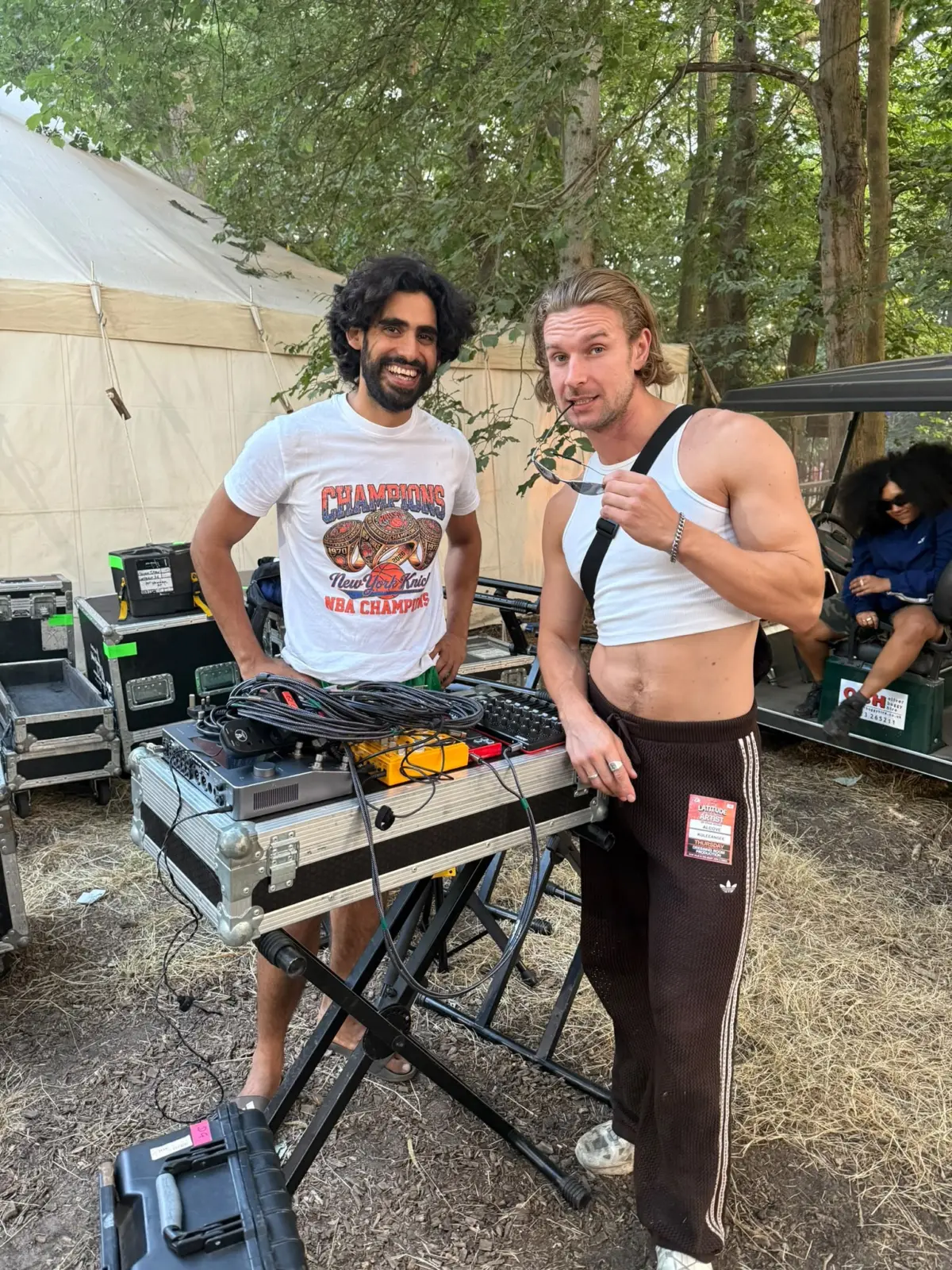
"Latitude was our first major festival as a full band," says Duncan Grant. "We got a really good Thursday night slot, when the main stages are closed, so most of the festival crowd was just wandering into tents to see what was on. It was perfect for us. We just had random people coming in, and we showed them a good time."
Kesh Kanabar adds:
"The band really suits the festival vibe—it’s inviting and euphoric. It was validating because we’ve always thought our music would work well at festivals. Beyond that, meeting other bands is one of the best things. We played a festival in Amsterdam and saw another Scottish band, Brògeal, backstage. We ended up going to a house party together and genuinely became friends."
In terms of future goals, Grant advocates for the return of a defunct giant of the Scottish live scene:
"I’d love T In The Park to come back and have a Scottish band headline the main stage. That would be special."
Madra Salach: Demystifying the Artist Village and Embracing Chaos
Irish folk-punk band Madra Salach brought their fiery, traditional-leaning punk to mainland Europe. Band members Paul Banks and Jack Martin quickly learned to navigate both the realities of backstage life and the unpredictability of international crowds.
"I think I was struck by how calm the vibes are in the artist’s village; everyone’s kind of having downtime," Paul Banks reflects. "Before I did this, I probably would have thought that everyone was on some rager and getting hammered all the time. But it’s all very chill and people like eating fruit."
On stage, the band uses humor to break the ice, even when it fails to translate.

"Pretty much every set we do, I’ll hand it over to Jack to tell a joke," Banks says. "On the continent, where maybe English isn’t their first language, Jack does his joke and absolutely dies on his arse. It’s been really special."
Jack Martin laughs:
"Sometimes they’re overly polite and give me a round of applause. They’re not even really jokes; they’re just short, rambling thoughts. But we’ve been really surprised at the turnout. You go to countries you’ve never been to and you think, ‘Wow, people in Poland like Irish folk.’ Also, getting to go on stage and perform ‘Band On The Run’ with Black Country, New Road at Haldernpop was not on my 2026 bingo card."
Nadia Kadek: Reclaiming the Intimacy of the Festival Experience
For British-Indonesian indie-folk artist Nadia Kadek, festivals have been a constant presence since childhood. Her mother worked at a Glastonbury café, allowing Kadek to attend the legendary 2007 festival as a child. In 2026, she returned to the festival circuit as a performer, opening the Sunrise Arena at Latitude and performing at Kendal Calling.
"I opened Latitude at the Sunrise Arena, which is a stage I’ve always wanted to play," Kadek says. "I love the idea of playing a Thursday slot when people are walking around discovering new music. Then later that night I got to go onstage with the Mystery Jets, who are one of my favourite bands, and sing a song with them. At Kendal Calling, there was a couple who knew all the words to my songs. Kendal is so far from home, and there were people all the way out there who knew my music. If two people can enjoy it, then it’s so worth it."
Unlike many of her peers, Kadek’s aspirations do not involve late-night headliner slots:
"None of my big dreams are actually about headlining. I’d love to open the Pyramid Stage at Glastonbury, or play the Latitude main stage on a Sunday afternoon, when everyone’s just chilling out on the last day. My favourite festival memories are those little moments: the first set of the weekend, or when the sun’s going down. Those are the moments that stick with you."
The Itch: Harnessing the "Manic Energy" of No-Soundcheck Sets
Dance-punk duo The Itch (Georgia Hardy and Simon Tyrie) view the chaotic, fast-paced nature of festival sets as an essential tool for artistic development. Having grown up attending festivals like Reading and Green Man as punters, performing on those same stages in 2026 felt like a significant milestone.

"Green Man was definitely a milestone for us," Georgia Hardy notes. "I’d been going as a punter for about 10 years, so it was a really big deal to finally play there. I think festivals are actually a really good way to hone your performance and your setlist in a way that you can’t necessarily do just by playing venues. There’s an element of ‘anything can happen.’ You haven’t necessarily done a soundcheck; you’ve usually just arrived, got ready, and walked straight onto the stage. There’s not much time to think about it, which can be quite freeing."
Simon Tyrie describes the unique psychological state that this environment produces:
"There’s this slight manic energy you get at festivals. The crowd might be sleep-deprived, and as a band you’re often in a similar state. You’ve probably been travelling for ages; you’ve just arrived, you don’t even know where you are, you’ve had an hour to get ready, and suddenly you’re on stage."
Tyrie’s ultimate goal remains Glastonbury—an event he refuses to attend unless he is booked to play:
"I don’t think I’d go as a punter while we’re still doing festivals—I’d just be sad that we weren’t playing. My experience of Glastonbury is all through myths and stories from other bands. I think about the Radiohead ’97 Pyramid Stage set. I don’t know if I can imagine that kind of set happening again now, but they were a band on their third album. Two more; we’ll see what happens…"
Future Outlook: The Headliner Pipeline of Tomorrow
The testimonies of the 2026 NME 100 class highlight a crucial truth: the health of the live music industry depends entirely on the cultivation of lower-bill talent. While massive headlining acts draw casual fans and secure ticket sales, it is the mid-afternoon and Thursday night acts that keep audiences engaged, foster community, and keep the live music scene fresh.
As legacy stadium acts eventually retire, the festival promoters of tomorrow will have to rely on the very artists currently honing their craft in the lower-font sections of today’s posters. Whether it is Ceebo returning to headline the festival where he once worked security, or Nadia Kadek soundtracking a sunny Sunday afternoon on a main stage, the small-font acts of 2026 are well on their way to becoming the headliners of tomorrow.