Executive Overview
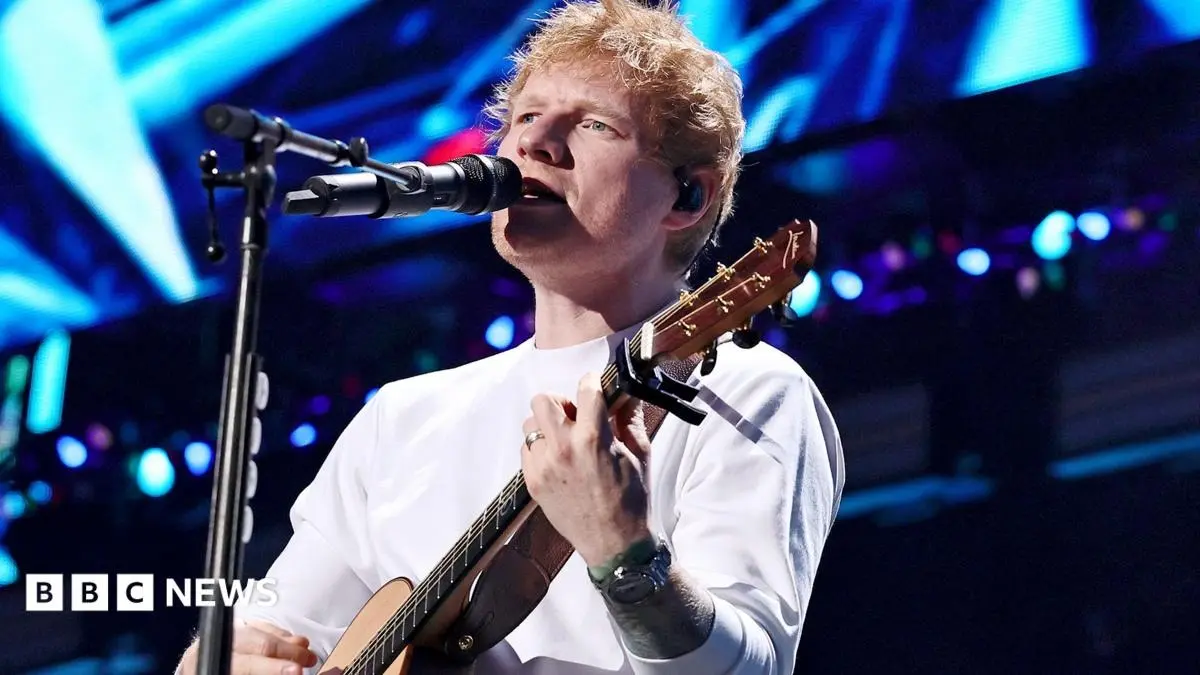
The intersection of popular music, corporate venue management, and geopolitical discourse has once again laid bare the fragility of major international concert tours. What began as a routine booking for Ed Sheeran’s high-profile United States tour has devolved into a multi-layered controversy, culminating in the abrupt removal of Grammy-winning rapper Macklemore, a cascading boycott by supporting acts, international radio blacklists, and a fierce public debate over artistic freedom, corporate censorship, and the Israeli-Palestinian conflict.
The crisis ignited on Monday when Macklemore was formally dropped from the tour lineup, a move that immediately triggered widespread industry backlash. In a display of solidarity, several prominent support acts—including Finneas, Lukas Graham, Aaron Rowe, and Beoga—withdrew from the bill. While Ed Sheeran quickly distanced himself from the administrative decision, placing the responsibility squarely on his promoters, the Messina Touring Group (MTG), critics have questioned the singer’s passive acceptance of the outcome.
MTG defended the removal with pragmatic finality: several key venues, most notably Gillette Stadium—owned by billionaire Robert Kraft and the Kraft Group—allegedly threatened to bar the performances entirely if Macklemore remained on the bill. Faced with the prospect of an outright tour cancellation, promoters executed the controversial excision to protect the commercial viability of the enterprise.
As the fallout deepens, the controversy has expanded far beyond the confines of the concert circuit. Cultural figures, human rights advocates, and media outlets worldwide are now interrogating the invisible boundaries of free expression within corporate-controlled entertainment spaces. With Macklemore pledging his entire $1 million net earnings from the tour to Palestinian humanitarian organizations, and radio stations in Europe pulling Sheeran’s catalog in protest, the tour’s resumption in Philadelphia on Saturday serves not as a celebration of live music, but as a flashpoint for deeper ideological fractures in modern entertainment.
Detailed Chronology
The Lead-Up and Monday’s Ouster
The events leading to the crisis had been quietly brewing behind the scenes as tensions surrounding public commentary on the Middle East intersected with the strict operational parameters of major American stadium complexes. Macklemore, known for his outspoken political views and recent advocacy for Palestinian causes, was slated as a primary support act for Sheeran’s expansive North American routing.
On Monday, however, the landscape shifted dramatically. Without prior public warning, Macklemore was removed from the tour roster. The swiftness of the decision caught industry observers off guard, but the immediate consequence was an instantaneous wave of artist resistance. Within hours of the announcement, fellow tour acts began evaluating their positions. By Monday evening, the first cracks in the tour’s infrastructure appeared as supporting musicians announced their resignations in protest, framing the rapper’s dismissal as an alarming precedent for artistic censorship.
Sheeran’s Response and the Promoters’ Justification
As public outcry mounted against the tour management, Ed Sheeran took to social media and official channels on Tuesday to clarify his personal stance. The British singer-songwriter asserted that the decision to drop Macklemore was made exclusively by the Messina Touring Group, asserting that he did not possess the contractual authority—or the unilateral desire—to dictate promoter-level security and venue compliance policies.
Sheeran walked a delicate diplomatic line in his public statements. He stated that he respects "Macklemore’s strength of purpose to stand up and shout for what he believes," while simultaneously clarifying that he rarely uses his own massive global platform for direct political messaging. This distinction, he argued, should not be misconstrued as apathy or a lack of personal conviction.
Simultaneously, the Messina Touring Group issued an unvarnished explanation for the expulsion. According to promoters, continued inclusion of the Seattle-born rapper would have triggered venue lockouts across the country. Specific attention was drawn to Gillette Stadium, home of the New England Patriots and a cornerstone venue of the tour. Promoters maintained that high-profile venue management groups refused to host the concerts with Macklemore on the bill, leaving MTG with a binary choice: cancel the entire tour or drop the controversial artist.
The Artists’ Boycott and International Repercussions
The domino effect of Macklemore’s removal rapidly devastated the tour’s supporting lineup. Finneas—the acclaimed producer, songwriter, and brother of pop icon Billie Eilish—withdrew his participation, followed swiftly by Danish pop-soul band Lukas Graham, Irish singer-songwriter Aaron Rowe, and the traditional Irish folk group Beoga, who had maintained a long-standing collaborative relationship with Sheeran. The departing acts released joint and individual statements condemning the decision, arguing that caving to venue ultimatums establishes a dangerous chilling effect on free speech within the music industry.
The shockwaves quickly crossed the Atlantic. In Ireland, Classic Hits Radio took the decisive step of dropping Ed Sheeran’s music from its broadcast rotation, responding directly to heavy listener backlash over the perceived complicity of the tour apparatus in silencing a political dissident.
Macklemore’s Retaliation and Financial Pledge
Refusing to exit quietly, Macklemore addressed the controversy head-on. On Wednesday, the rapper announced a definitive financial and rhetorical escalation: he would donate his entire $1 million in net earnings from the tour directly to six Palestinian humanitarian organizations.
In a widely shared social media post, Macklemore stated his intention was "to bring the conversation back to where it belongs: to the Palestinian people." He characterized the ongoing crisis in Gaza as "a manmade injustice" demanding immediate political intervention, directly challenging the narrative advanced by his critics and framing his removal as an attempt to suppress uncomfortable truths about global geopolitics.
Supporting Context & Metrics
The Financial Stakes of Tour Cancellation
To understand why Ed Sheeran and the Messina Touring Group elected to proceed without Macklemore rather than scrap the entire enterprise, one must examine the staggering economic realities of modern stadium tours. A cancellation of this magnitude does not merely mean missing out on ticket revenues; it triggers a complex web of financial liabilities.
- Venue Deposits and Rental Agreements: Major stadiums are booked months, sometimes years, in advance, with non-refundable deposits and contractual guarantees running into the millions of dollars.
- Production and Crew Costs: Moving a massive stage production, sound systems, lighting rigs, and hundreds of technical personnel across the United States incurs daily overhead expenses that persist whether a show happens or not.
- Ticketholder Refunds and Logistics: Processing refunds for hundreds of thousands of ticket buyers involves administrative costs, legal fees, and potential insurance complications, as standard tour cancellation insurance frequently excludes losses stemming from voluntary boycotts or political controversies.
Veteran industry voices, including veteran protest singer Billy Bragg, publicly urged Sheeran to scrap the tour entirely in an act of moral solidarity. However, financial analysts pointed out that doing so could have bankrupted smaller entities involved in the production and left the primary stakeholders facing insurmountable financial litigation.
The Logistics of a Solo Reconfiguration
Despite the loss of multiple support acts—most notably Beoga, whose intricate instrumental arrangements formed a core component of several key tracks in Sheeran’s setlist—the tour remains technologically and logistically viable. Sheeran’s reputation as a "one-man band" who relies heavily on loop pedals allows him to perform entirely solo if necessary. However, the setlist must undergo significant restructuring to compensate for the missing acoustic depth previously provided by his supporting collaborators.
Official Statements & Key Perspectives
Robert Kraft and the Kraft Group Response
Following days of silence and swirling accusations regarding backdoor lobbying, billionaire industrialist and sports mogul Robert Kraft issued a comprehensive statement through Gillette Stadium on his behalf. Kraft sought to reframe his philanthropic and personal record, directly addressing critics who accused him of stifling pro-Palestinian voices.
"I would like those speaking in support of the Palestinian people to know I have supported efforts that create opportunity for Palestinians," Kraft stated, highlighting historical initiatives aimed at bringing young Israelis and Palestinians together to build joint enterprises, foster employment, and forge interpersonal relationships.
"I have dedicated much of my life to building bridges between all people," the statement continued. "I believe deeply that all lives are worth protecting."
While Kraft’s statement emphasized his commitment to cross-cultural dialogue, it conspicuously omitted any confirmation or denial of Macklemore’s allegations that Kraft had actively coordinated with other stadium owners to orchestrate a nationwide venue ban against the rapper. Furthermore, representatives for Kraft accused Macklemore of harboring "a broader history of antisemitic rhetoric"—an allegation the rapper strongly denies—while asserting that the artist’s public commentary offered "selective information" that deliberately ignored the actions and atrocities committed by Hamas.
Macklemore’s Defense and Political Positioning
Macklemore’s camp has consistently rejected allegations of antisemitism, arguing that his activism is strictly directed at state policies, human rights abuses, and the protection of civilian populations caught in zones of active conflict. By redirecting his financial earnings from the tour into direct aid for Palestinian charities, the artist sought to turn a professional setback into a high-profile platform for his advocacy.
Ed Sheeran’s Balancing Act
Sheeran’s public communications have highlighted the profound discomfort artists face when global politics collide with commercial entertainment. By emphasizing his duty to his loyal fan base and the behind-the-scenes production crew whose livelihoods depend on the tour’s completion, Sheeran attempted to anchor his decision in professional obligation rather than political cowardice. Nevertheless, the simultaneous departure of his peers suggests that the music community remains deeply divided over whether a performer can ever truly remain neutral when systemic censorship is applied to a tour bill.
Future Outlook
As Ed Sheeran prepares to take the stage in Philadelphia, Pennsylvania, on Saturday to resume the North American leg of his tour, the shadow of the Macklemore controversy looms large over the enterprise. What was originally projected to be a straightforward celebration of contemporary pop music has transformed into a high-stakes cultural litmus test.
The long-term ramifications of this episode are likely to reverberate throughout the live entertainment industry for years to come. Promoters, venue owners, and artists alike are now forced to confront uncomfortable questions regarding contractual censorship, the political vetting of supporting acts, and the expanding weaponization of venue accessibility.
For concertgoers, the incident serves as a stark reminder of the invisible geopolitical forces shaping the entertainment they consume. Whether audiences will vote with their wallets by boycotting the remaining dates, or whether the tour will successfully weather the storm and finish its run, remains one of the most closely watched narratives in contemporary pop culture. One reality, however, is undisputed: the boundary between art and political activism has never been more porous, nor its crossings more volatile.