Executive Overview
In an era dominated by transient, algorithm-driven singles that vanish from public consciousness as quickly as they appear, the release of the Landmark Riddim stands as a monumental counter-narrative—a testament to patience, international collaboration, and the enduring power of Jamaican sound-system culture. Released on August 21, 2026, via Dub Shot Records, this expansive eighteen-track set is anchored by a singular, meticulously crafted instrumental that required nearly three years of cross-continental engineering to complete.
At the heart of this sprawling project is "Sweet Love," a soulful, deeply reflective vocal contribution by rising roots-reggae luminary Kazayah. Her performance floats effortlessly over a riddim that merges traditional Jamaican one-drop sensibilities with a distinct, smoky blues undertone—a fusion that its creators have dubbed "One Drop Blues."
The genesis of this project stretches far beyond a conventional studio session. Spearheaded by Maine-based label Stay Nice Music—directed by producer Joshua “Don Daka” Smith alongside co-producer David “Jah David” Goldmine—the Landmark Riddim represents a masterclass in modern roots architecture. It unites an elite roster of instrumentalists, including guitarist Lamont “Monty” Savory, Okiel McIntyre, Laurent “Tippy I” Alfred of I Grade Records, and renowned Spanish roots producer Roberto Sánchez. Together, they laid down a foundation of deep, resonant basslines, crisp guitar skanks, and soaring horn arrangements that gave fifteen distinct vocalists the canvas to paint their own lyrical stories.
From Kumar Fyah’s poignant reflections on his detention over a minor cannabis infraction to MediSun’s meditations on liberation, Badda General’s sharp commentary on sound-system clash culture, and Kazayah’s divine romantic ode, the project is a kaleidoscopic view of contemporary reggae consciousness. This comprehensive report explores the intricate journey behind the Landmark Riddim, examines the collaborative production process, profiles Kazayah’s remarkable ascent from the church pews of suburban Chicago to the global reggae stage, and evaluates the long-term impact of this landmark release on the global roots community.
Detailed Chronology: The Three-Year Evolution of the Landmark Riddim
Phase 1: The Blueprint and the Maine-Jamaica Connection (2023)
The story of the Landmark Riddim does not begin behind a mixing console in Kingston, but rather in the unlikely creative hub of Maine, where Joshua “Don Daka” Smith and his Stay Nice Music imprint operate. In early 2023, Smith envisioned a project that would honor the traditional Jamaican riddim format—where a single instrumental backing track serves as the foundation for multiple vocal interpretations—while pushing the sonic boundaries of roots reggae into fresh, unchartered territories.
Smith’s vision required a production team capable of marrying authentic Jamaican groove with pristine, contemporary engineering. He enlisted co-producer David “Jah David” Goldmine, a pivotal figure in modern roots production known for his meticulous ear and deep reverence for analog warmth. Together, they set out to build a rhythm section that could breathe, swing, and hit with visceral emotional weight.
The foundational sessions began with the recruitment of elite session players. Guitarist Lamont “Monty” Savory brought his unmistakable melodic phrasing, while Okiel McIntyre and Laurent “Tippy I” Alfred—a driving force behind the Virgin Islands’ acclaimed I Grade Records—contributed vital sonic layers. Crucially, the production team reached out across the Atlantic to Spanish roots maestro Roberto Sánchez, whose legendary analog studio setup and mastery of vintage mixing techniques provided the project with its warm, vintage-yet-modern sonic signature.
Phase 2: Crafting the "One Drop Blues" (2024)
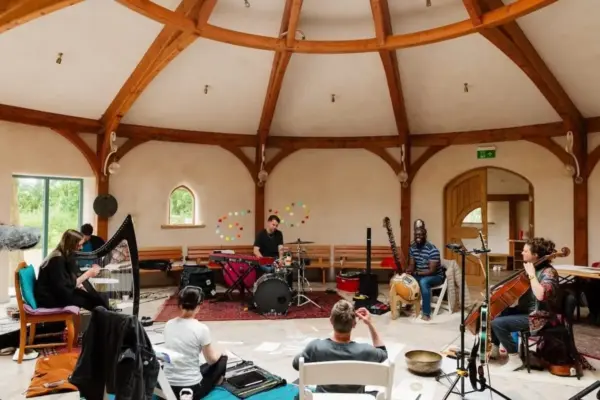
Over the course of 2024, the instrumental took shape piece by piece. Eschewing the temptation to rush the tracking process, the producers experimented extensively with tempo, pocket, and harmonic structure. They sought to distance themselves from sterile, digital-sounding riddims by focusing on organic instrumentation, room acoustics, and dynamic performance.
The breakthrough came with the deliberate infusion of blues sensibilities into the traditional reggae one-drop framework. By slowing the tempo slightly and allowing the bass guitar to dance around a heavier, more hypnotic kick drum, the team birthed what they would officially categorize as "One Drop Blues."
The rhythm track relied on a deliberate interplay between clipped, syncopated guitar skanks and a rolling, hypnotic bassline that gave the instrumental an undeniable melancholy and depth. When the horns—arranged and performed with striking emotional resonance—were finally layered over the rhythm, it became immediately clear to the production team that they were holding something extraordinary. The instrumental alone possessed a narrative arc, a mood that demanded exceptional lyricists to match its weight.
Phase 3: Vocal Intersect and the Assembly of Voices (2025–2026)
With the instrumental finalized after nearly three years of refinement, Stay Nice Music opened the floor to a carefully curated roster of vocalists. Adhering to the classic Jamaican sound-system tradition, fifteen distinct artists were invited to interpret the riddim through their unique artistic lenses.
Among them was Kumar Fyah, who used his slot to channel personal trauma into art, recounting his jarring detention over a minor quantity of ganja. MediSun delivered a soaring, spiritually grounded meditation on the true meaning of freedom, while Badda General injected sharp wit and commentary concerning the complexities of modern sound-system clash culture.
Amidst these heavy sociopolitical and cultural commentaries, Kazayah stepped into the studio to record what would become one of the project’s standout moments: "Sweet Love." Rather than leaning into geopolitical strife, Kazayah directed the rhythm toward the sacred geometry of human connection. Her lyrics frame a lover’s arrival not as a stroke of random fortune, but as ordained, cosmic timing—a relationship measured meticulously by mutual admiration, steadfast protection, and the profound vulnerability of being fully known by another soul.
Supporting Context & Metrics: The Architecture of Modern Roots Reggae
To fully grasp the significance of the Landmark Riddim, one must understand the economic and cultural ecosystem of contemporary reggae distribution. In an era where digital streaming platforms like Spotify, Apple Music, and YouTube dictate consumption habits, releasing an eighteen-track riddim album is an ambitious, almost rebellious undertaking.
The Riddim Format in the Digital Age
Originating in Jamaica during the golden eras of rocksteady and dancehall, the riddim format is built on communal creation. A producer builds a single track, and multiple artists ride it, creating a competitive and collaborative ecosystem that showcases stylistic diversity. In the streaming era, however, riddim albums often struggle with playlist fragmentation. Listeners frequently gravitate toward single-track hits, making cohesive front-to-back album listens a rarity.
By partnering with Dub Shot Records for an August 21, 2026 release, Stay Nice Music deployed a strategic rollout plan designed to counter this trend. The label utilized a multi-tiered release schedule, dropping select visualizers and singles—such as Kazayah’s "Sweet Love"—ahead of the full-length drop to build momentum across digital storefronts and social media algorithms.
Production Credits & Collaborative Matrix
The following matrix illustrates the cross-continental collaboration that fueled the Landmark Riddim:
| Contributor / Entity | Role / Specialty | Geographic Base |
|---|---|---|
| Joshua “Don Daka” Smith | Executive Producer / Label Direction | Maine, USA |
| David “Jah David” Goldmine | Co-Producer / Engineer | International |
| Lamont “Monty” Savory | Lead & Rhythm Guitarist | Jamaica / Global |
| Okiel McIntyre | Instrumentation / Arranging | Caribbean |
| Laurent “Tippy I” Alfred | I Grade Records Collaboration / Mixing | St. Croix / Global |
| Roberto Sánchez | Spanish Roots Producer / Analog Mixing | Spain |
| Shanelle “Kazayah” Mitchell | Featured Vocalist ("Sweet Love") | Chicago / Jamaica |
| Dub Shot Records | Global Distribution & Label Partner | United States |
Kazayah: From the Church Pews of Chicago to Tuff Gong
To understand the emotional depth of Kazayah’s performance on "Sweet Love," one must examine her unique musical lineage. Born Shanelle Mitchell to Jamaican immigrant parents in Evanston, Illinois—situated on the northern edge of Chicago—her earliest vocal training took place within the harmonious, impassioned confines of a Seventh-day Adventist congregation.
Growing up surrounded by gospel traditions while absorbing the rich cultural heritage of her parents’ homeland, Mitchell developed a vocal dexterity characterized by pristine pitch control, emotive phrasing, and a spiritual undercurrent that connects directly with listeners. Her bridge into the roots reggae community happened organically through a local Evanston-based producer who recognized her rare vocal gifts and introduced her to the wider world of Jamaican music.
Her undeniable talent quickly caught the attention of reggae royalty. Her debut EP, I Am Kazayah, was released through Tuff Gong Worldwide—the legendary label founded by the family of Bob Marley and spearheaded by Ziggy Marley. The endorsement from the Marley camp was not merely ceremonial; Kazayah’s subsequent touring schedule included high-profile opening slots supporting Ziggy Marley, exposing her voice to international audiences and cementing her status as one of the most promising young talents in modern roots music.
Official Statements and Artistic Intentions
While the collaborative nature of the Landmark Riddim speaks for itself, the philosophical motivations behind the project reveal a deep commitment to preserving and evolving reggae music’s foundational tenets.
Speaking on the nearly three-year gestation period of the instrumental, executive producer Joshua “Don Daka” Smith emphasized the necessity of patience in an impatient industry:
"When you are building a riddim that pays homage to the heavyweights of Jamaican history while trying to say something new, you cannot rush the foundation. We spent three years testing bass frequencies, tweaking guitar tones, and working with engineers across different time zones because we refused to compromise. The ‘One Drop Blues’ isn’t just a genre tag; it’s an emotional space. We wanted something that felt heavy, smoky, and timeless."
The decision to pair such a heavy, contemplative instrumental with Kazayah’s romantic lyricism was intentional, designed to showcase the versatility of the riddim. In discussing the themes behind "Sweet Love," Kazayah reflected on the spiritual alignment required for genuine affection:
"When I first heard the instrumental that Don Daka and the team put together, it had this incredible weight to it—almost like it was carrying the history of struggle and resilience. I didn’t want to write a superficial love song. I wanted to write something that honors when a man steps into your life as an answer to prayer. It’s about divine timing, feeling completely protected, and the rare gift of being entirely known and loved for who you truly are."
Furthermore, industry insiders have praised the collaborative ecosystem fostered by Dub Shot Records and Stay Nice Music. Laurent “Tippy I” Alfred noted that projects like the Landmark Riddim prove the modern roots community thrives when artists and producers cross geographic and stylistic borders to pool their expertise.
Future Outlook: The Legacy of the Landmark Riddim
As the global music community continues to digest the eighteen tracks housed within the Landmark Riddim, its long-term implications for the roots genre are becoming increasingly clear. By proving that high-concept, multi-artist riddim projects can still be executed with uncompromising analog warmth and artistic patience, Stay Nice Music and Dub Shot Records have set a new benchmark for contemporary reggae production.
For Kazayah, "Sweet Love" and her broader involvement in the project mark a critical milestone in her evolution from a promising regional talent to an established global artist. Having already proven her mettle under the banner of Tuff Gong Worldwide and alongside Ziggy Marley, her performance on the Landmark Riddim demonstrates her ability to elevate ensemble projects through sheer vocal command and lyrical maturity.
Looking ahead, the ripple effects of this three-year production marathon are expected to influence upcoming roots releases throughout late 2026 and beyond. Producers are taking note of the commercial and critical success of the "One Drop Blues" blueprint, signaling a potential shift away from synthetic, rushed riddims toward more organic, collaborative studio alchemy.
As listeners spin the project from start to finish—taking in Kumar Fyah’s legal grievances, MediSun’s calls for liberation, Badda General’s clash commentary, and Kazayah’s transcendent ode to devotion—the Landmark Riddim remains a resounding victory for artistic integrity. It is a reminder that when dedicated creators spend years honoring their craft, the resulting music does not merely fill a playlist; it imprints itself permanently on the cultural landscape.
To experience "Sweet Love" and explore the full eighteen-track journey of the Landmark Riddim, stream the project HERE.