Executive Overview
In the contemporary landscape of electronic music and nightlife culture, the traditional DJ booth has long stood as an unyielding altar. Positioned at the focal point of the venue, it traditionally commands visual supremacy, elevating the artist above the crowd as a modern high priest of sound. Whether constructed from heavy timber, brushed industrial steel, or wrapped in glowing LED screens, the conventional DJ booth makes its presence known. It demands attention, acting as a visual anchor that permanently dictates the spatial dynamics of a club, festival stage, or pop-up event space.
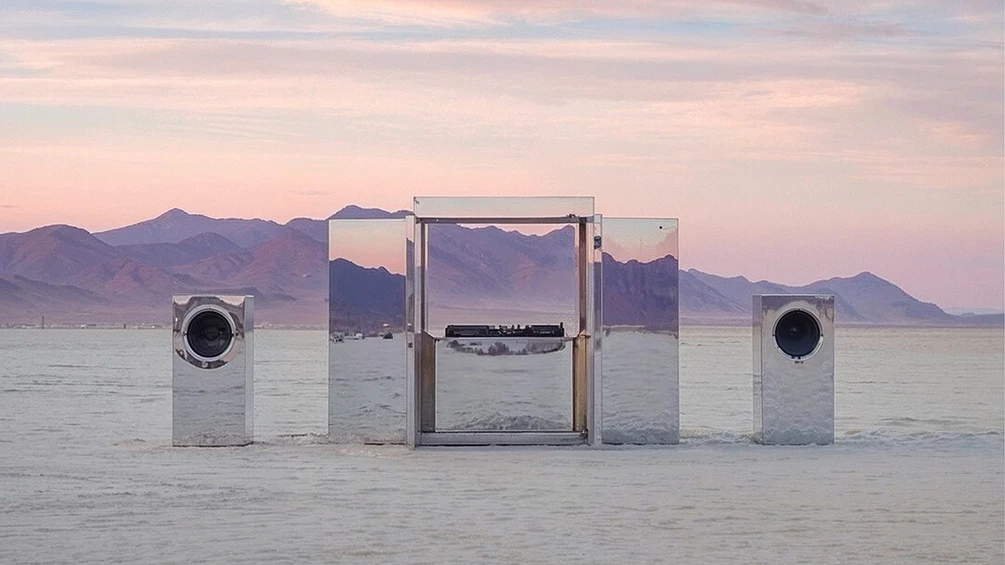
However, a paradigm shift is quietly underway. Enter a groundbreaking innovation from the European tech-creative studio Diorama: a modular, mirrored DJ booth engineered explicitly to vanish into its environment.
Conceived as a chameleon-like architectural installation, this new creation utilizes highly reflective surfaces to dissolve the physical barrier between the artist, the equipment, and the surrounding venue. Rather than imposing an artificial structure onto a historic ballroom, a brutalist warehouse, or an open-air natural landscape, Diorama’s design borrows its visual identity from the location itself. By mirroring floors, ceilings, walls, and crowds, the structure defies traditional stage design constraints. It functions simultaneously as a fully operational, professional-grade performance hub and a stealthy architectural ornament that can be reconfigured into myriad shapes for diverse functional applications.
This comprehensive report investigates the genesis of Diorama’s mirrored creation, exploring its modular mechanics, the philosophies of invisible architecture, the evolving psychology of club spaces, and what this means for the future of experiential event production.
Detailed Chronology: From Concept to Chameleon
The journey toward the creation of the mirrored DJ booth did not happen overnight; it is the culmination of years of experimentation at the intersection of architecture, stage design, and immersive art.
Phase 1: The Conceptual Inception
The project began within the brainstorming sessions of Diorama, a studio known for pushing the boundaries where technology meets creative spatial design. The core challenge presented to the design team was paradoxical: How do you build a platform for a performance that inherently requires maximum visibility, while minimizing the physical footprint and visual intrusion of the stage itself?
Traditional stage designers often lean toward hyper-visibility—using immersive projection mapping, massive LED walls, and complex truss systems. Diorama’s collective flipped this script. They asked what would happen if, instead of adding visual noise to a venue, a stage design actually subtracted itself from the equation. The initial sketches focused on optical illusions, ray tracing of light reflections, and the historical use of mirrors in art and architecture (dating back to illusionistic theatrical sets of the 19th century and the minimalist sculptures of Robert Morris in the 1960s).
Phase 2: Material Selection and Engineering Prototyping
Moving from digital renderings to physical prototypes proved to be the most rigorous phase of development. Standard glass mirrors were immediately ruled out due to safety concerns in high-energy nightlife environments, as well as their prohibitive weight and rigidity.
Instead, the studio engineered a proprietary system utilizing lightweight, shatter-resistant acrylic mirror panels bonded to high-density, modular aluminum framing. This combination achieved three critical metrics:
- Safety: Elimination of dangerous sharp shards in the event of high-impact collisions common in festival and club settings.
- Mobility: Substantial reduction in weight, allowing single technicians to transport and assemble panels without heavy machinery.
- Reflective Fidelity: Maintenance of a crisp, distortion-free reflection capable of seamlessly tricking the human eye into perceiving continuous space.
Phase 3: Modular Adaptation and Field Testing
By mid-2023, Diorama finalized the modular interlocking mechanism that allows the booth to shift forms. Unlike rigid, single-purpose furniture, the system relies on geometric triangulation. Panels can be joined at 45-degree, 90-degree, and 180-degree angles.
Field tests were conducted across various challenging environments: a historic European stone courtyard, a dark industrial warehouse with complex pipework, and an outdoor daytime beach party. In each setting, the booth successfully "disappeared," picking up the textures of cobblestones, weathered concrete, and shifting ocean light, respectively.
Supporting Context & Metrics: The Evolution of Nightlife Architecture
To understand the cultural and architectural significance of Diorama’s mirrored booth, one must examine the historical trajectory of DJ booth design and the broader metrics shaping modern event production.
The Evolution of the DJ Booth
- The Era of Isolation (1970s–1980s): During the birth of modern club culture at venues like the Paradise Garage and The Loft, the DJ booth was often tucked away, sometimes elevated or partially hidden, emphasizing the communal dancefloor experience over the celebrity of the selector.
- The Era of the Spectacle (1990s–2010s): With the rise of the global superstar DJ, the booth transformed into a command center. Technological shifts from vinyl to digital (CDJs, laptops) required stable, prominent surfaces. Simultaneously, electronic dance music (EDM) commercialization turned the stage into a rock-concert-style proscenium arch, complete pyrotechnics, and towering LED backdrops.
- The Minimalist and Immersive Counter-Movement (Present Day): In recent years, underground electronic music culture has experienced a massive pivot back toward intimacy, darkness, and architectural authenticity. Clubbers increasingly favor spaces where the line between crowd and artist blurs. Boiler Room sessions, 360-degree stages, and secret warehouse parties have driven demand for modular, low-profile, and context-aware stage designs.
Spatial and Technical Metrics
Diorama’s design addresses several key operational metrics valued by modern venue operators and festival producers:
- Footprint Versatility: The modular units can collapse from a standard 2-meter by 1.5-meter DJ console down to compact storage crates, reducing freight and logistics costs by roughly 40% compared to custom wooden or steel stage builds.
- Setup Time: Field tests indicate that a fully operational mirrored DJ setup can be assembled by a two-person crew in under 45 minutes.
- Light Absorption vs. Reflection: Utilizing specialized surface coatings, the mirrors achieve an 88% light-reflection rate while diffusing harsh direct glare, preventing stray laser or strobe reflections from accidentally blinding performers or audience members.
Official Statements and Design Philosophy
While the studio keeps its proprietary fabrication secrets closely guarded, statements released by Diorama’s lead creative directors shed light on the deeper philosophical underpinnings of the project.
"We live in an era of over-saturation," explains a spokesperson for Diorama. "Every square inch of a modern festival or club is plastered with digital screens, branding, and structural noise. We wanted to create an object that offers a visual exhale. By using reflection, our DJ booth does not conquer the space it inhabits; it honors it. It acts as a visual sponge, soaking up the textures, lights, and energy of the room and bouncing them back amplified."
Furthermore, the studio emphasizes the psychological impact on the crowd. In traditional setups, the crowd constantly looks up at a stage, creating a hierarchical separation. By mirroring the immediate environment—including the dancers standing right in front of the booth—the boundary softens.
"When you look at the booth, you don’t just see a piece of furniture hiding equipment," the studio notes. "You see the dancefloor reflected back at itself. The crowd becomes part of the stage architecture. The artist is no longer an isolated idol on a pedestal, but an integrated node within a living, breathing ecosystem of light, reflection, and sound."
Future Outlook: The Next Horizon for Chameleon Architecture
As the experiential events industry looks toward 2025 and beyond, the implications of Diorama’s mirrored DJ booth extend far beyond nightlife. The underlying technology—modular, reflective, adaptive architecture—opens up exciting frontiers across multiple sectors:
1. Pop-Up Retail and Fashion Runways
Fashion houses are constantly seeking innovative ways to stage runway shows that do not disrupt historic urban locations. A modular mirrored system that can morph from a DJ/sound booth into a minimalist runway backdrop or product display pedestal offers luxury brands unprecedented flexibility.
2. Sustainable Event Production
In an industry under increasing pressure to reduce its carbon footprint, single-use stage builds are becoming economically and environmentally untenable. Diorama’s reusable, reconfigurable modular system represents a circular design approach. Because the booth adapts to any environment, producers do not need to build custom, location-specific stages from scratch for every single event.
3. Integration with Responsive Lighting and Projection
The next phase of development for the studio reportedly involves embedding smart-glass technologies within the reflective panels. This would allow the mirrors to transition fluidly between total transparency, mirror reflection, and interactive digital display screens at the push of a button. Imagine a DJ booth that can instantly shift from invisible chrome camouflage to a dynamic, reactive media art canvas mid-set.
Conclusion
Diorama’s mirrored DJ booth is much more than a clever optical illusion; it is a profound commentary on the nature of space, performance, and presence in modern culture. By refusing to dominate its surroundings, the design achieves the ultimate modern luxury: subtlety, elegance, and adaptability. As electronic music continues to explore the boundaries of immersive design, innovations like this prove that sometimes the most powerful artistic statement a creator can make is simply to disappear.