In the storied landscape of the summer opera festival circuit, few revivals achieve the seamless theatrical alchemy witnessed on August 25, 2026, at the Glyndebourne Opera. Director David McVicar’s celebrated 2015 production of Wolfgang Amadeus Mozart’s Die Entführung aus dem Serail (The Abduction from the Seraglio) returned to the stage under the astute assistant direction of Greg Eldridge, offering an uncommonly cohesive masterclass in operatic performance. Under the baton of Evan Rogister, who led the period-instrument specialists of the Orchestra of the Age of Enlightenment (OAE), this iteration of Mozart’s Singspiel broke free of the schematic, lightweight tropes that often plague the work. Instead, it delivered an intellectually rigorous, visually arresting, and emotionally resonant meditation on freedom, desire, and cultural tolerance.
What distinguished this late-August performance was its rare ability to forge a seamless trinity out of the work’s traditionally disparate elements: orchestral vitality, vocal mastery, and spoken dialogue. Too often, productions of Die Entführung stumble over the chasm between Mozart’s sublime musical numbers and the spoken Singspiel text. Here, meticulous attention to pacing, textual delivery, and character motivation welded the components into a unified dramatic whole. Featuring an exceptional international cast—including Liv Redpath as Konstanze, Anthony León as Belmonte, Michael Mofidian as Osmin, Julie Roset as Blonde, Thomas Cilluffo as Pedrillo, and Franck Saurel returning as Pasha Selim—Glyndebourne’s revival proved that a period-accurate setting can yield sharper, more modern psychological insights than any heavy-handed contemporary concept.
Detailed Chronology: Unfolding the Glyndebourne Revival
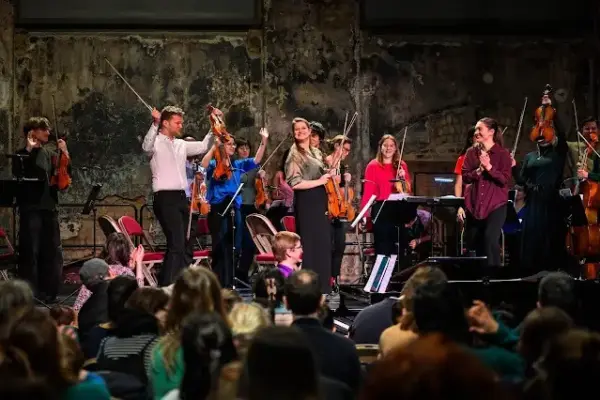
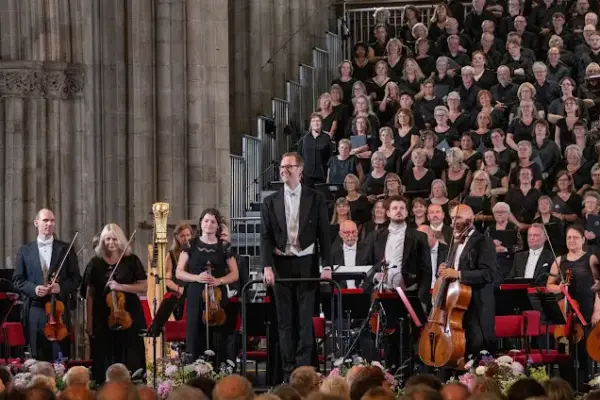
From the very opening notes of the overture, conductor Evan Rogister signalled that this would be an evening of high-stakes musical drama. Eschewing the temptation to treat the score as mere decorative eighteenth-century sheen, Rogister pulled no punches. The OAE delivered playing that was vital, crisp, and rhythmically accented. The Janissary (Turkish) elements were delightfully colored and relished without devolving into caricature, while individual woodwind solos—crucial in a score that pushes instrumental boundaries through the inclusion of basset horns—shone with distinct timbral character.

The dramatic momentum established in the pit instantly translated to the stage during the opera’s opening scene. Belmonte’s anxious search for his kidnapped beloved, Konstanze, segued organically from aria to duet, establishing an immediate rapport between Anthony León’s charismatic, high-strung Belmonte and Michael Mofidian’s ferociously bad-tempered Osmin. Mofidian’s Osmin was a masterclass in sharp edges and vibrant intolerance. Rather than relying on cheap, cartoonish buffoonery, the comedy in Mofidian’s portrayal arose naturally from character conflict. His severe, uncompromising demeanor stood in stark, humorous contrast to Julie Roset’s sparkling, physically exuberant Blonde when the two clashed in Act Two.
As the narrative progressed, the production leaned heavily into the psychological complexities of the plot’s alternative love pairings. While the opera ostensibly tracks the romantic trials of the aristocratic couple (Konstanze and Belmonte) alongside their servants (Blonde and Pedrillo), Mozart and librettist Johann Gottlieb Stephanie complicate matters by exploring tentative dynamics between Konstanze and Pasha Selim, as well as Blonde and Osmin.
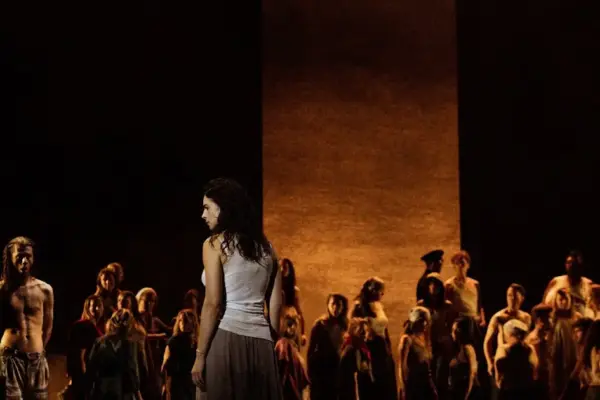
Glyndebourne’s staging brought these philosophical subtexts to the foreground. Franck Saurel’s Pasha Selim was not a stock villain, but a nuanced, credible anti-hero. The production portrayed Selim’s household—complete with children and a domestic warmth—as a genuine, highly appealing alternative to the life Belmonte offered. This artistic choice placed Liv Redpath’s Konstanze in genuine moral jeopardy. Redpath handled her three notoriously taxing arias with pristine accuracy and a luminous vocal line, yet her palpable physical and emotional attraction to Saurel’s Selim infused her coloratura with dramatic weight. Her hesitation felt real, her internal conflict palpable right up until her ultimate departure.

Similarly, Thomas Cilluffo’s Pedrillo combined robust vocal strength with wry, physical manipulation, executing dynamic stage business alongside Roset’s delightfully unbothered Blonde. The Act Two quartet, which exposes the underlying mistrust of the men regarding the women’s fidelity, crystallized the evening’s dramatic architecture. By the time Mofidian’s Osmin dropped his sword and stalked off the stage in the final moments—a gesture carrying both comic irony and genuine tragedy—the audience had been led on an intellectual and emotional journey of rare depth.
Supporting Context & Metrics: The Production’s Aesthetic and Historical Framework
To understand the triumph of this 2026 revival, one must examine the lineage of Die Entführung aus dem Serail within the British opera ecosystem. Unlike other Mozart masterpieces that directors routinely drag into modern-dress or high-concept settings—ranging from corporate boardrooms to dystopian futures—Die Entführung has remarkably resisted this urge. From Stephen Medcalf’s 2019 production for English Touring Opera and John Copley’s 2018 staging for the Grange Festival, back to Elijah Moshinsky’s iconic Covent Garden production and David Pountney’s 1978 landmark for Scottish Opera, directors have consistently turned to period settings to unpack the work’s complex political and cultural themes.
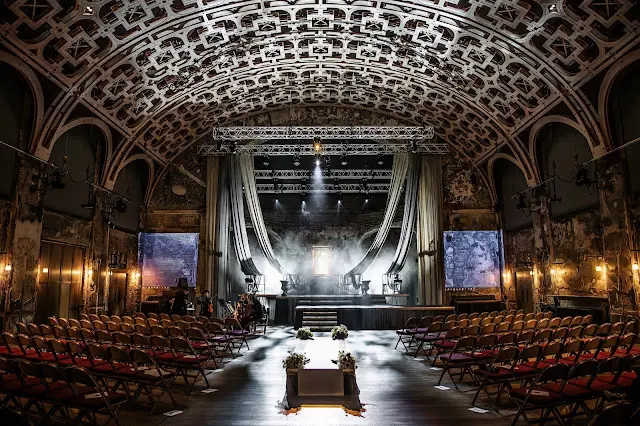
David McVicar’s 2015 conceptualization for Glyndebourne continues this tradition through the breathtaking lens of Vicki Mortimer’s set and costume design. As outlined in Mortimer’s archival program notes, the visual framework was deliberately constructed to validate Pasha Selim’s world. Utilizing a labyrinth of intricate screens, movable walls, and detailed interior spaces, Mortimer’s design facilitated rapid scene transitions while cleverly enabling the visual motifs of eavesdropping, observation, and enclosure.

Key Performance Metrics & Cast Breakdown
| Role | Artist | Vocal/Dramaturgical Highlights |
|---|---|---|
| Konstanze | Liv Redpath | Pristine coloratura; stylish, sympathetic portrayal; navigated profound psychological doubt. |
| Belmonte | Anthony León | Energetic, charmingly over-active stage presence; smooth vocal line. |
| Osmin | Michael Mofidian | Fierce, dramatic intensity; sharp-edged vocal delivery paired with physical comedy. |
| Blonde | Julie Roset | Pert, charming, and fiercely independent; brought vibrant energy to her scenes. |
| Pedrillo | Thomas Cilluffo | Physicalized acting style; combined vocal heft with wry manipulative charm. |
| Pasha Selim | Franck Saurel | Credible, magnetic anti-hero; portrayed a rich domestic life that legitimized the character’s appeal. |
| Conductor | Evan Rogister | Led the Orchestra of the Age of Enlightenment with crisp, rhythmically punched detail. |
| Director | David McVicar (Greg Eldridge, Revival Dir.) | Maintained a delicate balance between high comedy and serious dramatic inquiry. |
Quantitatively, the production succeeded by honoring the work’s structural proportions. By retaining a remarkably full account of the spoken dialogue—expertly coached and adjusted to flow seamlessly into the musical numbers—the performance rectified Mozart’s early structural hurdles where dramatic impetus relies heavily on text rather than continuous through-composed music. The vocal casting also struck an intelligent balance: rather than assigning the traditional heavy dramatic weights exclusively to the aristocratic leads, the casting allowed for near-interchangeable vocal heft, emphasizing the thematic parity between the characters.
Official Statements and Critical Reception
The critical consensus surrounding the August 25 performance highlighted the rarity of an opera production that successfully bridges the gap between musicological integrity and visceral theatrical storytelling.
Reviewing the artistic coherence of the evening, critical commentary emphasized the meticulous integration of text and tone:

"This was one of those performances which drew you into the drama whether it be orchestral music, singing or spoken word. The joy of this production was that it welded all three into a whole in a way that does not happen too frequently."
The artistic leadership and staging choices similarly drew praise for avoiding simplistic moral binaries. By presenting the harem not merely as a prison, but as a functioning, culturally rich household complete with children and domestic affection, the production gave urgent life to Enlightenment-era debates concerning freedom, mercy, and otherness.
Conductor Evan Rogister’s approach to the orchestral score was widely lauded for its precision. Commentators noted how Rogister and the Orchestra of the Age of Enlightenment elevated the score beyond standard eighteenth-century pastiche:

"From the opening notes of the overture, it was clear that conductor Evan Rogister pulled no punches. This was vital music, the detail crisp, the accents punched out, and the Turkish elements relished but not overdone."
Furthermore, the characterizations offered by the principal cast—particularly the friction between Mofidian’s unyielding Osmin and Roset’s resilient Blonde, alongside the seductive moral ambiguity of Saurel’s Pasha Selim—redefined how modern audiences can engage with a libretto often criticized for its antiquated Turkish tropes.
Future Outlook: The Legacy of McVicar’s Mozart at Glyndebourne
As the curtain fell on the summer 2026 festival season, the enduring success of David McVicar’s Die Entführung aus dem Serail offers a compelling blueprint for future operatic revivals. In an era where regional and international festivals frequently chase radical re-interpretations to generate headlines, Glyndebourne’s triumph proves that deep, faithful dramaturgical exploration can yield far more radical results.

The production demonstrates that historical period settings, when executed with rigorous psychological depth and uncompromising musical standards, do not sanitize classic works; rather, they illuminate their timeless anxieties. By treating Singspiel dialogue not as a necessary evil to be cut down or rushed through, but as the beating heart of the drama’s psychological landscape, the creative team has ensured that this staging remains a benchmark for Mozart interpretation.
Looking ahead, the triumph of this revival raises expectations for how upcoming Mozart productions will balance period authenticity with modern theatrical values. The OAE’s vibrant period-instrument execution, combined with a cast of young, dramatically fearless vocalists, signals a healthy, forward-looking ecosystem for classical performance at Glyndebourne. As opera houses worldwide grapple with questions of cultural representation, foreign-otherness, and enlightenment values, McVicar’s Die Entführung stands as a shining example of how a nearly 250-year-old masterpiece can still speak directly, intelligently, and powerfully to the modern human condition.