Executive Overview
The digital audio workspace (DAW) has long served as a battleground between sterile precision and the vibrant, unpredictable soul of vintage analog gear. For decades, producers and mixing engineers faced a steep financial barrier to entry if they wanted to infuse their tracks with the authentic harmonic distortion, warmth, and nonlinear behavior of classic hardware. Owning a pristine, vintage Solid State Logic (SSL) mixing console, a fleet of late-70s Roland polysynths, or a meticulously maintained Minimoog Model D required deep pockets, specialized maintenance, and a commercial studio footprint.
However, the landscape of music production economics experienced a seismic shift this October 2026. Plugin Boutique, one of the industry’s premier digital audio retail platforms, launched a sweeping promotional campaign slashing up to 87% off some of the most revered analog hardware emulations in existence. Featuring industry titans such as Solid State Logic, Roland, and Universal Audio, this limited-time sale represents a democratization of high-end studio sound.
This deep-dive report examines the structural breakdown of the October 2026 sale, analyzing the technological breakthroughs behind these software emulations, detailing the standout product discounts, and exploring the broader implications of how hardware modeling technology is reshaping modern music production, mixing, and sound design.
Detailed Chronology: The Evolution of Analog Modeling to Mass Market Accessibility
To understand the significance of the October 2026 Plugin Boutique sale, one must examine how the pro-audio industry transitioned from expensive hardware dependencies to democratized, highly accurate software emulations over the past two decades.
Phase 1: The Early Digital Era and the Quest for Warmth (Late 1990s – Early 2010s)
In the nascent days of native plug-ins, digital audio was frequently criticized for sounding "thin," "cold," or "clinical." Early attempts to replicate analog compressors and equalizers relied heavily on basic algorithms that captured static frequency curves but failed to emulate the dynamic, phase-shifting, and harmonic-rich saturation of physical circuits. Brands like Universal Audio pioneered DSP-backed hardware cards (the UAD-1 and later UAD-2 platforms) to shoulder the immense processing weight required for early analog emulations. During this era, owning even a single authentic-sounding channel strip or bus compressor plugin was considered a luxury investment, often running into hundreds of dollars per individual module.
Phase 2: Component-Level Modeling and Native Dominance (2010s – 2023)
As computer processing power exponentially increased, developers moved away from closed DSP ecosystems toward native CPU processing. Brands like Solid State Logic began releasing native versions of their flagship hardware. Concurrently, companies like Roland mastered proprietary technologies like Analog Circuit Behavior (ACB), which maps analog circuits down to individual resistors, capacitors, and transistors. Software developers stopped merely approximating the sound of analog gear and began accurately simulating its behavior. Despite these monumental engineering feats, premium analog emulations remained stubbornly expensive, typically targeted at professional mixing engineers and well-funded commercial studios.

Phase 3: The Democratization Wave (October 2026)
The current market landscape, highlighted by Plugin Boutique’s October 2026 promotional blitz, marks a major turning point. By driving unprecedented price drops—such as slashing SSL plugins by 87% down to under £20—the barrier between bedroom producers and elite studio gear has effectively collapsed. What was once restricted to platinum-selling mix engineers is now accessible to any creator with a laptop and an internet connection.
Supporting Context & Metrics: Breaking Down the Standout Deals
The October 2026 promotion features 18 distinct analog emulations, spanning compressors, EQs, mixing consoles, tape machines, and vintage synthesizers. A closer examination of the primary product highlights reveals the sheer scale of the savings and the technological pedigree behind each offering.
1. Solid State Logic: The Mix Bus Standard for Under £20
- Products: SSL Native Bus Compressor 2 & SSL Native Channel Strip 2
- Discount Metric: 87% off (Reduced from traditional three-figure pricing to just £17 each)
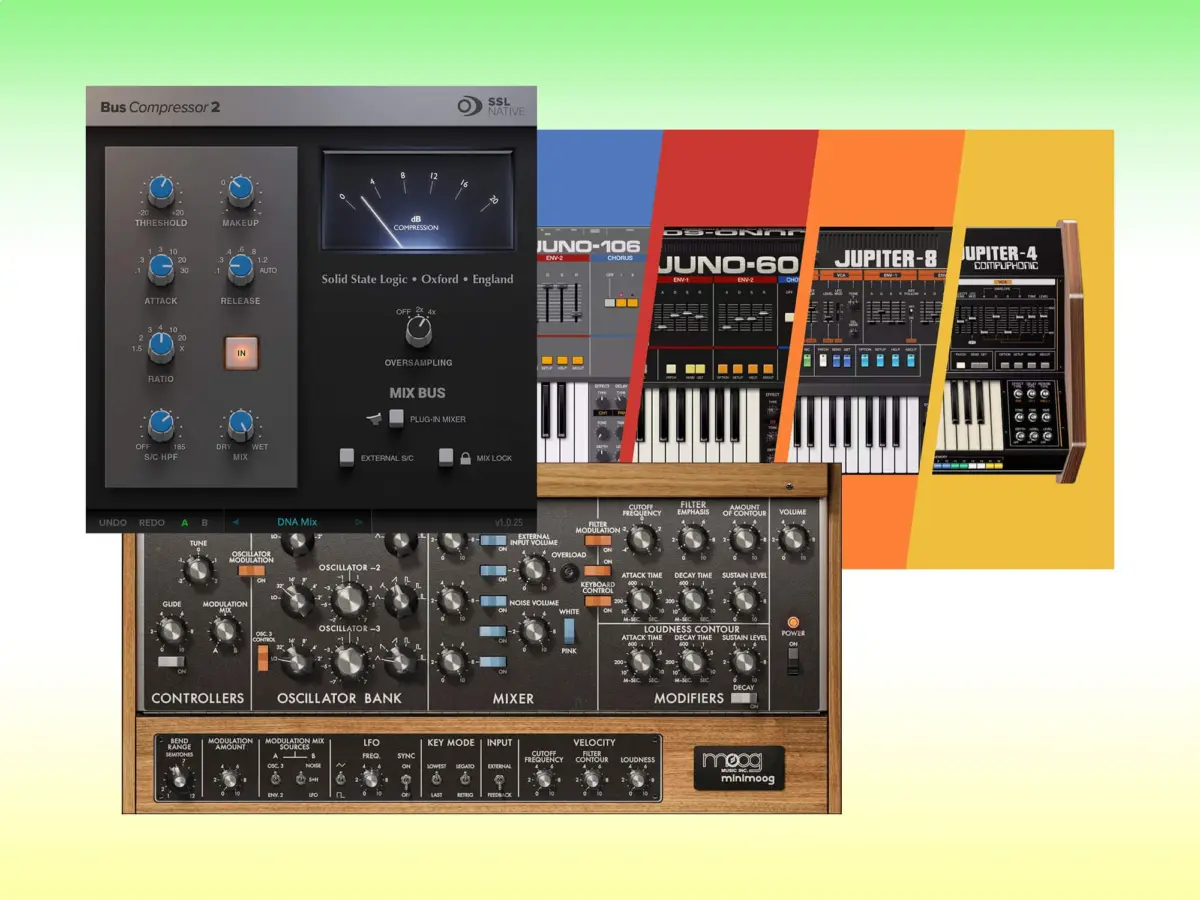
For decades, the SSL G-Series center-section bus compressor has been regarded as the secret weapon for "gluing" a mix together, lending a cohesive, polished energy that makes rough multitracks sound like a finished record. Similarly, the SSL 9000K console channel strip has shaped countless pop, hip-hop, and rock records through its pristine routing, transparent EQ curves, and unmistakable dynamic control.
Dropping the price of these two industry-standard processors to £17 each represents one of the most aggressive and impactful software price cuts in pro-audio history. Producers who previously relied on budget third-party approximations can now access the exact mathematical and sonic architecture of SSL’s legendary hardware desks for the price of a takeout meal.
2. Roland Analog Polysynth Collection: 70s and 80s Royalty
- Products: JUPITER-4, JUPITER-8, JUNO-60, JX-3P, JUNO-106 bundle
- Discount Metric: Reduced to £180 from £455
Hardware units of the Roland Jupiter-8 or Juno-60 regularly command astronomical sums on the vintage secondary market, often fetching tens of thousands of dollars. Roland’s Analog Polysynth Collection bridges this financial divide by deploying their proprietary Analog Circuit Behavior (ACB) engine. This bundle encapsulates five of the most defining polysynths in electronic music history. From the lush, chorus-drenched pads of the Juno-106 to the roaring, aggressive brass leads of the Jupiter-8, this collection delivers the tactile warmth and drift of analog oscillators without the perpetual tuning maintenance and capacitor replacement required by vintage hardware.
3. Universal Audio & Moog Music: The Model D Collaboration
- Products: Universal Audio Minimoog Emulation
- Discount Metric: Available for £35
The Moog Minimoog Model D is arguably the most influential monosynth ever created, leaving an indelible sonic footprint on records by Kraftwerk, Parliament-Funkadelic, Yes, and Dr. Dre. Developed in direct partnership with Moog Music exclusively for the Universal Audio platform, this software emulation captures the aggressive filter resonance, fat ladder filter sweeps, and unstable oscillator drift that made the physical instrument legendary. Priced at just £35 during the October event, this plugin brings a piece of synthesis history directly into the modern, in-the-box workflow.

4. Roland ZENOLOGY Pro: Five Decades of Research
- Products: Roland ZENOLOGY Pro Synthesizer
- Discount Metric: Reduced to £90 from £204 (rated 9/10 by MusicTech)
Rounding out the highlighted software deals is Roland’s flagship ZENOLOGY Pro workstation, which distills over 50 years of synthesizer research and development into a single hybrid plugin architecture. Utilizing Roland’s ZEN-Core Synthesis System, ZENOLOGY allows producers to blend vintage analog modeling with advanced PCM capabilities, making it an indispensable tool for modern film scoring, electronic music production, and sound design.
Industry Perspectives & Strategic Analysis
The widespread discounting of high-end audio emulations points to a broader structural evolution in the music software industry. As the market becomes increasingly saturated, software developers and retail platforms are shifting their monetization models toward volume-based promotional events, subscription hybrid models, and strategic cross-platform partnerships.
Industry analysts note that aggressive pricing campaigns by major retailers like Plugin Boutique serve a dual purpose: they capture market share from competing subscription services and bring a new generation of bedroom producers into the ecosystem of premium brands like SSL, Roland, and Universal Audio. Once users experience the workflow and sonic enhancement of a genuine SSL bus compressor or a Roland ACB synth, they are far more likely to invest in future flagship releases at full retail price.
Furthermore, the technological ceiling for analog emulation has reached an inflection point. With advancements in machine learning, neural network-based DSP, and hyper-accurate circuit modeling, the sonic gap between hardware and software has effectively vanished to the human ear. Prominent mix engineers have increasingly integrated native emulations into their hybrid setups, citing recallability, workflow speed, and cost-effectiveness as primary drivers.
Future Outlook: What the Analog Emulation Boom Means for Producers
As we look beyond October 2026, the ripple effects of this software pricing revolution will be felt across all tiers of music production.
- The Raising of Production Standards: As elite tools like the SSL Native series and Roland’s Analog Polysynth Collection become universally accessible, the baseline fidelity of independent music will inevitably rise. Mixes that previously suffered from harsh digital clipping or uninspired stock dynamics processors can now achieve commercial-grade polish on a shoestring budget.
- The Hybrid Studio Evolution: Rather than signaling the total death of hardware, accessible software emulations are acting as a gateway drug. Producers who fall in love with the software emulation of a Minimoog or an SSL channel strip are more likely to seek out hardware units as aspirational centerpieces for their physical studios.
- The Next Frontier in Modeling: With circuit-level emulation now thoroughly mastered, the next frontier for audio developers lies in adaptive, AI-driven plugin environments that respond dynamically to a producer’s individual workflow, offering real-time mixing suggestions and predictive tonal sculpting based on decades of multi-platinum mixing data.
For now, creators looking to upgrade their sonic palette have an unprecedented window of opportunity. Whether you are searching for the subtle tape saturation of a vintage Studer machine, the glue of an SSL bus compressor, or the roaring analog filters of a Roland polysynth, Plugin Boutique’s October 2026 sale has permanently altered the economics of professional audio production.