Executive Overview
In the rapidly evolving landscape of desktop music production hardware, manufacturers constantly search for the delicate equilibrium between pristine digital flexibility and the irreplaceable warmth of classic analogue circuitry. Enter Audient, a brand long celebrated for bridging the gap between high-end studio engineering and accessible home-studio gear. With the official announcement of its newly overhauled third-generation iD audio interface range, the company is not merely updating spec sheets; it is introducing an entirely new engineering platform anchored by what Audient terms "Analogue Intelligence."
The third-generation iD series unifies four of the brand’s most celebrated, tried-and-tested interface designs under a single, cohesive technological ecosystem. Rather than reinventing the wheel with entirely foreign hardware architectures, Audient has meticulously refined, renamed, and fundamentally supercharged its existing lineup. By incorporating real analogue preamps derived directly from their flagship recording consoles, coupling them with robust onboard Digital Signal Processing (DSP), and introducing advanced software integration tools like RoomTune and the Analogue Tone Suite, Audient has positioned the new iD family as a formidable centerpiece for both mobile creators and fully integrated professional studios.
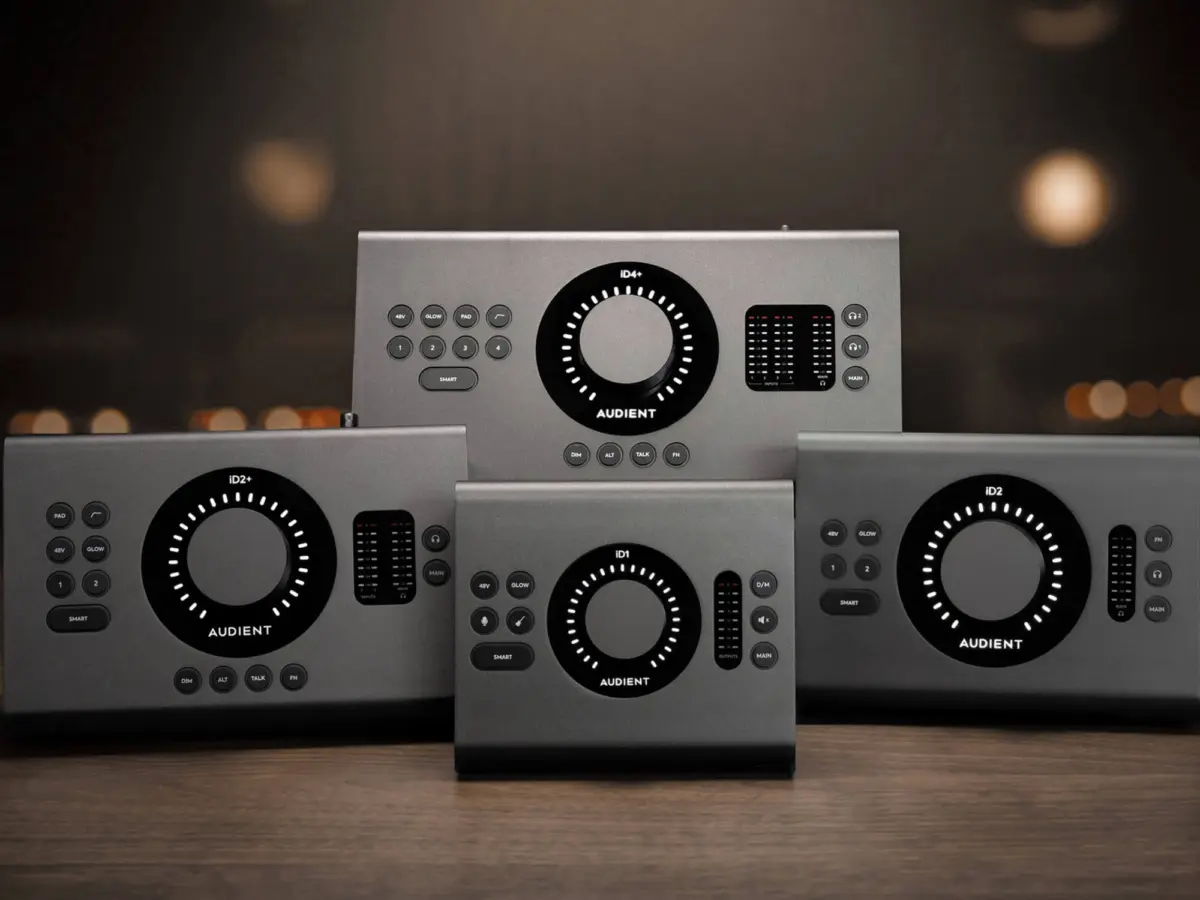
This comprehensive overhaul impacts the entire desktop range, streamlining naming conventions to reflect preamp counts clearly: the iD4 becomes the iD1, the iD14 transitions to the iD2, the iD24 evolves into the iD2+ and the flagship iD44 steps up as the iD4+. Each
model has been built from the ground up to deliver a unified workflow, ensuring that whether a user is operating a compact 2-in/2-out unit in a bedroom setup or commanding a sprawling 20-in/24-out session in a professional facility, the underlying technological DNA remains identical.
With pricing spanning from £169 to £499, this third-generation rollout aims to democratize high-end studio infrastructure, offering features—such as integrated monitor correction and console-grade preamps—that were previously the exclusive domain of high-tier commercial studios.
Detailed Chronology: The Evolution of the iD Family to MK3
To understand the magnitude of the third-generation iD release, it is essential to trace the trajectory of Audient’s desktop interface journey. For years, the iD series has enjoyed critical acclaim across the audio industry. Reviewers and home producers alike praised models like the original iD4 (awarded a solid 8/10 for its stellar build quality and compact footprint) and the powerhouse iD44 MkII (which earned an impressive 9/10 for its expansive routing capabilities and exceptional conversion).
However, as home and project studios grew increasingly sophisticated, the demands placed on desktop interfaces shifted. Producers no longer simply wanted an interface that converted analog signals to digital; they demanded integrated workflow solutions that could handle complex routing, real-time monitoring correction, and pre-DAW sound shaping without introducing latency or straining computer CPU resources.
Recognizing this paradigm shift, Audient’s engineering team embarked on a multi-year development cycle aimed at unifying their disparate desktop offerings into a single, cohesive ecosystem. The result is the MK3 platform.
Rather than maintaining fragmented software ecosystems for each device, the new architecture allows all four interfaces to operate on a shared platform. This standardization ensures that users can seamlessly scale their setups—perhaps transitioning from an iD1 on the road to an iD4+ in the control room—without having to relearn routing matrices or software control panels.
Furthermore, Audient seized the opportunity to rationalize its product naming conventions. The historical ambiguity of model numbers like iD4, iD14, iD24, and iD44 has been replaced by an intuitive nomenclature: the number now directly signifies the exact quantity of onboard mic preamps. Thus, the iD4 is now the iD1 (one preamp), the iD14 is the iD2 (two preamps), the iD24 becomes the iD2+ (two advanced preamps with expanded I/O), and the iD44 crowns the range as the iD4+ (four preamps and maximum connectivity).
This chronological progression demonstrates a maturation of Audient’s product strategy, moving from isolated hardware successes toward a unified, future-proofed hardware-software ecosystem.
Supporting Context & Metrics: Breaking Down the Lineup and Core Technologies
The new iD MK3 range is underpinned by a radical philosophy: real analogue circuitry must lead the signal chain, supported intelligently by onboard DSP. This hybrid approach forms the backbone of Audient’s "Analogue Intelligence" platform, ensuring that digital convenience never compromises sonic integrity.
The Console Heritage: Audient Console Mic Preamps
At the heart of every interface in the new range are Audient’s proprietary Console Mic Preamps. Designed to match the exact specifications found in the brand’s flagship ASP8024-HE large-format recording console, these preamps deliver a staggering 75dB of clean, transparent gain. This high headroom ensures that even notoriously gain-hungry passive ribbon microphones and dynamic mics can be driven effortlessly without introducing unwanted noise or distortion, providing a professional studio sheen right at the source.
The Four Pillars of the MK3 Range
The lineup is tailored to scale across various production environments, offering specific I/O configurations and advanced features for different tiers of creators:
- iD1 (Formerly iD4): Designed as the ultimate solution for solo musicians, mobile creators, and singer-songwriters. It features a 2-in/2-out configuration equipped with a single mic preamp, a discrete JFET instrument input for direct guitar and bass tracking, and pristine headphone outputs. (Priced at £169; scheduled for release in early 2027).
- iD2 (Formerly iD14): Upping the ante for growing project studios, this model offers a 10-in/6-out architecture driven by two mic preamps. It provides expanded connectivity options, making it ideal for tracking acoustic duos or small ensemble sessions. (Priced at £229; currently available).
- iD2+ (Formerly iD24): Tailored for producers building more expansive, integrated studio setups. This 10-in/14-out interface boasts two high-grade mic preamps, alongside advanced routing capabilities that integrate seamlessly with outboard hardware effects processors. (Priced at £329; currently available).
- iD4+ (Formerly iD44): The undisputed flagship of the desktop range, engineered to tackle high-channel-count sessions with absolute ease. Delivering 20-in/24-out connectivity powered by four discrete mic preamps, it also features dual JFET instrument inputs, two balanced hardware inserts for patching external compressors and EQs directly into the signal chain, and 16 channels of ADAT input and output for massive expansion. (Priced at £499; currently available).
Advanced Workflow Enhancements: Analogue Tone Suite and RoomTune
Beyond raw I/O metrics, the MK3 range introduces groundbreaking workflow tools designed to shape sound before it ever hits the digital audio workstation (DAW).
The Analogue Tone Suite provides four dedicated tonal-shaping tools embedded directly within the hardware’s DSP. This allows producers to impart vintage character, saturation, and harmonic richness at the source, freeing up computer processing power and inspiring confidence during the tracking phase.
Furthermore, Audient has integrated RoomTune Monitor Correction into the iD2+ and iD4+ models (with compatibility extending to the iD1 and iD2 via the optional RM1 Reference Microphone). RoomTune addresses one of the most persistent challenges in modern home production: acoustic anomalies within untreated or semi-treated rooms. By utilizing the RM1 Reference Microphone (available separately for £39.99 on non-plus models), the system calibrates frequency responses directly at the monitoring stage, ensuring mixes translate accurately across external playback systems.
Official Statements: The Vision Behind "Analogue Intelligence"
The engineering philosophy driving the third-generation iD range represents a significant departure from standard industry practices. Rather than relying purely on software plug-ins or superficial cosmetic redesigns, Audient focused heavily on hardware-software symbiosis.
Andrew Allen, Chief Product Officer at Audient, elaborated on the core philosophy guiding the launch during the product unveiling:
"With the next-gen iD range, we’ve built a range around four things most interfaces in its class can’t offer: real analogue preamps, built-in RoomTune Monitor Correction, onboard DSP FX, and a discrete Analogue Tone Suite."
Allen emphasized that this release is much more than a routine seasonal update, framing it as a technological milestone for the company:
"This isn’t a spec refresh—iD is a completely new technology platform built on our Analogue Intelligence Platform."
This official stance underscores Audient’s commitment to preserving the tactile, organic qualities of traditional analog hardware while embracing the precision and adaptability of modern digital signal processing. By keeping the analogue preamp at the very front of the signal chain and deploying DSP strictly as an intelligent support mechanism, Audient aims to eliminate the sterile, clinical digital fatigue often associated with entry-to-mid-tier USB interfaces.
Future Outlook: Industry Impact and Availability
As the audio technology sector looks toward the future, the release of the Audient iD MK3 range signals a shift in what consumers expect from desktop audio hardware. The expectation is no longer merely that an interface acts as a passive bridge between microphones and a computer; modern creators demand active acoustic management, low-latency DSP processing, and professional-grade analog circuitry packaged within desktop-friendly form factors.
The commercial rollout strategy reflects a phased approach to market availability. While the iD2, iD2+, and iD4+ are currently available for purchase through authorized global dealers—priced at £229, £329, and £499 respectively—producers anticipating the ultra-portable iD1 will need to exercise patience, with its release slated for early 2027 at a competitive price point of £169. Additionally, budget-conscious users utilizing the iD1 or iD2 will need to factor in the nominal £39.99 investment for the RM1 Reference Microphone if they wish to leverage the full capabilities of the RoomTune monitor correction system.
Ultimately, Audient’s third-generation iD range reinforces the brand’s reputation for forward-thinking engineering and acoustic excellence. By consolidating four distinct models onto a singular, robust platform powered by Analogue Intelligence, Audient has not only streamlined its product catalog but has raised the performance ceiling for project studios worldwide. As producers increasingly demand professional-grade tools that can adapt to challenging acoustic environments and complex hybrid workflows, the iD MK3 series stands well-equipped to meet the challenge, bridging the gap between classic studio heritage and modern desktop production.