Executive Overview
For six decades, Star Trek has served as a cultural vanguard, conceptualizing technologies that bridge the gap between speculative fiction and hard science. Among its most enduring and physically mesmerizing concepts is the wormhole—a theoretical tunnel through spacetime connecting vastly distant regions of the universe. While the franchise has historically walked a fine line between scientific plausibility and dramatic accessibility, its cinematic and televised interpretations of wormholes have consistently captured the imagination of both science-fiction enthusiasts and theoretical physicists.
Recent computer simulations and advancements in general relativity reveal that a real-world wormhole would look less like a swirling, violent vortex of science-fiction trope and more like a shimmering, translucent crystal ball or floating soap bubble. Its surface would present multiplied, highly distorted projections of the destination lying on the other side. Yet, beneath the aesthetic wonder lies a hazardous reality. For gravitational physicists studying black holes and the early universe, the foundational question remains: should humanity actually fly through one?
Balancing mathematical equations with cinematic narrative, Star Trek has not only reflected the evolution of theoretical physics—from John Wheeler’s geometric models in the 1950s to Kip Thorne’s traversable wormholes in the late 1980s—it has actively inspired generations of scientists to probe the outer boundaries of spacetime. This deep-dive investigation explores the physics behind the fiction, examining how the franchise’s iconic depictions stack up against Einstein’s field equations, quantum mechanics, and the persistent dangers of cosmic navigation.
Detailed Chronology: Wormholes on Screen and in Theory
1950s–1970s: From Mathematical Curiosities to Science Fiction
The intellectual genealogy of the wormhole predates its cinematic debut by decades, though the concept evolved rapidly once it entered the public consciousness. In 1957, Princeton University gravitational physics professor John Wheeler, alongside Charles Misner, coined the term "wormhole" in their landmark paper Classical Physics as Geometry. Their primary objective was not interstellar travel, but rather an attempt to describe electric charges—such as electrons—as the microscopic terminations of hidden tunnels threading through space.
It was not until 1973 that theoretical physicists H.G. Ellis and K.A. Bronnikov independently published the first rigorous descriptions of traversable wormholes satisfying Albert Einstein’s equations of general relativity. These models outlined geometric configurations of matter capable of balancing the immense spacetime curvature required to keep a tunnel open.
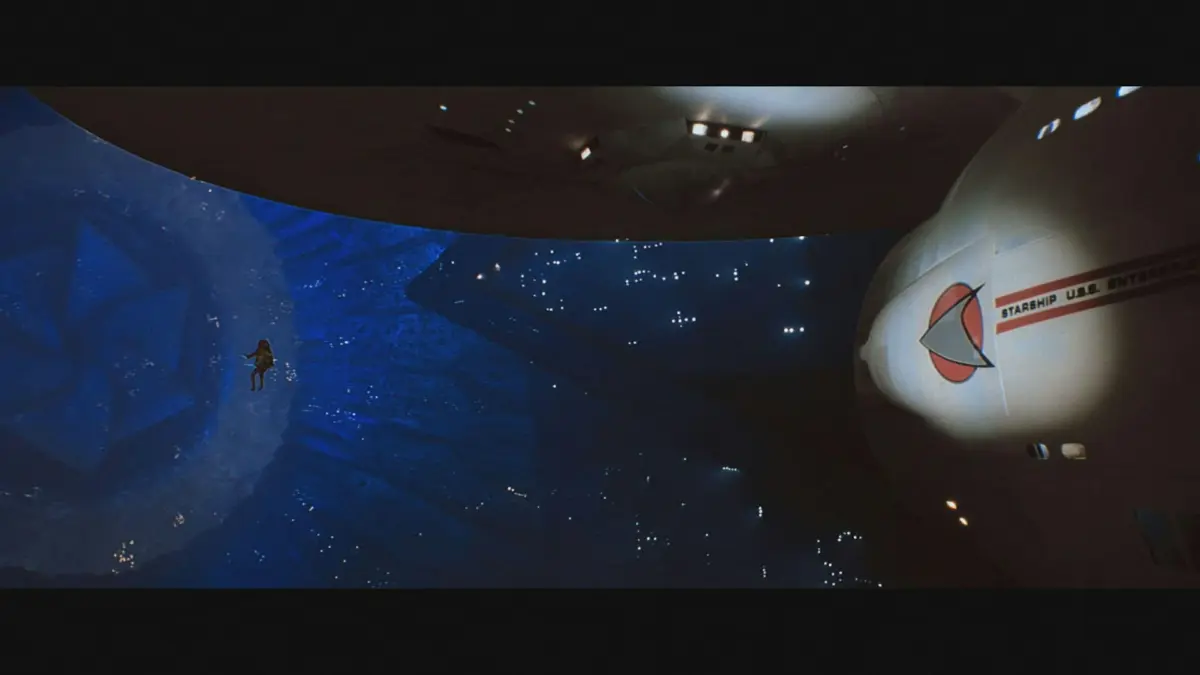
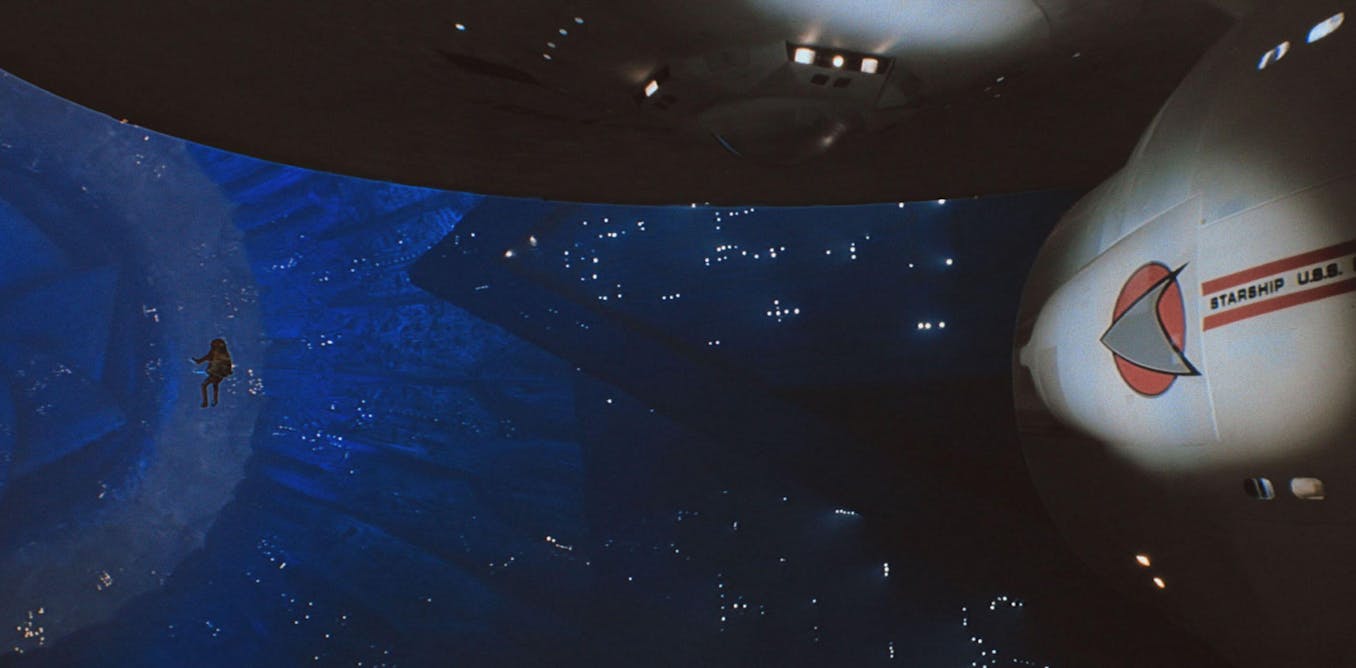
However, popular culture caught up in 1979 with the release of Star Trek: The Motion Picture.
- The Incident: During a warp drive malfunction, Commander Willard Decker exclaims, "Wormhole distortion has overloaded the main power systems!"
- The Physics: The USS Enterprise is sucked into a violently distorted pocket of spacetime, leading to systemic failures and a perilous near-collision with a drifting asteroid.
While pioneering, this inaugural cinematic wormhole bore little resemblance to modern astrophysical theory. It did not appear to connect two distinct points in space; rather, it manifested as an anomalous hazard that dissipated the moment the crew regained control of the vessel. Nevertheless, modern astrophysicists look back on the sequence with fondness. From the perspective of general relativity, if one were to inject exotic matter—characterized by negative pressure—into a constrained region of spacetime, that region could theoretically expand exponentially. If the surrounding space fails to expand at a matching rate, the excess space must balloon outward, birthing a narrow tunnel into an entirely new universe.
Late 1980s: The Era of Traversable Portals and Kip Thorne
By the late 1980s, Star Trek had evolved alongside theoretical physics. In Star Trek: The Next Generation (1987–1994), wormholes transitioned from accidental cosmic anomalies to commercially traded or strategically vital commodities—most famously highlighted in episodes where merchants and civilizations attempted to harness or sell them.
This narrative maturation mirrored real-world breakthroughs. In 1988, theoretical astrophysicist Kip Thorne (who would later win the Nobel Prize in Physics) published a seminal framework for traversable wormholes alongside his Caltech colleagues. Thorne demonstrated that for a macroscopic wormhole to remain open long enough for a human—or a starship—to cross safely, it would require stabilization via an exotic form of matter that violates classical energy conditions.
Unlike the transient anomalies of the 1970s film, The Next Generation leaned closer to these rigorous academic frameworks, anchoring the crew’s voyages in the harrowing realities of cosmic stability and structural integrity.
Supporting Context & Metrics: Optics, Time Dilation, and Stability
To understand the immense gulf between Hollywood spectacle and astrophysical reality, researchers rely on advanced computational models and Einstein’s field equations.
The Visual Illusion: Soap Bubbles Over Vortex Tunnels
On screen, wormholes are routinely portrayed as rushing tunnels lined with nebulae and lightning. However, computer simulations of traversable wormholes mapped out by teams studying gravitational lensing paint a starkly different picture.
Because a wormhole bends light along intense gravitational pathways, an observer approaching its mouth would not see a dark abyss. Instead, they would encounter a spherical aperture resembling a soap bubble or crystal ball. The surface of this sphere acts as a multi-directional lens, reflecting and distorting light from the destination universe. An explorer could circle the opening in a starship, enter from any vector, and—rather than crashing into a physical center—emerge instantaneously from a corresponding aperture light-years away.
Debunking Cinematic Slow-Motion
One of the most persistent tropes in sci-fi depictions of gravitational trauma is the "slow-motion effect." In Star Trek: The Motion Picture, the crew struggles against temporal distortion, moving and speaking in sluggish, delayed motions as they attempt to fire photon torpedoes.
From the standpoint of general relativity, this is a misrepresentation of gravitational time dilation:
- The Explorer’s Experience: For astronauts traversing a wormhole, time moves at a normal, unencumbered rate. Their personal wristwatches will tick precisely at one second per second.
- The Relative Discrepancy: Upon exiting, the travelers might discover that friends or Starfleet personnel left behind have aged far more than they have. This occurs because the travelers spent time embedded within a steep gravitational potential gradient.
- The Real-World Precedent: This exact phenomenon is not merely theoretical; it is actively accounted for in modern infrastructure. Atomic clocks aboard Global Positioning System (GPS) satellites tick at a slightly different rate than clocks on Earth’s surface due to the weaker gravitational field in orbit. When returned to Earth, they show measurable temporal drift—not because the satellites experienced time in "slow motion," but because time itself flows at varying rates relative to mass-energy distributions.
The Physics of Collapse: Why Scaffolding Matters
Maintaining a traversable wormhole is an exercise in extreme cosmic engineering. The original Ellis-Bronnikov wormhole models require specific configurations of exotic matter to act as structural scaffolding, keeping the throat from pinching shut.
However, numerical simulations confirm that these configurations are notoriously fragile. Even infinitesimal disturbances—such as the thermal radiation emitted by a passing starship or minor quantum fluctuations—can trigger catastrophic, near-instantaneous collapse. While researchers have recently proposed spinning variants of the Ellis-Bronnikov wormhole that appear mathematically more robust, their nonlinear stability remains unproven. Sending a Galaxy-class starship through one would serve as an empirically definitive, albeit suicidal, stress test.
Official Statements and Expert Perspectives
The intersection of science fiction and theoretical research has long fostered a collaborative dialogue between filmmakers and academic institutions.
Dr. Ronald Mallett, a theoretical physicist known for his research on spacetime manipulation, notes that popular media plays an irreplaceable role in democratizing complex cosmic concepts: "When millions of viewers watch a starship navigate a wormhole, it sparks an innate curiosity about general relativity that decades of academic papers alone could never achieve. It bridges the gap between abstract tensor calculus and human ambition."
Reflecting on the challenges of visualizing these phenomena, computational astrophysicists involved in modern black hole and wormhole simulations emphasize the rigidity of Einstein’s mathematics. Dr. Oliver James, lead author of foundational wormhole visualization studies, explained in technical briefs regarding cinematic black holes (Interstellar and related studies): "When you run the light-ray tracing equations through a wormhole metric, nature dictates the geometry. You cannot simply invent an aesthetic tunnel for dramatic effect without violating the very laws of gravity you seek to illustrate."
Meanwhile, risk-averse theoretical physicists echo a cautious sentiment regarding practical exploration. As one researcher quipped regarding the mandate to "boldly go where no one has gone before": "The job of a Starfleet captain may be exploration at all costs, but a physicist calculating the stress-energy tensor of a collapsing throat prefers to let the redshirts test the equipment first."
Future Outlook: From Science Fiction to Horizon-Scale Physics
As astrophysics enters the era of gravitational-wave astronomy and ultra-high-resolution imaging—ushered in by the Event Horizon Telescope—the line between speculative mathematics and observable reality continues to blur.
While macroscopic, traversable wormholes suitable for human transit remain firmly within the realm of theoretical physics and science fiction, the mathematical tools required to study them are advancing rapidly. Researchers are actively probing whether quantum entanglement might provide the microscopic equivalent of a wormhole bridge (summarized by the famous ER=EPR conjecture proposed by Juan Maldacena and Leonard Susskind), suggesting that quantum mechanics and general relativity are fundamentally intertwined at the Planck scale.
Whether humanity will ever harness exotic matter to stabilize a cosmic gateway remains one of the ultimate unanswered questions of modern science. Until that day arrives, Star Trek will continue to occupy its unique cultural space: a visionary laboratory where the mathematical poetry of Einstein’s universe is translated into daring adventures, inspiring the next generation of scientists to look up at the stars and wonder what lies on the other side of the bubble.