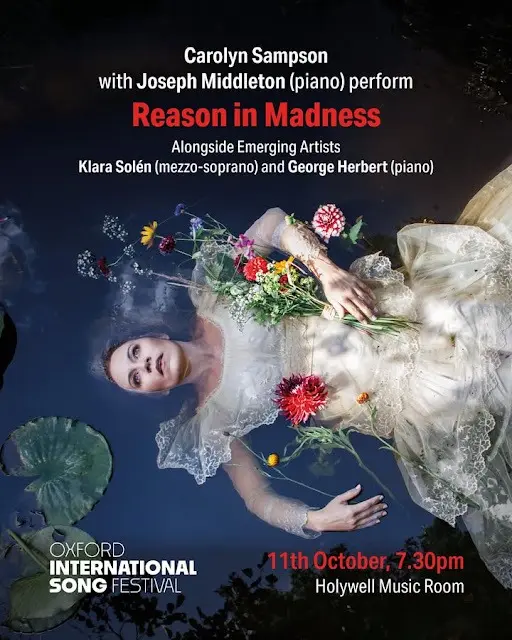
The Oxford International Song Festival recently offered a masterclass in the psychological boundaries of classical vocal art. During a single, meticulously curated Sunday lineup on October 11, 2026, the festival tackled three distinct historical and thematic threads. While the morning and afternoon slots illuminated Mozart’s lasting influence and Benjamin Britten’s complex emotional landscape, it was the evening gala at the historic Holywell Music Room—titled Reason in Madness—that truly captured the audience’s imagination.
Conceived as an intense exploration of obsession, fixation, and the fragile boundary between sanity and psychological collapse, the evening program brought together renowned soprano Carolyn Sampson and pianist Joseph Middleton. The duo navigated a vast, cross-cultural repertoire of 19th- and 20th-century art songs.
Before the headlining performance, festival emerging artists mezzo-soprano Klara Solén and pianist George Herbert set a high bar with Scandinavian and late-romantic works. From there, Sampson and Middleton mapped out a gallery of literary and operatic archetypes—including Gretchen, Ophelia, Mignon, and Bilitis. Through virtuosic phrasing, nuanced dynamic control, and fearless emotional delivery, the artists transformed the intimate Holywell Music Room into a theater of the human psyche. The evening brilliantly demonstrated how composers across generations have translated mental unraveling into timeless musical architecture.
Detailed Chronology of the Performance
The Overture: Emerging Voices Set the Tone
The evening commenced with an introductory showcase featuring the festival’s brightest emerging talents: mezzo-soprano Klara Solén and pianist George Herbert. Their short program immediately established a moody, atmospheric baseline for the night’s broader explorations of isolation and romantic yearning.
Solén and Herbert opened with Gösta Nystroem’s 1948 song cycle, På reveln (At the Reef), which sets evocative texts by three Swedish poets.
- In the title track, Herbert’s evocative, shimmering piano writing supported Solén’s direct, unadorned vocal line, immediately establishing a coastal, windswept atmosphere.
- This transitioned into Otrolig dag (Special Day), which utilized a deceptive simplicity—delicate, crystalline piano textures paired with lyrically engaging vocal phrases.
- The mini-set concluded with Havet sjunger (Singing of the Sea), a piece that shifted fluidly from a cold, melancholy stillness into rich, late-romantic drama.
Solén and Herbert wrapped up their opening slot with Alma Schindler-Mahler’s Erntelied (Harvest Song). Beginning with a deceptively conventional, flowing piano melody, the song gradually darkened. The harmonic language grew increasingly complex, amplifying the dramatic tension until it achieved a deeply saturated, high-romantic intensity that resonated powerfully within the hall.
German Romanticism and the Descent into Obsession
As soprano Carolyn Sampson and pianist Joseph Middleton took the stage, the focus shifted sharply to the core theme of obsession. They began with Franz Schubert’s iconic Gretchen am Spinnrade. Initially interior and strictly controlled, Sampson’s delivery portrayed a woman whose mind was palpably elsewhere. Following the explosive emotional climax on the word "sein Kuss" (his kiss), Gretchen’s anxiety spiraled, leaving a lasting sense of psychological disturbance.

This exploration of the spinning motif expanded through settings of Emanuel Geibel’s poetry by both Brahms and Schumann:
- Brahms’s Mädchen emerged as a deceptively charming, folk-like song underpinned by a sophisticated, shadowed piano part.
- Schumann’s Die Spinnerin mirrored this rustic charm while introducing fascinating, mechanical piano evocations of the spinning wheel.
The program then turned to Shakespeare’s tragic figures. Schumann’s Herzelied (Heartache) introduced the haunted figure of Ophelia through drooping, overlapping piano phrases. This served as a bridge to Johannes Brahms’s Ophelia-Lieder, composed originally for theatrical performance. Sampson and Middleton performed all five brief songs with stark directness, avoiding over-embellishment and letting the folk-like simplicity underscore Ophelia’s tragic state.
Richard Strauss’s Drei Lieder der Ophelia offered a striking contrast. Setting Karl Joseph Simrock’s German translations of Shakespeare, Strauss crafted complex, demanding miniatures:
- Wie erkenn’ ich mein Treulieb featured a dazzling, restless piano accompaniment that juxtaposed an expressionist vocal line with moments of startling naivety.
- Guten Morgen, ‘s ist Sankt Valentinstag moved at a vivid, unsettling speed.
- Sie trugen ihn auf der Bahre bloss combined Middleton’s eerie, creeping piano textures with Sampson’s bleached, ghostly vocal tone, perfectly capturing Ophelia’s sudden, erratic shifts in mental state.
The Enigma of Mignon
The first half of the concert culminated in Hugo Wolf’s settings of the Mignon Lieder from Goethe’s seminal romantic novel Wilhelm Meister. Mignon—a figure born of complex trauma and incestuous tragedy—demanded the utmost psychological depth from the performers.
- In Mignon I – Heiße mich nicht reden, Sampson delivered a bleak, moving interpretation over uncompromising piano framing.
- Mignon II – Nur wer die Sehnsucht kennt highlighted Middleton’s ability to drive urgent, anxious momentum from the keyboard.
- Mignon III – So last mich scheinen offered an unearthly, haunting purity.
- The sequence concluded with Kennst du das Land, where Sampson’s vocal intensity was mirrored by a turbulent piano accompaniment that suggested Mignon was entirely trapped within her own fractured reality.
The French Reimagining: Symbolism, Myth, and Decay
The second half of the evening transported the audience to France, beginning with Henri Duparc’s orchestral-hued French setting of Mignon’s journey, Romance de Mignon. Duparc utilized harmonic instability and a throbbing, pulse-like piano accompaniment to create a deeply unsettling atmosphere, building to lush, romantic climaxes followed by a lingering postlude.
The program then ventured into the hazy, mythological world of Pierre-Félix Louïs’s Les Chansons de Bilitis (1894). The performers alternated settings by Claude Debussy and Charles Koechlin:
- The set opened with Koechlin’s Hymne à Astarté, an imposing invocation driven by a massive piano score and dramatic, unbridled vocal lines.
- Carolyn Sampson then inhabited three of Debussy’s Chansons de Bilitis, bringing a quiet, supple inwardness reminiscent of her acclaimed portrayal of Mélisande. Middleton’s classical restraint in La Flûte de Pan contrasted with the subtle, pulsing passion of La Chevelure and the effortlessly fluid, deceptive climax of Le Tombeau des naïades.
- The Bilitis sequence closed with Koechlin’s formal, neo-classical Épitaphe de Bilitis.
The Shakespearean thread returned briefly through French lenses: Camille Saint-Saëns’s La mort d’Ophélie utilized a motoric, spinning piano line that suddenly blossomed into lyrical warmth, while Ernest Chausson’s Chanson d’Ophelia offered a sparse, dark-hued dialogue. A brief detour through Duparc’s masterpiece Au pays où se fait la guerre showcased Sampson’s ability to seamlessly scale from discreet narrative to soaring dramatic heights.

The official program concluded with Francis Poulenc’s gripping dramatic monologue, La Dame de Monte-Carlo, set to a text by Jean Cocteau. Originally written for soprano Denise Duval, the piece paints a portrait of an aging, bitter woman haunting the gaming tables and pawnshops of the Riviera. Sampson embraced the theatricality of the text, snarling and spitting out words with sharp irony, bringing the evening’s exploration of obsession to a brilliant, biting climax.
To break the tension, the duo offered a warm, reflective encore: Schubert’s profound melodrama, Abschied der Erde.
Supporting Context & Metrics
- Event Context: Part of the premier Oxford International Song Festival, held annually to celebrate the breadth of art song repertoire from classical masterworks to contemporary creations.
- Venue: Holywell Music Room, Oxford—widely recognized as Europe’s oldest purpose-built music room, celebrated for its pristine acoustics and intimate chamber atmosphere.
- Featured Composers (13 Total): Gösta Nystroem, Alma Schindler-Mahler, Franz Schubert, Johannes Brahms, Robert Schumann, Richard Strauss, Hugo Wolf, Henri Duparc, Charles Koechlin, Claude Debussy, Camille Saint-Saëns, Ernest Chausson, and Francis Poulenc.
- Key Literary Figures Explored: Gretchen (Faust), Ophelia (Hamlet), Mignon (Wilhelm Meister), Bilitis (Les Chansons de Bilitis), and Jean Cocteau’s unnamed aging gambler (La Dame de Monte-Carlo).
- Date of Review: October 11, 2026.
Official Statements and Artistic Vision
While formal press releases from the festival organizers focused broadly on the weekend’s ambitious triad of thematic blocks (Immortal Mozart, Britten in Love, and Reason in Madness), the artistic synergy between Carolyn Sampson and Joseph Middleton underscored a unified curatorial philosophy.
Speaking on the challenges of programming such psychologically dense material, performance notes highlighted the intention to dismantle traditional tropes of female madness in 19th-century literature. Rather than portraying characters like Ophelia and Mignon as passive victims of circumstance, Sampson and Middleton’s interpretation foregrounded agency, hyper-awareness, and the psychological weight of intense romantic fixation.
The inclusion of the festival’s Emerging Artists—Klara Solén and George Herbert—was also hailed by organizers as a vital bridge, ensuring that the legacy of interpreting complex art song repertoire is successfully handed down to a new generation of musicians who possess the requisite emotional maturity and technical polish.
Future Outlook
The success of Reason in Madness at the Holywell Music Room cements the Oxford International Song Festival’s reputation as a daring laboratory for thematic programming. By refusing to shy away from dark, psychologically demanding repertoires, the festival continues to push the boundaries of traditional song recitals.
Looking ahead, the critical acclaim garnered by Carolyn Sampson and Joseph Middleton—alongside the impressive showing of emerging talents like Solén and Herbert—signals a robust, forward-looking trajectory for the genre. As audiences increasingly demand immersive, narrative-driven concert experiences, programs that weave literature, history, and vocal virtuosity into a cohesive whole will undoubtedly serve as the gold standard for future international music festivals. Audiences and critics alike will eagerly anticipate how the festival builds upon this thematic ambition in its subsequent editions.