Executive Overview
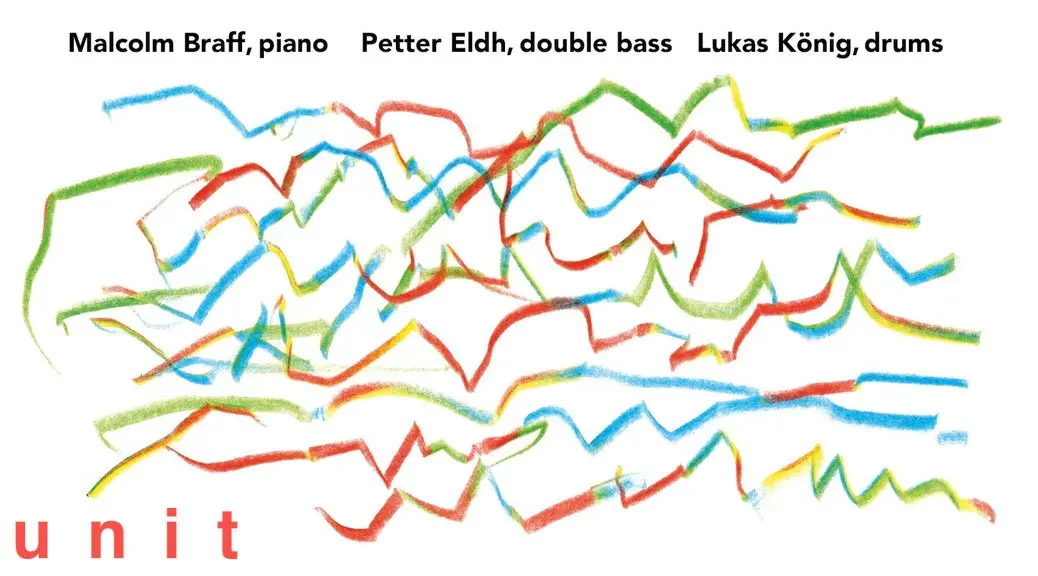
In the contemporary landscape of improvised music, few artists approach the piano with the philosophical detachment and physical immediacy of Malcolm Braff. For Braff, the instrument is not an altar of self-expression, but a conduit for shared energy—a medium through which he can step aside and observe the ripples his actions send through an ensemble. His latest release, the concise yet deeply immersive record Outside, stands as a masterclass in this philosophy. Recorded alongside two of Europe’s most formidable creative forces—Swedish bassist Petter Eldh and Austrian drummer Lukas König—the album challenges conventional perceptions of rhythm, meter, and musical form.
At once experimental and profoundly listenable, Outside is more than a collection of songs; it is the practical application of more than two decades of academic and artistic research. Braff has spent the better part of twenty years dissecting what he calls the "mechanics of swing," an inquiry that has culminated in his ambitious "Generalized Theory of Swing" at Jazzcampus Basel. This record captures that theory in motion, warping temporal expectations and offering listeners a disorienting yet exhilarating auditory journey. This article examines the philosophical roots of Braff’s artistry, the cross-continental chemistry of his current trio, the academic frameworks that govern his work, and the lasting impact of Outside on the modern jazz ecosystem.
Detailed Chronology and Artistic Evolution
Formative Years: A Borderless Upbringing
Malcolm Braff’s unique worldview is inextricably linked to a nomadic upbringing that defied cultural boundaries. Born in Rio de Janeiro, Brazil, to a missionary father, Braff spent his formative years moving across continents, absorbing the vibrant polyrhythms of Cape Verde and Senegal before ultimately settling in Switzerland. This borderless existence instilled in him an expansive perspective on musical traditions, preventing him from viewing jazz or any other genre as a static museum piece.
Instead, Braff’s musical identity was forged through deep, formative collaborations with artists from outside the traditional Western canon. Most notable among these was his decade-long partnership with percussionist Yaya Ouattara from Burkina Faso. Ouattara, whom Braff regards "more than a brother," brought the djembe into the heart of Braff’s piano trio—a radical departure from the drum kit that culminated in the critically acclaimed 2006 live album Yele, released on Unit Records. This foundational experience taught Braff to view rhythm not as a rigid grid measured by metronomes, but as a breathing, organic force shaped by human interaction and physical movement.
The Philosophy of the Instrument
Braff’s approach to the piano is remarkably unpretentious. Rather than obsessing over the creation of a distinct "personal voice," he views the act of playing as sufficient in itself. When sitting at the piano, Braff does not listen to his own playing in real-time; instead, he listens to the impact his choices exert upon his fellow musicians, constantly posing the internal question: "What power am I having on the music?"
He rejects the grandiose identity of the tortured artist or the virtuosic soloist, famously noting that being a pianist "is not what I am, just something I enjoy doing." By treating a familiar instrument as a familiar tool, Braff is able to get "out of the way," silencing his ego to focus purely on the physical action of sound creation. Furthermore, he conceptualizes the trio not as three distinct soloists vying for dominance, but as a singular, multifaceted instrument operating with one collective mind.
The Genesis of Outside
The release of Outside marks a pivotal chapter in Braff’s discography. Though technically closer in duration to an extended play (EP) than a full-length long-player (LP), the album operates outside traditional constraints of time—fittingly, given that the record’s core thematic exploration is time itself. Braff approaches time not as a linear, marching progression of seconds and bars, but as fluid waves that can be bent, compressed, and expanded at will.
The album opens with the arrestingly titled "Viennese Gröt à la Berlinaise," a track that immediately upends listener expectations. Lukas König’s hyper-percussive styling cuts through the mix like a gunshot, stirring into the warm, viscous gloopiness of Petter Eldh’s thrumming bass tones. Meanwhile, Braff’s irrepressible bounce acts as the adhesive holding these disparate elements together.
On the subsequent track, "3TOES," Braff takes the traditional concept of swing and thoroughly dismantles it, turning it inside out. The track showcases the democratic balance of the trio: König’s frenetic rim clicks and Eldh’s vibrating string passages are granted ample breathing room by the strategic intervals in Braff’s exuberant harmonic framework. The result is a recording that demands active listening while offering immediate emotional gratification.
Supporting Context & Metrics
To fully appreciate the architectural brilliance of Outside, one must examine the academic and logistical infrastructure supporting the trio. Braff’s tenure at Jazzcampus Basel has provided him with a laboratory to formalize decades of intuitive performance experience into rigorous pedagogical frameworks.
The "Generalized Theory of Swing"
For over twenty years, Braff has researched the micro-timing phenomena that make jazz feel alive. While traditional music theory often treats swing as a static mathematical ratio (such as dotted-eighth and sixteenth-note subdivisions), Braff’s research demonstrates that swing is, in fact, a complex psychological and physical illusion. His "Generalized Theory of Swing" investigates the "distortion of time as perceived by the listener."
Key metrics and concepts within Braff’s research include:

- Micro-timing Deviations: Analyzing the millisecond-level shifts that occur when master musicians intentionally pull ahead of or lag behind a strict tempo.
- Psychological Anticipation: How a listener’s brain predicts rhythmic arrival points, and how manipulating these expectations generates emotional tension and release.
- Intervallic Space: The deliberate creation of silence and negative space within a rhythmic cell to allow secondary percussion elements (such as König’s rim clicks) to carry the momentum of the piece.
Ensemble Dynamics and Instrumentation
The synergy on Outside relies heavily on the specific pairing of Braff with Petter Eldh and Lukas König.
| Musician | Role | Primary Contribution to Outside |
|---|---|---|
| Malcolm Braff | Piano / Bandleader | Conceptual framework, harmonic elasticity, temporal wave manipulation. |
| Petter Eldh | Double Bass | Relentless curiosity, rich vibrational low-end, harmonic grounding and counterpoint. |
| Lukas König | Drums / Percussion | Whiplash-inducing styling, sharp percussive accents, dynamic textural contrast. |
Eldh, known for his work across the European jazz underground, brings an insatiable drive and melodic ingenuity to the lower registers. König complements this with a volatile, highly kinetic approach to the drum kit, avoiding predictable comping in favor of spontaneous, textural explosions. Together with Braff, they form an interdependent ecosystem where no single voice outweighs the others.
Official Statements and Critical Perspectives
The critical reception of Outside underscores its status as a landmark release in contemporary European jazz. Industry analysts and reviewers have praised the album’s ability to balance cerebral complexity with visceral accessibility.
In his review for UK Vibe, critic James Read notes the disorienting yet rewarding nature of the project:
"Braff has spent more than twenty years researching the ‘mechanics of swing’… The result is a witty but ambitious ‘Generalized Theory of Swing’, which investigates the ‘distortion of time as perceived by the listener.’ That at least begins to explain what’s going on as I listen to Outside and why this disorientating, expectation-defying record is such an enjoyable ride."
Read further elaborates on the tactile nature of the trio’s interplay, describing the opening track’s sonic architecture:
"König’s percussiveness is like a gunshot stirred into the warm gloopiness of Eldh’s tone, while Braff’s bounce is the viscous glue holding it together. It’s a remarkable record, both thought-provoking and enjoyable in equal measure."
Braff himself has frequently emphasized that his music is designed to bypass intellectual gatekeeping, connecting with the listener’s nervous system before the conscious mind has time to categorize it. In academic lectures at Jazzcampus Basel, he has articulated his desire to strip away the performance anxiety that plagues modern instrumentalists:
"When you know your instrument deeply enough, you stop worrying about who you are supposed to be. The music becomes an action of the body, a physical reflex shared between human beings in a room."
Future Outlook
As Outside circulates through the global jazz community, its implications for the future of improvised music are significant. By bridging the gap between rigorous academic inquiry—exemplified by Braff’s "Generalized Theory of Swing"—and uninhibited, visceral performance, the trio has established a new benchmark for how rhythm sections can operate in the 21st century.
Emerging Trends in Temporal Experimentation
The success of Braff, Eldh, and König points toward several broader developments in contemporary creative music:
- Deconstruction of Meter: Moving away from standard time signatures (4/4, 3/4) toward fluid, wave-based temporal structures where tempo is treated as elastic rather than absolute.
- Democratic Ensemble Roles: Eradicating the traditional hierarchy of soloist and accompanist, favoring instead a web of continuous, non-linear dialogue.
- Pedagogical Integration: The translation of high-level improvisational techniques into formal conservatory curricula, ensuring that the next generation of jazz musicians approaches rhythm not just by feel, but through deep analytical awareness.
What Lies Ahead for the Trio
While Outside is brief in duration, its impact is expected to resonate across upcoming international tours and festival appearances. Braff’s ongoing research at Jazzcampus Basel continues to evolve, with future projects aimed at further exploring the psychological dimensions of auditory time-distortion. Whether the trio returns to the studio for an expanded full-length release or continues to push the boundaries of concise, high-intensity EP recordings, one thing remains certain: Malcolm Braff, Petter Eldh, and Lukas König will continue to operate far outside the conventional lines of jazz, inviting audiences to experience time anew with every note they play.