Executive Overview
For the better part of the past fifteen years, Manchester-born, London-based pianist and composer Jamie Safir has operated as one of the British music scene’s best-kept secrets. While his name may not have dominated marquee headliners for most of that tenure, his artistry has consistently elevated the work of some of the most prominent names in modern popular and jazz music. From sharing stages with pop royalty like Kylie Minogue, Will Young, Jessie Ware, and Annie Lennox to collaborating with contemporary jazz luminaries such as Laufey, Veronica Swift, and Ian Shaw, Safir has built a reputation as a consummate accompanist, musical director, and collaborator. A familiar fixture at iconic London venues like Ronnie Scott’s, his technical mastery, harmonic sophistication, and intuitive ear have made him an invaluable asset to countless bandleaders and vocalists.
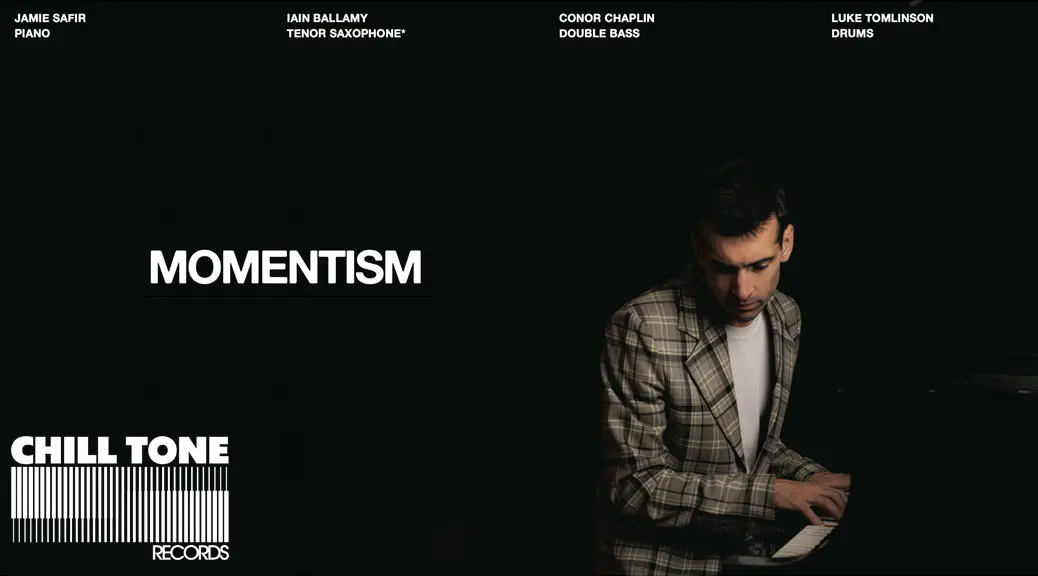
Yet, working in the shadows of others can often delay a musician’s artistic reckoning. That era of quiet cultivation has officially drawn to a close with the release of his debut album as a leader and primary composer, Momentism. Comprising nine meticulously crafted original compositions, the album represents far more than a routine milestone; it is the culmination of a decade and a half of stylistic osmosis, backstage education, and internal artistic evolution.
Momentism bridges the often-fractured worlds of jazz sophistication and singer-songwriter melodic accessibility. Drawing from an eclectic pool of influences—ranging from classic pop-folk icons like James Taylor, Joni Mitchell, Rufus Wainwright, and Burt Bacharach to jazz titans Chick Corea, Herbie Hancock, and Steely Dan—Safir has forged a distinct musical identity. Anchored by a dynamic rhythm section featuring bassist Conor Chaplin and drummer Luke Tomlinson, and elevated by the seasoned, searching saxophone of veteran player Iain Ballamy on more than half the tracks, the album showcases a pianist who refuses to choose between cerebral harmonic depth and emotional resonance.
This deep-dive profile explores the trajectory of Jamie Safir’s career, the creation and critical reception of Momentism, the broader socio-musical context of contemporary British jazz, and what this confident debut portends for a musician finally stepping directly into the spotlight.
Detailed Chronology: From Northern Roots to London’s Jazz Epicenter
To understand the stylistic breadth and meticulous craftsmanship of Momentism, one must trace the circuitous path that brought Jamie Safir from his formative years in Manchester to the beating heart of London’s vibrant jazz circuit.
The Formative Years and the Manchester Foundation
Born in Manchester, a city with a rich industrial history and an equally proud musical lineage, Safir was exposed early on to a diverse sonic landscape. While classical piano training provided the technical scaffolding necessary for his future endeavors, it was his early fascination with popular songcraft, jazz harmony, and the fluid boundaries of improvised music that truly shaped his musical sensibilities.
Unlike many jazz pianists who narrow their focus exclusively to the American Songbook during their formative years, Safir possessed a voracious appetite for singer-songwriters and pop architects. The lyrical economy of James Taylor, the harmonic idiosyncrasies of Joni Mitchell, the theatrical flair of Rufus Wainwright, and the peerless melodic construction of Burt Bacharach all left indelible marks on his developing compositional style. These influences instilled in him a belief that complex harmonic structures and deeply hummable, emotionally resonant melodies do not need to be mutually exclusive.
Relocation to London and the Apprenticeship of the Sideman
Upon relocating to London—a global nexus for creative improvisation—Safir immersed himself in the city’s unforgiving yet deeply rewarding music scene. In the ecosystem of modern London jazz and pop, longevity is rarely granted overnight; it is earned through versatility, reliability, and an uncanny ability to adapt to diverse musical environments.
Safir’s CV over the subsequent decade and a half reads like a masterclass in musical ubiquity. In the pop and contemporary spheres, he became a trusted collaborator for high-profile artists, including pop icons Kylie Minogue, Annie Lennox, Will Young, and Jessie Ware. Operating within these high-pressure, stadium-scale environments demands a level of precision and professional polish that few classical or jazz conservatories can formally teach.
Simultaneously, Safir forged deep roots within the British jazz community. His dexterity and sensitive touch made him an in-demand accompanist for vocalists, most notably through his close creative partnership with acclaimed singer Ian Shaw. Their collaborative work, including the celebrated project What’s New, highlighted Safir’s rare gift for listening—knowing precisely when to propel a vocalist forward and when to lay back to create emotional space. Through these myriad sideman roles, Safir performed countless nights at Ronnie Scott’s, absorbing the room’s history, studying the phrasing of visiting international headleaders, and quietly refining his own compositional voice away from the critical gaze.
Supporting Context & Metrics: The Anatomy of Momentism
When an artist spends fifteen years supporting others before releasing a debut record, the resulting project is rarely a tentative experiment. Instead, Momentism arrives as a fully realized statement of purpose.

The Lineup and Collaborative Chemistry
At the core of Momentism is a tightly knit piano trio, featuring Safir alongside bassist Conor Chaplin and drummer Luke Tomlinson. The rhythm section provides a resilient yet flexible foundation, navigating complex time signatures and shifting tonal centers with deceptive ease. Chaplin’s bass lines offer a warm, anchoring counterpoint to Safir’s piano, while Tomlinson’s drumming balances rhythmic propulsion with textural nuance, avoiding the heavy-handedness that sometimes plagues modern jazz percussion.
However, the secret weapon of the recording sessions is the inclusion of veteran saxophonist Iain Ballamy, who contributes his distinctive voice to more than half of the album’s tracks. Ballamy’s presence injects a vital dose of unpredictability into the proceedings. Known for a career that has defied categorization—spanning collaborations with everyone from Bill Bruford to Kenny Wheeler—Ballamy brings a fluid, searching tenor approach that constantly challenges Safir’s composed parameters. The tension between Safir’s structural restraint and Ballamy’s exploratory, instinctive phrasing constitutes one of the recording’s defining triumphs.
Deconstructing the Tracklist
The nine compositions comprising Momentism map out Safir’s stylistic geography with precision:
- "Boulevardier", "Zacharius", and "Amethyst": These tracks immediately establish Safir’s gift for melodic retention. Rather than treating melody as a mere vehicle for subsequent soloing, Safir crafts themes that linger in the listener’s consciousness long after the track has faded. There is a cinematic quality to these pieces, echoing the sophistication of classic jazz writing while retaining a contemporary rhythmic vitality.
- "Black Star Sapphire (For Strayhorn)": On this composition, Safir makes his reverence for the jazz tradition explicit. Dedicated to the legendary Billy Strayhorn—the mastermind behind many of Duke Ellington’s most exquisite arrangements—the track embraces lush, sprawling harmonies and sophisticated structural shifts. Yet, true to Safir’s sensibility, it avoids pastiche or empty imitation, functioning instead as a modern dialogue with jazz royalty.
- "Momentism" (Title Track): The album’s title track serves as its philosophical anchor. The concept of "momentism"—the radical act of being fully present in the present moment—is framed not only as a spiritual or psychological ideal, but as the foundational prerequisite for both improvised music and human existence. In a live setting, this philosophy translates into deep listening and spontaneous creation, principles that pulse through every bar of the recording.
Official Statements and Critical Reception
The transition from sideman to leader has not gone unnoticed by critics and peers alike. Early critical appraisals of Momentism have highlighted the rare maturity of the release. Jazz journalism veteran Mike Gates, writing for UK Vibe, noted the album’s striking balance of accessibility and intellectual depth, observing that Safir’s music is "accessible without being simplistic, harmonically thoughtful without becoming needlessly cerebral."
At the same time, critical discourse surrounding the album has engaged in a healthy debate regarding the tension between composition and improvisation. While Safir’s meticulous craftsmanship is universally praised, some reviewers have pondered whether the pianist’s acute self-control occasionally reigns in the music’s wilder impulses. As critics have noted, moments where the ensemble takes greater structural risks—often catalyzed by Iain Ballamy’s unrestrained saxophone excursions—hint at an even deeper, more volatile power waiting to be fully unleashed.
Safir himself has remained pragmatic and reflective about the journey to releasing Momentism. In various interviews surrounding the album’s rollout, he has emphasized that the lengthy gestation period was not a delay, but a necessity. Absorbing the diverse musical vocabularies of pop vocalists, jazz masters, and singer-songwriters required time. "You cannot rush a voice," Safir noted in pre-release discussions. "It has to find you through the people you play with and the rooms you inhabit."
Future Outlook: Stepping into the Light
The release of Momentism marks a definitive pivot point in Jamie Safir’s career. No longer content to merely decorate the backgrounds of other artists’ projects, he has established himself as a compelling compositional voice with a distinct perspective on where modern jazz intersects with classic songcraft.
The momentum generated by the album’s release culminates in a high-profile live showcase: the official Momentism Album Launch featuring special guest Graeme Blevins, scheduled for Monday, 14th September at Ronnie Scott’s in London. Taking over the stage of the world-famous Soho institution—a venue where Safir has spent countless nights supporting others—as a leader marks the symbolic closing of one chapter and the exhilarating opening of another.
What Lies Ahead
As the UK and international jazz scenes continue to evolve, blending genre-fluid experimentation with a renewed appreciation for melody and craft, Safir is uniquely positioned to capture a wide audience. His ability to move fluidly between pop sophistication and jazz improvisation makes him an ambassador for a generation of musicians who refuse to be boxed in by rigid genre boundaries.
Looking forward, the artistic challenge for Safir will be to lean further into the improvisational risk that critics have identified as the final frontier of his development. If Momentism represents the careful, beautiful construction of a musical home, his subsequent projects promise to throw open the doors and invite the unpredictable elements of live performance to reshape the architecture.
For listeners who have spent years quietly admiring his work from the wings, the message is clear: Jamie Safir’s time just outside the spotlight has officially ended. The spotlight is now his, and Momentism suggests he is more than ready to inhabit it.